
Short Answer
Definition of Atomic Theory
Atomic theory is the scientific framework that explains the nature and behavior of matter by proposing that all substances are composed of fundamental units called atoms. These atoms are the smallest indivisible particles that retain the properties of an element. The theory has evolved over centuries, integrating philosophical ideas and empirical evidence to form the foundation of modern chemistry and physics.
Origins and Early Philosophical Concepts
The concept of atoms dates back to ancient Greece, where philosophers like Democritus, around the 5th century BCE, introduced the idea that matter consists of tiny, indivisible particles called “atomos,” meaning uncuttable in Greek. This early hypothesis provided a simple yet profound explanation for the diversity of matter, suggesting that everything is made up of these fundamental building blocks. Despite the absence of experimental tools, this philosophical insight laid the groundwork for future scientific inquiry.
Transition to Empirical Science During the Scientific Revolution
The 16th and 17th centuries marked a pivotal shift from speculative philosophy to experimental science. Figures such as Robert Boyle championed the scientific method, emphasizing observation and experimentation over abstract reasoning. Boyle’s law, which describes the inverse relationship between the pressure and volume of gases, contributed to the atomic theory by implying that matter could be quantitatively analyzed and broken down into smaller components. This era demonstrated how simplicity in theory could coexist with rigorous empirical validation.
Dalton’s Atomic Model and Its Significance
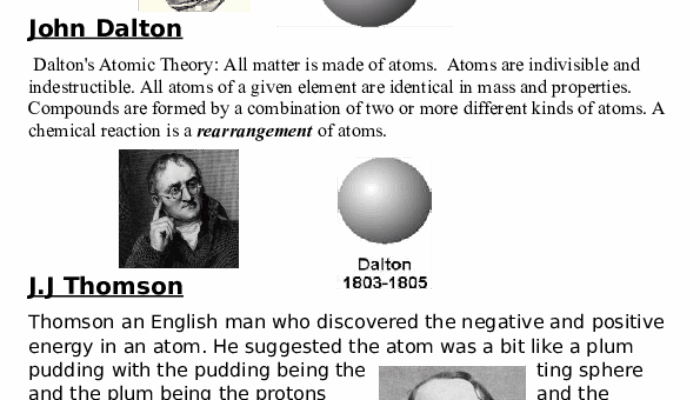
In the 19th century, John Dalton formalized atomic theory by proposing that atoms are indivisible particles with unique masses that combine in fixed ratios to form compounds. His postulates clarified the nature of chemical reactions and provided a straightforward framework for understanding matter’s composition. Dalton’s model was instrumental in transforming atomic theory from a philosophical idea into a practical scientific tool, facilitating clearer communication and further research.
Advancements in Atomic Structure: Electrons and Beyond
The discovery of the electron by J.J. Thomson in 1897 revolutionized atomic theory by revealing that atoms are divisible and contain smaller charged particles. Thomson’s “plum pudding model” depicted the atom as a positively charged sphere with embedded electrons, offering a simple visualization of atomic structure. Subsequent models, including Rutherford’s nuclear model and Bohr’s quantized orbits, refined this understanding by introducing the nucleus and discrete electron energy levels, respectively, enhancing the conceptual clarity of atomic behavior.
Quantum Mechanics and Modern Atomic Understanding
The early 20th century brought the development of quantum mechanics, which, despite its complexity, introduced new ways to comprehend atomic phenomena. Concepts such as wave-particle duality and the uncertainty principle challenged classical views but also provided clearer explanations for atomic interactions, including how electrons absorb and emit energy in quantized packets called photons. This duality of complexity and clarity invites a deeper appreciation of the fundamental principles governing matter.
Collaborative Progress in Atomic Theory
The evolution of atomic theory exemplifies the cumulative nature of scientific advancement. Contributions from ancient philosophers, Renaissance scientists, and modern physicists collectively shaped our current understanding. This collaborative journey highlights how diverse perspectives and discoveries build upon one another, making the complex history of atomic theory more accessible and coherent.
Why Understanding Atomic Theory Is Important
Atomic theory is crucial for comprehending the material world, underpinning fields such as chemistry, physics, and materials science. It explains the behavior of matter at the most fundamental level, enabling technological innovations, medical advancements, and a deeper understanding of natural phenomena. The theory’s development also illustrates the power of human curiosity and the scientific method in unraveling the mysteries of the universe.
Common Misconceptions About Atomic Theory
Atoms are indivisible and cannot be broken down.
Atoms consist of smaller subatomic particles such as electrons, protons, and neutrons, and can be split in nuclear reactions.
Atomic models have remained unchanged since their inception.
Atomic models have evolved significantly, from Democritus’s indivisible particles to quantum mechanical models describing complex electron behavior.
Real-World Applications of Atomic Theory
Atomic theory informs numerous practical applications, including the development of pharmaceuticals, nuclear energy, and materials engineering. For example, understanding atomic interactions allows chemists to design drugs that target specific molecules, while physicists harness nuclear reactions for energy production. Additionally, the theory aids in the creation of new materials with tailored properties for electronics and manufacturing.
FAQ
What is atomic theory?
Atomic theory is the scientific framework that explains matter is composed of atoms, the smallest units retaining element properties.
Who first proposed the idea of atoms?
The ancient Greek philosopher Democritus first proposed the concept of atoms as indivisible particles.
What was John Dalton's contribution to atomic theory?
Dalton formalized atomic theory by proposing atoms as indivisible particles with unique masses combining in fixed ratios.
How did quantum mechanics change atomic theory?
Quantum mechanics introduced concepts like wave-particle duality and uncertainty, refining the understanding of atomic behavior.
Can atoms be divided into smaller parts?
Yes, atoms consist of subatomic particles such as electrons, protons, and neutrons and can be split in nuclear reactions.






Leave a Reply