

Short Answer
Definition of Dark Matter and Dark Energy
In astrophysics, dark matter and dark energy represent two of the most intriguing and elusive components of the universe. While luminous objects such as stars and galaxies are visible through electromagnetic radiation, these dark constituents remain undetectable by conventional means, yet they dominate the universe’s mass-energy budget.
- Dark Matter:
Constituting about 27% of the universe’s total mass-energy, dark matter does not interact with light, making it invisible. Its presence is inferred primarily through gravitational effects on visible matter, radiation, and the large-scale structure of the cosmos. - Dark Energy:
Accounting for roughly 68% of the universe’s composition, dark energy is a mysterious force driving the accelerated expansion of the universe, acting as a repulsive influence on cosmic scales.
Historical Background and Discovery
The concept of dark matter originated in the early 20th century when astronomers like Fritz Zwicky studied galaxy clusters such as the Coma Cluster. Zwicky noticed that the visible mass of galaxies was insufficient to explain the gravitational forces holding the cluster together, leading him to propose the existence of unseen mass. Decades later, the discovery of the universe’s accelerating expansion in the late 1990s, through observations of distant supernovae, introduced the concept of dark energy, challenging previous assumptions of a decelerating cosmos.
Composition and Theoretical Candidates
Dark matter is hypothesized to consist of particles that interact weakly with ordinary matter and electromagnetic radiation. Leading candidates include Weakly Interacting Massive Particles (WIMPs) and axions, both of which are subjects of ongoing experimental searches, such as those conducted at the Large Hadron Collider (LHC).
Dark energy, on the other hand, is often associated with the cosmological constant, a concept introduced by Albert Einstein to maintain a static universe. Although initially discarded, this constant has been revived to explain the observed acceleration of cosmic expansion. Alternative theories suggest dark energy may arise from vacuum energy fluctuations predicted by quantum field theory or from dynamic fields that evolve over time.
Mechanisms and Cosmic Roles
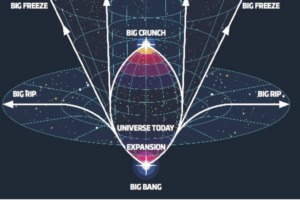
Dark matter functions as the gravitational framework upon which galaxies and larger cosmic structures form and evolve. Its gravitational pull influences the motion of stars and galaxies, shaping the universe’s architecture. Conversely, dark energy exerts a repulsive effect on the fabric of space-time, counterbalancing gravity and causing the universe to expand at an accelerating rate.
Origins and Formation Theories
The genesis of dark matter is closely linked to the conditions of the early universe, particularly the Big Bang approximately 13.8 billion years ago. As the universe expanded and cooled, both visible and invisible matter emerged from primordial interactions, with dark matter playing a crucial role in the formation of cosmic structures.
In contrast, the origin of dark energy remains less certain. It may be a manifestation of vacuum energy inherent in empty space or a dynamic field with properties that change over cosmic time, diverging from the static cosmological constant model.
Scientific Investigations and Observational Efforts
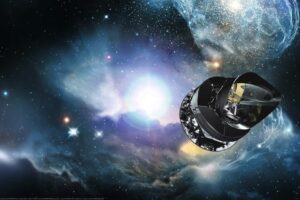
Modern astrophysics employs a variety of methods to probe dark matter and dark energy. Missions like the European Space Agency’s Euclid spacecraft and NASA’s Wide Field Infrared Survey Telescope (WFIRST) are designed to gather extensive data on cosmic structures and expansion. Techniques such as gravitational lensing, where light bends around massive objects, help map dark matter distribution, while supernova observations provide insights into the nature of dark energy.
Mathematical Framework and Cosmological Models
The standard cosmological model, known as ΛCDM (Lambda Cold Dark Matter), incorporates dark energy as the cosmological constant (Λ) and dark matter as cold, non-relativistic particles. The Friedmann equations describe the expansion of the universe, incorporating these components:
H² = (8πG/3)ρ – (kc²/a²) + (Λc²/3)
- H: Hubble parameter (expansion rate)
- G: Gravitational constant
- ρ: Total energy density (including matter and radiation)
- k: Curvature parameter
- a: Scale factor of the universe
- Λ: Cosmological constant representing dark energy
Common Misunderstandings
- Misconception: Dark matter is made of ordinary matter like planets or black holes.
Correction: Dark matter is non-baryonic and does not consist of ordinary matter; it interacts weakly with electromagnetic forces. - Misconception: Dark energy is simply empty space.
Correction: While related to vacuum energy, dark energy is a dynamic and poorly understood force driving cosmic acceleration, not just empty space.
Significance in Cosmology and Beyond
Understanding dark matter and dark energy is pivotal for comprehending the universe’s structure, evolution, and ultimate fate. These components influence galaxy formation, cosmic expansion, and the large-scale geometry of space-time. Their study challenges and extends fundamental physics, potentially leading to new paradigms in particle physics, quantum mechanics, and cosmology.
Practical Examples and Observational Evidence
Gravitational lensing provides tangible evidence of dark matter by revealing mass distributions that cannot be accounted for by visible matter alone. Observations of the cosmic microwave background radiation also support the presence of dark matter and dark energy, aligning with predictions from the ΛCDM model. The accelerated recession of distant supernovae exemplifies dark energy’s influence on cosmic expansion.
Conclusion
Dark matter and dark energy remain central mysteries in contemporary astrophysics, representing the unseen majority of the universe’s content. Ongoing research continues to deepen our understanding, promising to unlock further secrets about the cosmos and the fundamental laws governing it. As exploration advances, these enigmatic phenomena may redefine our conception of reality and the universe’s destiny.
FAQ
What is dark matter?
Dark matter is a type of matter that does not emit or interact with electromagnetic radiation, making it invisible, but it can be detected by its gravitational effects on visible matter.
What is dark energy?
Dark energy is a hypothetical form of energy that permeates space and accelerates the expansion of the universe.
How was dark matter created?
Dark matter is believed to have formed shortly after the Big Bang as particles that interact weakly with normal matter.
How was dark energy created?
Dark energy may originate from vacuum energy in quantum field theory or a dynamic field evolving over time, but its exact origin remains uncertain.
Why are dark matter and dark energy important in cosmology?
They constitute about 95% of the universe's mass-energy, influencing its structure, evolution, and ultimate fate.
Leave a Reply