
Short Answer
Definition of Gravitational Lensing
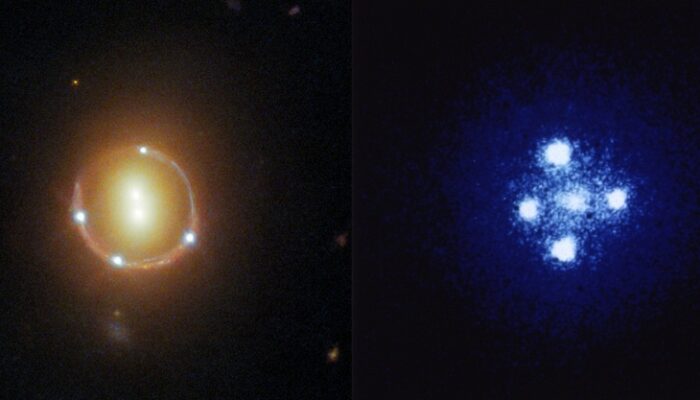
Gravitational lensing is a phenomenon predicted by Einstein’s general theory of relativity, where massive objects cause a curvature in spacetime that bends the path of light traveling near them. This bending acts like a natural cosmic lens, magnifying and distorting the images of distant celestial bodies such as galaxies and quasars. It provides a unique observational tool to detect and study matter that cannot be seen directly, especially dark matter.
- Massive Objects:
Objects like galaxy clusters or black holes with strong gravitational fields that warp spacetime. - Light Deflection:
The bending of light rays as they pass near these massive bodies, altering the apparent position and shape of background sources. - Natural Magnification:
The effect enhances and distorts images, similar to a magnifying glass, revealing details otherwise invisible.
Fundamental Principles Behind Gravitational Lensing
According to general relativity, gravity is not just a force but a manifestation of curved spacetime caused by mass and energy. When photons from distant objects travel through this curved spacetime, their trajectories are deflected. The degree of bending depends on the mass and distribution of the intervening object. This interaction allows astronomers to infer the presence and properties of matter that does not emit or absorb electromagnetic radiation.
Types and Manifestations of Gravitational Lensing
Gravitational lensing manifests in several forms, each providing different insights into cosmic structures:
- Strong Lensing:
Produces striking visual effects such as Einstein rings, arcs, and multiple images of a single background galaxy. These features directly map the mass distribution of the lensing object. - Weak Lensing:
Causes subtle distortions in the shapes of numerous background galaxies. Statistical analysis of these distortions over large sky areas helps reconstruct the large-scale distribution of dark matter.
Gravitational Lensing as a Probe of Dark Matter
Dark matter, which neither emits nor reflects light, remains invisible to traditional telescopes. Gravitational lensing offers a powerful indirect method to detect and map this elusive component by observing its gravitational influence on light. Studies reveal that galaxy clusters are enveloped by massive halos of dark matter, which dominate their total mass and govern the dynamics of galaxies within them.
Insights into the Nature of Dark Matter
Beyond detecting dark matter, gravitational lensing provides clues about its fundamental properties. The patterns and strength of lensing effects challenge alternative theories that modify gravity to explain cosmic phenomena without dark matter. Instead, lensing data strongly support dark matter as a distinct entity. Furthermore, subtle irregularities in lensing maps encourage exploration of dark matter models beyond the classical cold dark matter framework, including warm or self-interacting dark matter candidates.
Challenges in Gravitational Lensing Research
Interpreting gravitational lensing data requires advanced computational techniques and high-resolution observations. Distinguishing the lensing effects caused by ordinary (baryonic) matter-such as stars, gas, and dust-from those caused by dark matter demands precise modeling. Additionally, the interplay between cosmic expansion, dark energy, and dark matter complicates the analysis, necessitating sophisticated approaches to disentangle these influences.
Future Prospects and Technological Advances
Upcoming astronomical facilities like the Vera C. Rubin Observatory and the Euclid space telescope are set to revolutionize gravitational lensing studies. These observatories will collect vast amounts of high-quality data, enabling more accurate and extensive mapping of dark matter across the universe. This influx of information will refine theoretical models, test competing hypotheses, and potentially uncover new physics beyond current understanding.
Gravitational Lensing and Its Connection to Particle Physics
Gravitational lensing bridges the gap between large-scale cosmic observations and microscopic particle physics. It raises profound questions about the fundamental constituents of dark matter, such as whether it consists of exotic particles like weakly interacting massive particles (WIMPs) or axions. Alternatively, it may hint at more radical concepts involving the nature of spacetime itself. Each lensing observation contributes to this ongoing quest to unify cosmology with fundamental physics.
Significance of Gravitational Lensing in Modern Science
Gravitational lensing unveils the hidden scaffolding of the universe, revealing how invisible matter shapes galaxy clusters, influences cosmic evolution, and forms the large-scale structure of the cosmos. It challenges our understanding of the universe’s composition and inspires continued exploration into the unknown. By exposing the unseen, gravitational lensing expands the frontiers of human knowledge and deepens our appreciation of the universe’s complexity.
Common Misconceptions About Gravitational Lensing
Gravitational lensing only produces dramatic visual effects like Einstein rings.
While strong lensing creates striking images, weak lensing causes subtle distortions that require statistical analysis to detect.
Dark matter can be directly observed through telescopes.
Dark matter does not emit or reflect light; it is detected indirectly through its gravitational effects, such as lensing.
Gravitational lensing disproves the existence of dark matter by supporting modified gravity theories.
Lensing observations strongly support dark matter as a separate component rather than modifications to gravity alone.
Real-World Applications and Examples
Gravitational lensing has been instrumental in mapping dark matter in galaxy clusters like the Bullet Cluster, where lensing data revealed the separation of dark matter from ordinary matter during a collision. It also aids in discovering distant galaxies magnified by lensing, allowing astronomers to study the early universe. These practical applications demonstrate lensing’s vital role in advancing astrophysical research.
FAQ
What is gravitational lensing?
Gravitational lensing is the bending of light from distant celestial bodies by massive objects, allowing astronomers to infer the presence of dark matter.
Why is gravitational lensing important?
It provides insights into the distribution and properties of dark matter, which cannot be directly observed.
What are the types of gravitational lensing?
There are two main types: strong lensing, which creates dramatic visual effects, and weak lensing, which causes subtle distortions.

Leave a Reply