
Short Answer
Understanding Dark Matter
Dark matter represents one of the most intriguing and elusive components of the universe. Although it cannot be observed directly through conventional means, its presence is inferred from its significant gravitational effects on visible matter, radiation, and the large-scale structure of the cosmos. This mysterious substance constitutes a substantial portion of the universe’s total mass-energy content, yet its fundamental nature remains unknown.
- Invisible yet influential:
Dark matter does not emit, absorb, or reflect light, making it undetectable by traditional telescopes. - Gravitational effects:
Its existence is primarily deduced from gravitational influences on galaxies, galaxy clusters, and cosmic background radiation.
Experimental Approaches to Detecting Dark Matter
Direct Detection Techniques
Efforts to observe dark matter particles directly involve highly sensitive detectors placed deep underground to minimize interference from cosmic rays and environmental radiation. These experiments aim to capture the rare and subtle interactions between dark matter particles and ordinary matter.
- Cryogenic detectors:
Utilize ultra-cold temperatures to detect tiny energy deposits caused by particle collisions. - Liquid noble gas detectors:
Employ xenon or argon in liquid form to identify scintillation and ionization signals from potential dark matter interactions. - Scintillators:
Materials that emit light when struck by particles, helping to reveal faint interaction events.
These experiments focus on identifying weakly interacting massive particles (WIMPs), a leading dark matter candidate, by reducing background noise and improving calibration to enhance sensitivity.
Indirect Detection Methods
Indirect searches look for secondary signals produced when dark matter particles annihilate or decay. Observatories monitor cosmic phenomena such as gamma rays, neutrinos, and cosmic rays emanating from regions with dense dark matter concentrations.
- Gamma-ray telescopes:
Instruments like the Fermi Gamma-ray Space Telescope scan the sky for excess gamma radiation that could indicate dark matter interactions. - Neutrino observatories:
Detect neutrinos potentially generated by dark matter annihilation in celestial bodies. - Cosmic ray detectors:
Analyze charged particles that may result from dark matter decay processes.
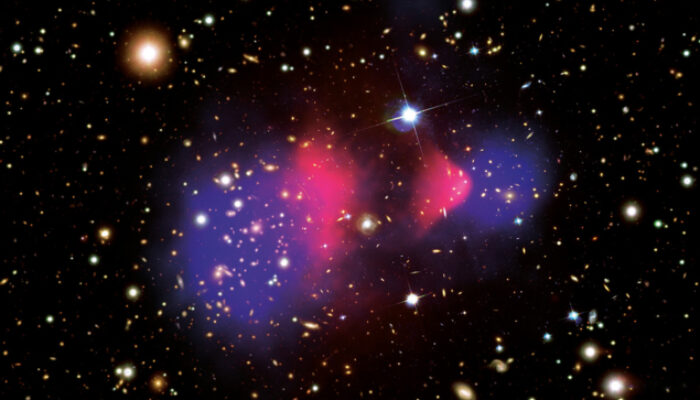
Notably, studies of the Bullet Cluster-a collision of galaxy clusters-have provided compelling indirect evidence by revealing a separation between visible matter and gravitational mass attributed to dark matter.
Theoretical Frameworks and Candidate Particles
The quest to identify dark matter is supported by a rich theoretical landscape that proposes various particle candidates and models. These frameworks employ advanced physics concepts to predict properties and interactions of dark matter.
- WIMPs:
Hypothetical particles that interact weakly with normal matter and have masses in the range of tens to hundreds of GeV. - Axions:
Ultra-light particles proposed to solve certain quantum chromodynamics problems and potentially constitute dark matter. - Sterile neutrinos:
Hypothetical neutrinos that do not interact via the standard weak force, making them viable dark matter candidates. - Primordial black holes:
Black holes formed in the early universe that might account for some or all dark matter.
Theoretical models often draw from supersymmetry, extra-dimensional theories, and string theory, providing predictions about interaction cross-sections, mass ranges, and decay channels. Computational simulations help refine these models by comparing predictions with experimental and observational data.
Astrophysical and Cosmological Evidence
Observations across multiple scales in the universe offer indirect but persuasive evidence for dark matter’s existence.
- Galaxy rotation curves:
Stars in galaxies rotate at speeds that cannot be explained solely by visible matter, implying additional unseen mass. - Gravitational lensing:
The bending of light from distant objects by massive foreground structures reveals mass distributions inconsistent with visible matter alone. - Cosmic microwave background (CMB):
Measurements of the CMB provide insights into the early universe’s composition, supporting the presence of dark matter.
These phenomena collectively challenge the sufficiency of visible matter to explain gravitational effects, underscoring the necessity of an invisible mass component.
Technological Innovations in Dark Matter Research
Advancements in technology are pivotal in enhancing the sensitivity and accuracy of dark matter detection efforts.
- Next-generation detectors:
Devices using dual-phase xenon or liquid argon technologies improve signal discrimination and sensitivity. - Deep underground laboratories:
Facilities shielded beneath mountains reduce background noise from cosmic radiation. - Photodetection and data acquisition:
Cutting-edge sensors and electronics capture and process faint signals with high precision. - Machine learning algorithms:
Employed to analyze complex data sets, distinguishing potential dark matter signals from noise.
International collaborations exemplify the global commitment to overcoming engineering challenges such as material purity and cryogenics, driving the field forward.
Role of Particle Colliders in Dark Matter Exploration
High-energy particle colliders, notably the Large Hadron Collider (LHC), contribute to dark matter research by attempting to produce dark matter candidates through particle collisions.
- Missing energy signatures:
Events where energy appears to vanish, suggesting the creation of invisible particles like dark matter. - Event reconstruction:
Sophisticated techniques analyze collision data to identify subtle decay patterns and invisible final states. - Statistical analysis:
Rigorous methods assess the significance of potential dark matter signals amidst background processes.
The integration of collider results with direct and indirect detection findings forms a comprehensive strategy to constrain and identify dark matter properties.
Philosophical and Foundational Implications
The pursuit of dark matter extends beyond empirical science, touching on profound questions about the nature of reality and the limits of human understanding.
- Redefining matter:
Challenges traditional concepts of what constitutes matter and the forces governing it. - Expanding cosmic perspective:
Encourages reconsideration of the universe’s composition and the fundamental laws of physics. - Human curiosity and perseverance:
Embodies the enduring quest for knowledge that drives scientific progress.
Future Directions and Prospects
The horizon of dark matter research is marked by promising innovations and interdisciplinary collaborations that may soon unlock its secrets.
- Directional detectors:
Instruments designed to map the velocity distribution of dark matter particles, providing new insights. - Quantum sensing technologies:
Exploit quantum entanglement and coherence to achieve unprecedented detection sensitivity. - Space-based experiments:
Proposed missions aim to circumvent terrestrial limitations and explore dark matter signals from space. - Cross-disciplinary synergy:
Combining astrophysics, particle physics, and advanced computation to accelerate discovery.
These advancements hold the potential to revolutionize our understanding of the dark sector, revealing new physics beyond the Standard Model and reshaping cosmological theories.
Significance of Dark Matter Research
Investigating dark matter is crucial for comprehending the universe’s structure, evolution, and fundamental laws. It bridges the gap between the observable and the hidden, linking cosmic phenomena with particle physics. The ongoing search not only deepens scientific knowledge but also inspires technological innovation and philosophical reflection, highlighting humanity’s quest to unravel the universe’s deepest mysteries.
FAQ
What is dark matter?
Dark matter is an unseen substance that makes up a significant portion of the universe's mass, inferred from its gravitational effects on visible matter.
How is dark matter detected?
Dark matter is detected through direct methods, such as sensitive underground detectors, and indirect methods, such as observing cosmic phenomena like gamma rays.



Leave a Reply