
Short Answer
Definition of Baryons and Doubly Charmed Baryons
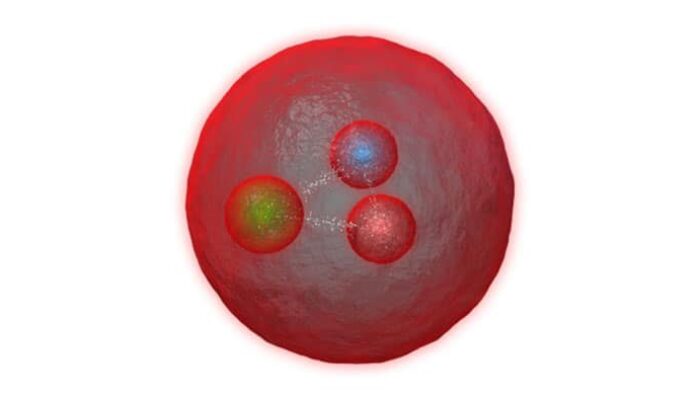
Baryons are subatomic particles composed of three quarks, forming a fundamental class within the family of hadrons. They constitute the core components of atomic nuclei, including familiar particles such as protons and neutrons. Among the diverse baryon types, doubly charmed baryons are distinguished by containing two charm quarks alongside a lighter quark, resulting in unique properties that set them apart from more common baryons.
- Baryons:
Particles made up of three quarks bound together by the strong force. - Doubly Charmed Baryons:
Baryons containing two charm quarks and one lighter quark, exemplified by the particle denoted as (Ξcc++).
Role of the LHCb Experiment in Particle Discovery
The Large Hadron Collider beauty (LHCb) experiment at CERN plays a pivotal role in probing the characteristics of heavy quarks, particularly beauty (bottom) and charm quarks. By analyzing high-energy proton-proton collisions, LHCb enables the detection of rare particles such as doubly charmed baryons. These collisions generate extreme conditions where short-lived particles emerge and decay, allowing physicists to observe their signatures through decay products.
Quantum Chromodynamics and the Significance of Doubly Charmed Baryons
Quantum Chromodynamics (QCD) is the fundamental theory describing the strong interaction, the force responsible for binding quarks and gluons inside hadrons. The discovery of doubly charmed baryons provides a tangible testbed for QCD predictions, especially concerning the behavior of multiple heavy quarks within a single particle. These baryons challenge existing theoretical models related to quark confinement, stability, and the dynamics of the strong force at high energies.
Detection and Characteristics of the (Ξcc++) Particle
The (Ξcc++) baryon was identified through meticulous examination of collision data at the LHC, where its relatively high mass of approximately 3.5 GeV/c² makes it accessible for detection. Its decay pathways produce distinct signatures that researchers can track, confirming its presence. This discovery enriches the catalog of known particles and refines theoretical frameworks concerning baryon formation and decay mechanisms.
Implications for Baryon Spectroscopy and Multiquark States
The observation of the doubly charmed baryon opens new avenues in the study of baryon spectroscopy, the classification of baryons based on their quark content and properties. It prompts reconsideration of particle classification schemes and stimulates theoretical exploration into the existence of even more exotic states, such as baryons containing three charm quarks or combinations involving other heavy quark flavors.
Hadron Formation and Early Universe Connections
Understanding the formation and decay of hadrons like the (Ξcc++) sheds light on quark interactions across different energy scales. These insights are crucial for reconstructing conditions in the early universe, where baryons emerged from the primordial quark-gluon plasma shortly after the Big Bang. Each new particle discovery contributes to a more comprehensive picture of the universe’s formative moments and the fundamental forces shaping matter.
Broader Impact on Science, Technology, and Society
Discoveries in particle physics, including the identification of exotic baryons, have far-reaching effects beyond theoretical science. Advances in understanding matter’s fundamental constituents influence technological innovations such as medical imaging and quantum computing. Moreover, these findings inspire philosophical reflection and motivate future generations to explore profound questions about the nature of reality and the universe.
Advancements in Experimental Techniques and Theoretical Models
The complexity of detecting and analyzing doubly charmed baryons drives continuous improvement in experimental methodologies and theoretical approaches. Collaborative international efforts foster interdisciplinary dialogue, enhancing the precision of quark interaction studies. The synergy between cutting-edge technology and particle physics research promises novel methods for probing the universe’s fundamental structure.
Future Prospects and Continuing Research
The LHCb’s discovery of the (Ξcc++) is a catalyst for ongoing investigations into heavy baryons and quark dynamics. Upcoming experiments aim to deepen understanding of these particles, potentially uncovering new states and refining knowledge of the strong force. This progress exemplifies the enduring human quest to unravel the complexities of nature at its most fundamental level.
Summary
The inaugural observation of the doubly charmed baryon by the LHCb experiment represents a landmark achievement in particle physics. It enriches theoretical and experimental discourse, challenges existing paradigms, and broadens the horizon for future discoveries. As research advances, the insights gained from studying such exotic particles will illuminate the intricate tapestry of the universe’s fundamental building blocks and their interactions.
FAQ
What is a doubly charmed baryon?
A doubly charmed baryon is a baryon that contains two charm quarks and one lighter quark, resulting in unique properties.
How was the (Ξcc++) baryon discovered?
It was discovered through data analysis of high-energy proton-proton collisions at the LHCb experiment.
What is the significance of doubly charmed baryons in particle physics?
They provide a testbed for Quantum Chromodynamics predictions and challenge existing theoretical models regarding quark confinement.






Leave a Reply