
Short Answer
Understanding the Dark Matter Debate
In astrophysics, the concept of dark matter has been central to explaining the puzzling behaviors observed in galaxy formation and motion. The gravitational lensing effects seen in galaxies reveal a mismatch between the visible matter and the gravitational forces acting upon them, leading scientists to propose the existence of dark matter. However, some researchers question this dominant view, suggesting alternative theories that might resolve the inconsistencies in galaxy rotation curves without relying on unseen matter. This article delves into these alternative perspectives, offering a comprehensive overview of the current cosmological discussions.
Galactic Dynamics and the Dark Matter Hypothesis
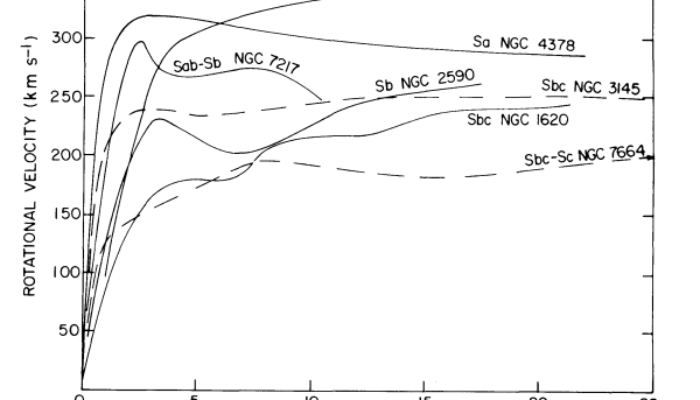
Observations of galactic motion provide compelling evidence for the presence of mass that cannot be directly observed. Spiral galaxies, for example, display flat rotation curves that contradict the expectations from Newtonian physics when considering only visible matter. Instead of decreasing with distance from the galactic center, the rotational velocity remains nearly constant, implying a significant amount of unseen mass. This discrepancy led to the dark matter hypothesis, which suggests that galaxies are surrounded by halos of non-baryonic matter. Despite its widespread acceptance, the exact nature of this dark matter remains elusive, prompting scientists to explore alternative explanations for these gravitational anomalies.
Modified Newtonian Dynamics (MOND)
One prominent alternative to dark matter is Modified Newtonian Dynamics, or MOND, introduced by Mordehai Milgrom in the early 1980s. MOND proposes a revision of Newton’s laws of motion and gravity at very low accelerations, such as those found at the outskirts of galaxies. By altering the equations governing gravitational forces in these regimes, MOND aims to reproduce the observed flat rotation curves without invoking additional matter. This theory has shown some success in explaining galactic phenomena, including the Tully-Fisher relation, which links the luminosity of a galaxy to its rotational velocity. However, MOND struggles to account for larger-scale cosmological observations, such as the cosmic microwave background radiation and the formation of large-scale structures, which limits its acceptance as a complete alternative.
Emergent Gravity: A New Perspective on Gravitational Forces
Emergent gravity, a theory advanced by Erik Verlinde, offers a radically different viewpoint by suggesting that gravity is not a fundamental force but an emergent effect arising from the thermodynamic properties of spacetime. According to this framework, the gravitational pull experienced by galaxies results from the information encoded in the fabric of spacetime itself, rather than from unseen mass. This approach aligns with holographic principles derived from quantum theory and provides a novel explanation for gravitational anomalies without requiring dark matter. While still in its early stages, emergent gravity has attracted interest for its potential to unify gravity with thermodynamics and quantum mechanics.
Modifications to Spacetime and Gravity Theories
Beyond MOND and emergent gravity, other theories propose that our current understanding of spacetime and general relativity may be incomplete, especially at cosmic scales or high velocities. Concepts such as quantum gravity and extra-dimensional models suggest that unknown properties of spacetime could influence gravitational interactions in ways that mimic the effects attributed to dark matter. These theories require complex mathematical formulations and await empirical validation but contribute valuable insights to the ongoing exploration of galactic dynamics.
Integrating Observational Data and Theoretical Models
It is important to recognize that alternative theories do not simply oppose the dark matter paradigm but rather complement the scientific quest to explain galactic phenomena. Observational data, including measurements of baryon acoustic oscillations, gravitational lensing, and extensive multi-wavelength surveys, play a crucial role in testing these hypotheses. Advances in observational technology, such as next-generation radio telescopes and high-resolution imaging, enable astronomers to map galactic structures with unprecedented precision. This synergy between observation and theory fosters collaboration aimed at developing comprehensive models that incorporate both visible and invisible influences on galaxy behavior.
The Role of Interdisciplinary Research
Progress in understanding dark matter and its alternatives benefits greatly from interdisciplinary approaches. Insights from particle physics, cosmology, and quantum mechanics enrich the investigation, introducing concepts like supersymmetry and higher-dimensional theories that challenge conventional views. Embracing innovative ideas while maintaining rigorous empirical scrutiny is essential for advancing our comprehension of the universe’s fundamental nature.
Conclusion: The Future of Dark Matter Research
While dark matter remains the leading explanation for the unusual rotation curves of galaxies, alternative theories deserve serious consideration and thorough examination. By exploring modified gravity models, emergent spacetime concepts, and refining observational techniques, the astrophysical community is poised for potential breakthroughs. These efforts not only question the prevailing dark matter framework but also embody the essence of scientific inquiry, driving us closer to unraveling the profound mysteries of the cosmos.
FAQ
What is dark matter?
Dark matter is a theoretical form of matter that does not emit light or energy, making it invisible and detectable only through its gravitational effects on visible matter.
What are the main alternatives to dark matter?
The main alternatives include Modified Newtonian Dynamics (MOND) and emergent gravity, which propose different frameworks for understanding galactic motion without invoking dark matter.
How does MOND explain galaxy rotation curves?
MOND modifies Newton’s laws at very low accelerations to account for the observed flat rotation curves of galaxies without needing additional unseen mass.
Leave a Reply