
Short Answer
Definition
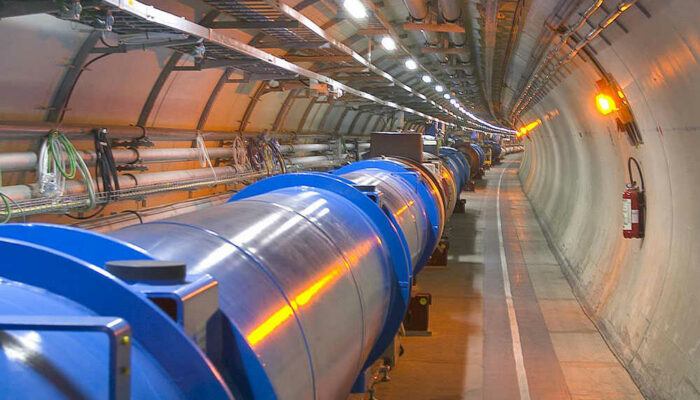
The world’s largest particle collider is a monumental scientific apparatus designed to accelerate and collide subatomic particles at near-light speeds. Situated along the Franco-Swiss border, this colossal machine serves as a gateway to exploring the fundamental components and forces that constitute the universe. Beyond its physical enormity, the collider embodies humanity’s profound desire to decode the mysteries of existence and the origins of the cosmos.
Purpose and Significance
At its core, the collider is not merely a feat of engineering but a vital instrument for probing the laws that govern reality. By recreating conditions akin to those just after the Big Bang, it allows scientists to investigate particles and interactions that are otherwise inaccessible. This pursuit addresses a timeless human impulse: the quest to understand the “why” behind natural phenomena and to uncover the unseen framework underlying the universe.
Operational Overview
The collider operates by propelling particles around a circular tunnel exceeding 27 kilometers in circumference. These particles are accelerated to velocities approaching the speed of light before being directed to collide. The resulting high-energy impacts generate data that reveal the properties of fundamental particles and forces. Each collision is a carefully orchestrated experiment designed to test theoretical predictions and expand our knowledge of particle physics.

Scientific Discoveries and Contributions
- Higgs Boson Discovery:
One of the collider’s landmark achievements was confirming the existence of the Higgs boson, a particle integral to explaining how other particles acquire mass. - Dark Matter Research:
Ongoing experiments aim to detect and understand dark matter, a mysterious substance that constitutes a significant portion of the universe’s mass but remains invisible to direct observation.
Human Curiosity and Intellectual Drive
The fascination with the collider extends beyond its scientific output. It taps into a deep-seated human curiosity about the invisible forces shaping reality. Historically, people have sought to explain phenomena beyond sensory perception-from celestial movements to the nature of light and matter. The collider represents a modern extension of this intellectual journey, enabling us to transcend our natural limitations and engage with the subatomic world.
Technological Innovations Stemming from the Collider
The pursuit of particle collisions at unprecedented energies has catalyzed advancements in several cutting-edge technologies:
- Superconducting Magnets:
Essential for steering and accelerating particles, these magnets operate at extremely low temperatures to achieve high efficiency. - Cryogenics:
Advanced cooling systems maintain the collider’s components at near absolute zero, ensuring optimal performance. - Data Processing:
The enormous volume of collision data has driven innovations in computing and data analysis techniques, benefiting various scientific and industrial fields.
Global Collaboration and Cultural Impact
The collider is a testament to international cooperation, involving thousands of scientists, engineers, and technicians from diverse countries and backgrounds. This collective effort transcends national boundaries, reflecting a shared commitment to advancing human knowledge. As a symbol of unity, the collider highlights how collaborative endeavors can overcome geopolitical differences in pursuit of common scientific goals.
Philosophical and Existential Dimensions
Beyond empirical science, the collider engages with profound metaphysical questions that have intrigued humanity for centuries:
- Nature of Matter:
What constitutes the fundamental building blocks of reality? - Origins of the Universe:
How did the cosmos begin, and what forces shaped its evolution? - Dimensions Beyond Perception:
Are there aspects of reality that lie beyond human sensory experience?
By addressing these inquiries, the collider bridges the gap between scientific investigation and philosophical contemplation, enhancing its allure as a beacon of enlightenment.
Impact on Understanding Reality
Each experiment conducted within the collider contributes to a growing mosaic of cosmic understanding. The insights gained challenge existing assumptions and inspire new perspectives on the nature of existence. This evolving knowledge prompts reconsideration of fundamental dichotomies such as order versus chaos, particle versus wave, and the known versus the unknown, fostering a renewed sense of wonder and intellectual exploration.
Conclusion: The Collider as a Symbol of Human Endeavor
Ultimately, the world’s largest particle collider transcends its role as a scientific instrument. It stands as a symbol of humanity’s relentless pursuit of knowledge, uniting global intellects in a shared mission to unravel the universe’s deepest secrets. By advancing both theoretical understanding and practical technology, the collider exemplifies the dynamic interplay between curiosity, innovation, and collaboration that drives human progress.
FAQ
What is the primary function of the Large Hadron Collider?
The primary function is to accelerate and collide subatomic particles to explore the fundamental components of the universe.
What significant discovery was made by the collider?
The Large Hadron Collider confirmed the existence of the Higgs boson, essential for understanding how particles acquire mass.
How does the collider contribute to our understanding of dark matter?
Ongoing experiments at the collider aim to detect and understand dark matter, a mysterious substance that constitutes a large portion of the universe's mass.





Leave a Reply