
Short Answer
Definition of Quasars
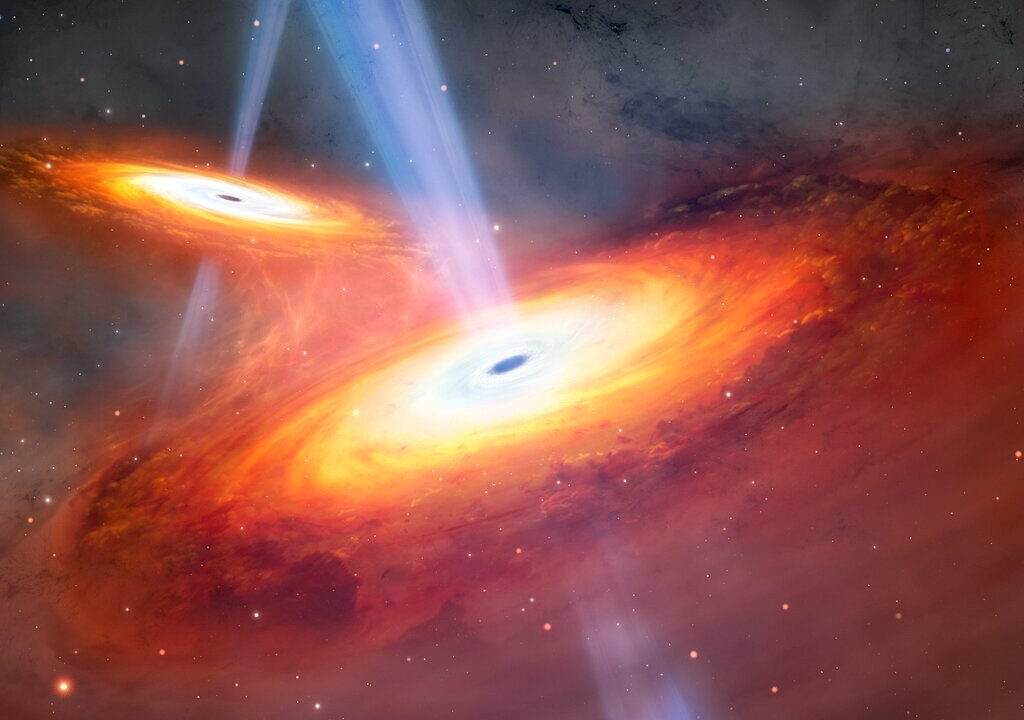
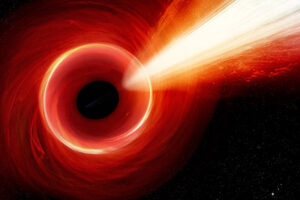
Quasars, short for “quasi-stellar objects,” are extraordinarily luminous celestial bodies that emerged in the early universe. They represent a distinct phase in the evolution of massive galaxies, characterized by intense energy emissions powered by supermassive black holes at their cores. These objects serve as cosmic beacons, illuminating the distant reaches of space and time, and providing valuable insights into the universe’s infancy.
Formation and Origins of Quasars
The rapid appearance of quasars shortly after the Big Bang presents a compelling puzzle in astrophysics. Several theories attempt to explain how such massive black holes formed so early in cosmic history:
- Direct Collapse of Gas Clouds:
Under specific conditions, enormous clouds of primordial gas could have collapsed directly under gravity, bypassing star formation and creating massive black holes that later grew by accreting surrounding matter. - Seed Black Holes from Population III Stars:
The first generation of stars, known as Population III stars, were massive and metal-free. Their explosive deaths may have left behind black hole remnants that merged and expanded into the supermassive black holes powering quasars.
These formation pathways are deeply intertwined with the early universe’s environment, influenced by dark matter distribution and radiation fields.
Quasars as Probes of the Early Universe
Quasars are invaluable tools for studying the conditions of the cosmos during its formative epochs. The light emitted by quasars travels through the intergalactic medium (IGM), interacting with hydrogen atoms and leaving distinctive absorption lines in their spectra. These features enable astronomers to deduce the density, temperature, and ionization state of the IGM, particularly during the epoch of reionization when the universe transitioned from neutral to ionized.
Observational Evidence and Redshift Significance
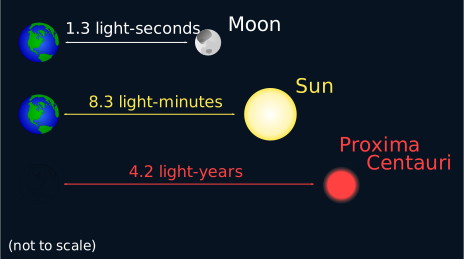
Recent discoveries have identified quasars at redshifts exceeding 7, corresponding to a period roughly 700 million years after the Big Bang, or about 13 billion years ago. Notable examples, such as quasar J1342+0928, exhibit extraordinary brightness, suggesting that the conditions necessary for quasar formation were more common than previously thought. These findings challenge existing theoretical models and prompt a reevaluation of early cosmic structure formation.
Role of Quasars in Galaxy Evolution
Quasars are not isolated phenomena; they reside within massive host galaxies and appear to influence their development significantly. The interaction between the supermassive black hole’s activity and the surrounding galactic environment-often referred to as feedback mechanisms-can regulate star formation and alter the galaxy’s evolution. Understanding this co-evolution sheds light on the complex relationship between black holes and their host galaxies, revealing fundamental processes that shape the universe.
Challenges and Limitations in Quasar Studies
While quasars provide profound insights, their extreme environments may not represent typical galactic conditions. The intense radiation and energetic processes near supermassive black holes create unique circumstances that differ from average galaxies. Consequently, caution is necessary when generalizing quasar observations to broader cosmic contexts, as their distinctive properties might reflect specific, rather than universal, phenomena.
Why Quasars Are Crucial to Astrophysics
Quasars are more than just luminous objects; they are essential keys to unlocking the mysteries of the early universe. By studying quasars, scientists gain a window into the formation of the first massive black holes, the nature of the intergalactic medium, and the evolution of galaxies. These insights contribute to a deeper understanding of cosmic history and the forces that have shaped the universe over billions of years.
Summary and Future Perspectives
The investigation of the earliest quasars continues to be a frontier in astrophysics, offering clues about the universe’s origins and evolution. As observational technology advances, the hope is to unravel the complex processes behind black hole formation, cosmic reionization, and galaxy growth. Whether quasars will ultimately reveal the universe’s deepest secrets or highlight the intricate complexity of cosmic evolution remains an open and fascinating question.
FAQ
What are quasars?
Quasars are extremely luminous objects powered by supermassive black holes and are among the earliest astronomical objects formed in the universe.
Why are quasars important for astrophysics?
They provide insights into the early universe, the formation of galaxies, and the conditions of the intergalactic medium.
How do quasars help us understand the universe's evolution?
Their light offers information about cosmic conditions during the epoch of reionization and the growth of galaxies.


Leave a Reply