
Short Answer
Definition of Electron Mass
The mass of an electron is a fundamental physical constant essential to the fields of particle physics and quantum mechanics. It represents the intrinsic rest mass of the electron, a subatomic particle that plays a crucial role in atomic structure and electromagnetic interactions. This constant is pivotal in scientific research, education, and various technological applications.
- Rest Mass:
The electron’s rest mass is the mass it possesses when at rest, unaffected by external forces or motion. - Value:
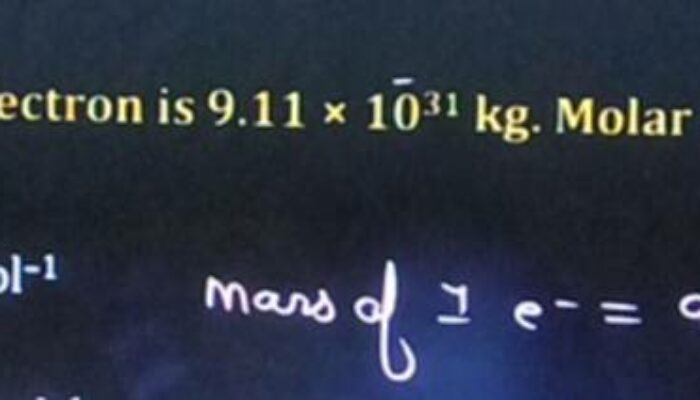
The accepted value of the electron’s rest mass is approximately 9.11 × 10⁻³¹ kilograms.
Types of Mass in Physics and Their Relevance to the Electron
Mass in physics can be classified into different categories, each with distinct implications:
- Inertial Mass:
Measures an object’s resistance to acceleration when a force is applied. - Gravitational Mass:
Determines the strength of an object’s interaction with gravitational fields. - Rest Mass:
The intrinsic mass of a particle when it is stationary, fundamental to defining particle properties.
When discussing the electron’s mass, the rest mass is the most relevant, as it defines the electron’s inherent property independent of its motion or environment.
Educational Importance of Electron Mass in Multiple-Choice Questions (MCQs)
In academic settings, the electron’s mass is frequently featured in multiple-choice questions to evaluate students’ grasp of fundamental physics concepts. These questions serve several educational purposes:
- Testing Factual Knowledge:
Assessing students’ ability to recall the precise value of the electron’s rest mass. - Conceptual Understanding:
Encouraging comprehension of how the electron’s mass influences atomic behavior, electromagnetism, and relativistic effects. - Application Skills:
Challenging students to apply the electron’s mass in problem-solving scenarios, such as calculating kinetic energy or analyzing particle interactions.
Designing Effective MCQs on Electron Mass
Crafting meaningful multiple-choice questions about the electron’s mass requires careful consideration to maximize educational value. Effective MCQs should:
- Go beyond simple memorization by incorporating context or problem-solving elements.
- Encourage higher-order thinking, such as analysis and synthesis of concepts.
- Integrate interdisciplinary knowledge, linking electron mass to electromagnetism, quantum mechanics, and atomic theory.
For example, a question might present a scenario where students calculate the kinetic energy of an electron accelerated through a known potential difference, thereby applying the mass value in a practical context.
Historical Context of Electron Mass Discovery
The discovery and measurement of the electron’s mass mark significant milestones in the history of physics:
- Discovery:
J.J. Thomson identified the electron in 1897 through cathode ray experiments, revealing the existence of subatomic particles. - Measurement Techniques:
Early mass determinations involved cathode ray deflection and later refined methods such as mass spectrometry. - Scientific Impact:
These discoveries laid the groundwork for modern atomic theory and the Standard Model of particle physics.
Implications of Electron Mass in Physics and Technology
The electron’s mass is not merely a numerical constant but a cornerstone in understanding the physical universe:
- Atomic Stability:
The electron’s mass influences the structure and stability of atoms, affecting chemical bonding and material properties. - Electromagnetic Phenomena:
It plays a role in defining charge-to-mass ratios, critical for understanding particle behavior in electric and magnetic fields. - Quantum Mechanics:
The mass is integral to quantum models describing electron behavior, energy levels, and wave-particle duality.
Common Misconceptions About Electron Mass
The electron’s mass changes depending on its speed.
The rest mass of the electron is constant; however, its relativistic mass increases with velocity, a concept distinct from rest mass.
Electron mass is irrelevant in everyday physics.
Although extremely small, the electron’s mass is fundamental to many physical processes and technologies, including electronics and spectroscopy.
Why Understanding Electron Mass Is Crucial
Grasping the concept of electron mass is vital for students and professionals alike, as it underpins much of modern physics and technology. It enables a deeper appreciation of atomic and subatomic phenomena, informs the design of electronic devices, and supports advancements in fields such as quantum computing and particle physics research. Moreover, engaging with this concept through thoughtfully designed MCQs fosters critical thinking and a comprehensive understanding of the natural world.
FAQ
What is the mass of an electron?
The mass of an electron is approximately 9.11 × 10^-31 kilograms.
Why is the electron mass important in physics?
The electron mass is crucial for understanding atomic structure, electromagnetic interactions, and plays a significant role in various technological applications.






Leave a Reply