
Short Answer
Definition of Light and Gravitational Waves
Light and gravitational waves are two fundamental types of waves that traverse the universe, each embodying unique physical properties and origins. While both propagate through space, they differ significantly in their nature, generation, and interaction with matter.
- Light:
An electromagnetic wave consisting of oscillating electric and magnetic fields, traveling at a constant speed in vacuum. - Gravitational Waves:
Ripples in the fabric of spacetime itself, produced by massive accelerating bodies, as predicted by general relativity.
Physical Nature and Origin
Light is a form of electromagnetic radiation that has captivated human curiosity for centuries. It is composed of photons, which are massless quantum particles exhibiting wave-particle duality. These photons carry electromagnetic force and enable light to manifest across a broad spectrum, from visible colors to ultraviolet and beyond.
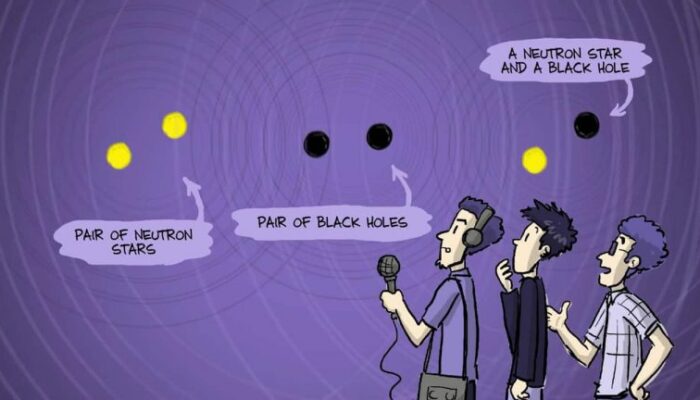
In contrast, gravitational waves arise from distortions in spacetime caused by violent astrophysical phenomena such as merging black holes or neutron stars. These waves are classical perturbations described by Einstein’s general theory of relativity, representing dynamic changes in the geometry of spacetime rather than oscillations of a field within it.
Propagation and Speed
Both light and gravitational waves travel at the universal speed limit, approximately 299,792 kilometers per second (denoted as c). However, their modes of propagation differ:
- Light:
Electromagnetic waves propagate through space without requiring a medium, sustained by oscillating electric and magnetic fields. - Gravitational Waves:
These waves are fluctuations in spacetime’s metric itself, effectively rippling the very fabric of the cosmos as they move outward from their source.
Interaction with Matter
The way these waves interact with matter is fundamentally distinct. Light readily engages with charged particles, enabling a wide range of optical phenomena such as reflection, refraction, and diffraction. This interaction underpins numerous technologies, including microscopes, cameras, and telecommunications.
Gravitational waves, on the other hand, interact extremely weakly with matter. They can pass through entire galaxies, stars, and planets with negligible attenuation, making their detection a formidable challenge. Instruments like the Laser Interferometer Gravitational-Wave Observatory (LIGO) are designed to measure the minute distortions these waves cause in spacetime.
Generation Mechanisms
The sources of light and gravitational waves differ markedly in scale and nature:
- Light Emission:
Generated by accelerating charged particles, light is emitted by a vast array of sources, from glowing stars to human-made lasers, saturating the universe with electromagnetic radiation. - Gravitational Wave Production:
Produced only by extreme cosmic events involving massive bodies accelerating at high velocities, such as black hole mergers or neutron star collisions, gravitational waves carry encoded information about these cataclysmic occurrences.
Quantum vs Classical Descriptions
Light is well understood within the framework of quantum mechanics, with photons serving as the quantum carriers of electromagnetic force. This dual wave-particle nature allows light to exhibit behaviors characteristic of both particles and waves.
Conversely, gravitational waves are currently described by classical general relativity. The hypothetical quantum counterpart, gravitons, remains elusive, representing one of the major open questions in modern physics regarding the unification of gravity with quantum theory.
Scientific and Technological Significance
The study of light has been foundational to numerous scientific disciplines and technological advancements, from understanding atomic structures to enabling modern communication systems.
Gravitational waves open a novel observational window into the universe, allowing scientists to detect and analyze phenomena invisible to traditional electromagnetic telescopes. This new form of astronomy enriches our understanding of cosmic events and the dynamic nature of spacetime.
Common Misconceptions
Light and gravitational waves are the same because both are waves.
Despite both being waves, light is electromagnetic radiation mediated by photons, while gravitational waves are distortions in spacetime itself.
Gravitational waves require a medium to travel.
Gravitational waves propagate as changes in spacetime geometry and do not need any medium.
Gravitational waves interact strongly with matter.
They interact extremely weakly, passing through matter almost unaffected.
Why Understanding These Waves Matters
Comprehending the differences and complementarities between light and gravitational waves is crucial for advancing physics and cosmology. Light reveals the universe’s visible components and electromagnetic interactions, while gravitational waves provide insights into the behavior of spacetime and the most energetic cosmic events. Together, they form a comprehensive narrative of the cosmos, driving scientific innovation and expanding our cosmic perspective.
Conclusion: The Complementary Nature of Cosmic Waves
While light and gravitational waves share the characteristic of wave propagation, their fundamental distinctions highlight the richness of the universe’s physical phenomena. Their coexistence enhances our ability to explore and understand the cosmos, each offering unique information that the other cannot provide. The discovery and study of gravitational waves, a century after their theoretical prediction, underscore the ever-evolving nature of scientific knowledge and the boundless mysteries awaiting exploration.
FAQ
What are the primary differences between light and gravitational waves?
Light is an electromagnetic wave composed of photons, while gravitational waves are ripples in spacetime caused by massive accelerating bodies.
How do light and gravitational waves propagate?
Both travel at the speed of light, but light requires no medium, while gravitational waves are fluctuations in spacetime.
Why are gravitational waves difficult to detect?
They interact extremely weakly with matter, allowing them to pass through most objects with negligible effects.
Leave a Reply