
Short Answer
Definition of Dark Energy
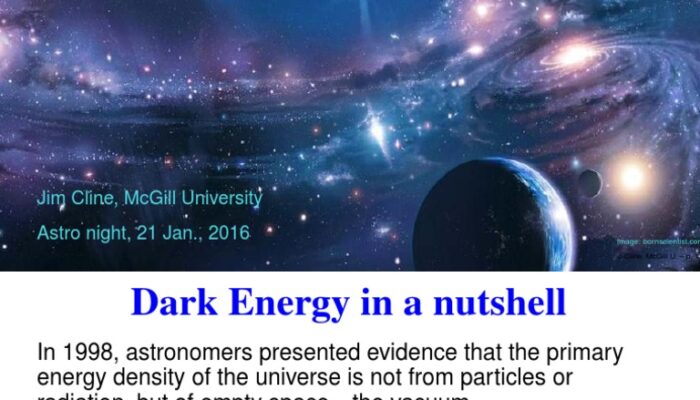
Dark energy is a mysterious and pervasive force that constitutes about 68% of the total energy content of the universe. Unlike familiar forces such as gravity, electromagnetism, and nuclear interactions, dark energy is not directly observable but is inferred from its effects on the cosmos. It acts as a repulsive force, driving the accelerated expansion of the universe and influencing its large-scale structure.
- Dominant cosmic component:
Dark energy makes up the majority of the universe’s energy budget, surpassing all known forms of matter and energy combined. - Invisible and elusive:
It cannot be detected through conventional means but is identified through its gravitational effects on cosmic expansion. - Repulsive nature:
Unlike gravity, which attracts matter, dark energy pushes space apart, causing the universe to expand at an increasing rate.
Historical Context and Discovery
The discovery of dark energy emerged in the late 1990s when astronomers observed distant supernovae and found that the universe’s expansion was accelerating rather than slowing down as previously expected. This groundbreaking observation challenged existing cosmological models and earned the discoverers the Nobel Prize in Physics. The acceleration implied the presence of a repulsive force counteracting gravity on cosmic scales.
Mechanism Behind Dark Energy
Dark energy operates on the largest scales of the universe, where gravitational forces weaken. It acts as a form of negative pressure or antigravity, stretching the fabric of space-time itself. This effect becomes dominant in the vast voids between galaxy clusters, where it accelerates the expansion of the cosmos. The phenomenon can be likened to an invisible tide that gradually pulls galaxies apart, reshaping the universe’s structure over billions of years.
Mathematical Representation: The Cosmological Constant
In Einstein’s field equations of General Relativity, dark energy is often modeled by the cosmological constant, denoted by the Greek letter Lambda (Λ). Initially introduced to maintain a static universe, Λ now represents a constant energy density filling empty space uniformly.
- Einstein’s field equations:
( G_{munu} + Lambda g_{munu} = frac{8pi G}{c^4} T_{munu} ) - Variables:
( G_{munu} ) is the Einstein tensor describing spacetime curvature, ( g_{munu} ) is the metric tensor, ( T_{munu} ) is the energy-momentum tensor, ( G ) is the gravitational constant, and ( c ) is the speed of light. - Cosmological constant problem:
Quantum field theory predicts a vacuum energy density vastly larger than observed, creating a significant discrepancy known as the cosmological constant problem.
Dynamic Dark Energy: Quintessence
Some theoretical models propose that dark energy is not a fixed constant but a dynamic field called quintessence. Unlike the cosmological constant, quintessence can vary in strength and evolve over time, potentially altering the universe’s expansion history. This concept introduces new physics beyond the Standard Model and General Relativity, offering insights into the universe’s origin and ultimate fate.
Interaction with Dark Matter
Dark energy coexists with dark matter, which comprises about 27% of the universe’s energy content. While dark matter exerts gravitational attraction, binding galaxies and clusters together, dark energy drives the expansion of space itself. The interplay between these two invisible components creates a cosmic tug-of-war that shapes the large-scale structure and evolution of the universe.
Real-World Analogies and Cosmic Implications
To visualize dark energy’s effect, imagine the universe as a grand cosmic dance. Gravity acts as the lead partner, pulling galaxies together and slowing their movement. Dark energy, however, is like an accelerating rhythm that pushes the dancers apart, increasing the pace of expansion. Over time, this leads to a universe that becomes increasingly vast, cold, and isolated, with galaxies drifting beyond each other’s reach.
Common Misconceptions About Dark Energy
Dark energy is the strongest force in the universe.
While dark energy dominates the universe’s large-scale behavior, it is negligible at small scales and does not act like traditional forces such as electromagnetism or the nuclear forces.
Dark energy can be directly detected.
Dark energy is inferred from its gravitational effects on cosmic expansion and cannot be observed directly with current instruments.
Dark energy is constant and unchanging.
Some theories suggest dark energy may vary over time, as in the quintessence model, which remains an active area of research.
Significance of Dark Energy in Cosmology
Dark energy fundamentally alters our understanding of the universe’s fate and structure. It challenges the traditional view that gravity alone governs cosmic evolution by introducing a repulsive force that accelerates expansion. This has profound implications for the ultimate destiny of the cosmos, suggesting a future where galaxies become isolated and matter is diluted to near nothingness. Studying dark energy pushes the boundaries of physics, cosmology, and our comprehension of space and time.
FAQ
What is dark energy?
Dark energy is a mysterious force that makes up about 68% of the universe's energy content and drives its accelerated expansion.
Can dark energy be detected directly?
No, dark energy cannot be observed directly and is inferred from its effects on cosmic expansion.
How does dark energy affect the universe?
It causes the universe to expand at an increasing rate, counteracting the gravitational pull of matter.
Leave a Reply