
Short Answer
Definition of a Light-Year
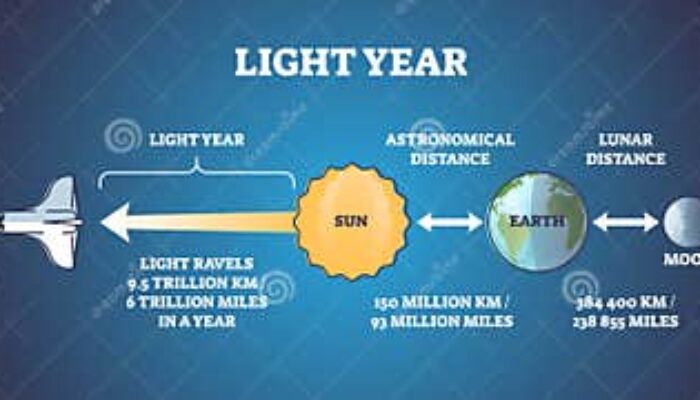
A light-year is a unit used to express astronomical distances, defined as the length that light travels in a vacuum over the span of one Julian year (365.25 days). Despite the term containing “year,” which typically denotes time, a light-year specifically measures distance rather than duration. This distinction is fundamental for accurately describing the vast separations between celestial objects in the universe.
- Speed of Light:
Light moves at a constant velocity of approximately 299,792 kilometers per second (about 186,282 miles per second). - Distance Covered:
Over one year, light travels nearly 9.46 trillion kilometers (around 5.88 trillion miles), making the light-year an ideal scale for cosmic distances.
The Relationship Between Space and Time in a Light-Year
While a light-year is fundamentally a distance measurement, it inherently links space and time due to the finite speed at which light travels. When astronomers say a star is 10 light-years away, it means the light we observe today left that star a decade ago. This connection means that observing distant objects is simultaneously looking back in time, providing a glimpse into the universe’s past.
This dual nature of the light-year is crucial in astronomy, as it allows scientists to study the history and evolution of stars, galaxies, and cosmic phenomena by analyzing the light that has traveled vast distances over extended periods.
Comparison with Other Astronomical Distance Units
Besides the light-year, astronomers use other units to measure cosmic distances, each with distinct origins and applications:
- Parsec:
Approximately equal to 3.26 light-years, a parsec is derived from parallax measurements, which involve triangulating the position of stars relative to Earth’s orbit. - Astronomical Unit (AU):
Defined as the average distance between Earth and the Sun, about 149.6 million kilometers (93 million miles), the AU is useful for measuring distances within our solar system.
These units complement each other, with light-years emphasizing light travel time and parsecs focusing on geometric methods, broadening the toolkit for cosmic distance measurement.
Practical Applications of the Light-Year in Astronomy
The light-year simplifies communication about the immense scales of the universe. Expressing distances in light-years makes it easier to grasp the vast separations between stars, galaxies, and other celestial bodies without resorting to unwieldy numbers in kilometers or miles.
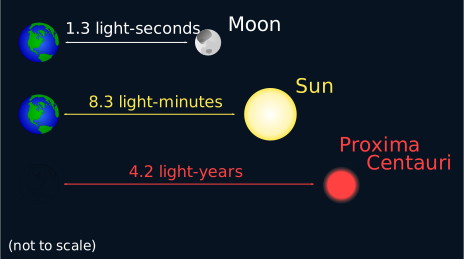
For example, stating that the nearest star system, Alpha Centauri, is about 4.37 light-years away conveys both the distance and the time it takes for its light to reach Earth, enriching our understanding of spatial and temporal scales in the cosmos.
Educational and Cultural Importance
The concept of a light-year plays a significant role in science education and public engagement with astronomy. It provides a relatable framework for discussing the universe’s enormity and the nature of light travel, making abstract cosmic distances more tangible.
Visual aids, such as diagrams showing how far light travels in a year or comparisons with familiar distances like the Earth-Moon gap, help learners internalize the scale. Additionally, analogies involving spacecraft travel times further ground the concept in everyday experience.
Common Misunderstandings About Light-Years
- Misconception: A light-year is a measure of time.
Correction: Despite the word “year,” a light-year quantifies distance-the length light travels in one year. - Misconception: Light-years and parsecs are interchangeable.
Correction: While related, parsecs are based on parallax angles and equal about 3.26 light-years; they represent different measurement methods. - Misconception: Light-years are only relevant in science fiction.
Correction: Light-years are a fundamental scientific unit essential for understanding and describing the universe’s scale.
Why Understanding Light-Years Is Important
Grasping the concept of a light-year is vital for appreciating the scale and history of the cosmos. It bridges spatial and temporal dimensions, allowing us to comprehend not only how far away objects are but also how far back in time we are observing them. This insight is foundational in astronomy, astrophysics, and cosmology, shaping our knowledge of the universe’s structure and evolution.
Moreover, clarifying the nature of light-years enhances scientific literacy, enabling individuals to critically evaluate information encountered in media, education, and popular culture, where the term is sometimes misused or misunderstood.
FAQ
What is a light-year?
A light-year is a unit of distance that defines how far light travels in one year, approximately 9.46 trillion kilometers.
Why is a light-year not a measure of time?
Despite the term ‘year’, a light-year quantifies distance, specifically the distance light travels in one year.
How does a light-year relate to astronomical distances?
Astronomers use light-years to express the vast distances between celestial objects, making it easier to understand cosmic scales.




Leave a Reply