

Short Answer
Understanding Consciousness and Thought
The investigation into consciousness and the nature of thought lies at the crossroads of philosophy, neuroscience, and physics. Central to this inquiry is a profound puzzle: if humans are fundamentally composed of atoms, how do these basic particles give rise to complex mental activities such as thinking, reflection, and cognition? This article explores the intricate relationships and mechanisms that enable consciousness to emerge from our atomic makeup.
Definition of Consciousness and Thought
Consciousness refers to the state of being aware of oneself and the environment, encompassing sensory experiences, emotions, and higher-order cognitive functions. Thought involves the mental processes that allow for reasoning, problem-solving, and decision-making.
- Consciousness:
The subjective experience of awareness and perception. - Thought:
The cognitive activity involving processing information, forming ideas, and making judgments.
Emergence: From Atoms to Mind
Atoms, the fundamental units of matter, form the basis of all physical structures, including the human brain. However, consciousness cannot be explained solely by the properties of individual atoms. Instead, it arises from emergent properties-complex phenomena that manifest when simpler components interact within a system.
For instance, a single neuron does not possess consciousness or the ability to think. Yet, when billions of neurons interconnect to form neural networks, they collectively generate the capacity for information processing, memory formation, and decision-making. This hierarchical organization illustrates how simple atomic interactions culminate in sophisticated cognitive functions.
Neural Mechanisms Underlying Cognition
The brain operates as a highly complex network of neurons communicating via synapses. Synaptic transmission involves chemical messengers that transmit signals between neurons, enabling the brain to process and respond to information.
- Synaptic Plasticity:
The ability of synapses to strengthen or weaken over time based on activity, which is fundamental to learning and memory. - Neural Networks:
Interconnected neurons that work together to perform cognitive tasks.
This dynamic interplay of neurons and synapses bridges the gap between physical matter and mental processes, illustrating how cognition emerges from biological substrates.
Quantum Foundations and Subatomic Particles
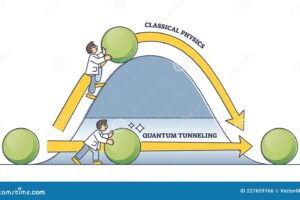
At a deeper level, atoms themselves are composed of subatomic particles such as quarks and gluons, which form protons and neutrons. Quantum mechanics governs the behavior of these particles, introducing elements of probability and uncertainty into the fabric of reality.
This probabilistic nature challenges classical deterministic views and may have implications for concepts like free will, adding complexity to our understanding of thought and consciousness.
Philosophical Perspectives on Mind and Matter
The debate over the nature of consciousness often centers on two main philosophical viewpoints:
- Dualism:
Proposed by René Descartes, dualism posits that the mind and body are distinct entities, with consciousness existing as a non-physical substance separate from the material brain. - Materialism:
This perspective argues that consciousness arises entirely from physical processes within the brain, without any non-material components.
Reconciling these views remains a significant challenge, as it involves bridging the tangible world of atoms with the intangible experience of subjective awareness.
Brain Regions and Cognitive Functions
Consciousness encompasses a spectrum of mental activities, from basic sensory perception to complex reasoning and emotional processing. Different brain areas specialize in these functions:
- Frontal Cortex:
Responsible for executive functions such as planning, decision-making, and problem-solving. - Limbic System:
Plays a key role in regulating emotions and memory.
This functional specialization highlights the sophisticated neural architecture that supports diverse aspects of thought.
Environmental Influence and Embodied Cognition
Cognitive processes are not isolated within the brain but are deeply influenced by interactions with the external environment. The theory of embodied cognition emphasizes that our thinking is shaped by physical experiences and social contexts.
Thus, cognition emerges from a dynamic relationship between the organism and its surroundings, where external stimuli and lived experiences play crucial roles in shaping mental activity.
Artificial Intelligence and the Nature of Thought
The rise of artificial intelligence (AI) and machine learning introduces new dimensions to the study of consciousness. AI systems can simulate human-like problem-solving and behavior, prompting questions about whether machines can truly “think” or possess awareness.
While AI processes data through algorithms, it lacks subjective experience, underscoring the fundamental differences between biological cognition and computational operations. This distinction invites ongoing reflection on what constitutes genuine thought and consciousness.
Why Understanding Consciousness is Important
Exploring how consciousness arises from atomic and molecular structures enriches our comprehension of human nature and cognition. This knowledge has profound implications across multiple fields:
- Neuroscience:
Enhances understanding of brain function and mental health. - Philosophy:
Informs debates on mind-body relationships and personal identity. - Technology:
Guides ethical considerations in AI development and human-computer interaction.
Ultimately, unraveling the mystery of consciousness helps illuminate the essence of what it means to be human-a remarkable fusion of elemental matter and complex mental phenomena.
FAQ
What is consciousness?
Consciousness is the state of being aware of oneself and the environment, encompassing sensory experiences and cognitive functions.
How do atoms relate to thought?
Atoms interact to form complex neural networks in the brain, which enable cognitive functions such as thinking and decision-making.
What is the significance of emergent properties?
Emergent properties arise when simpler components interact, leading to complex phenomena like consciousness that cannot be explained by individual components alone.




Leave a Reply