
Short Answer
Definition of the Big Bang and Its Role in Spacetime and Gravity
The Big Bang theory describes the origin of our universe as a monumental event that not only generated matter and energy but also established the fundamental framework of spacetime and gravity. This initial explosion marks the beginning of the cosmos, setting into motion the physical laws and structures that govern everything we observe today.
Formation of Spacetime at the Universe’s Dawn
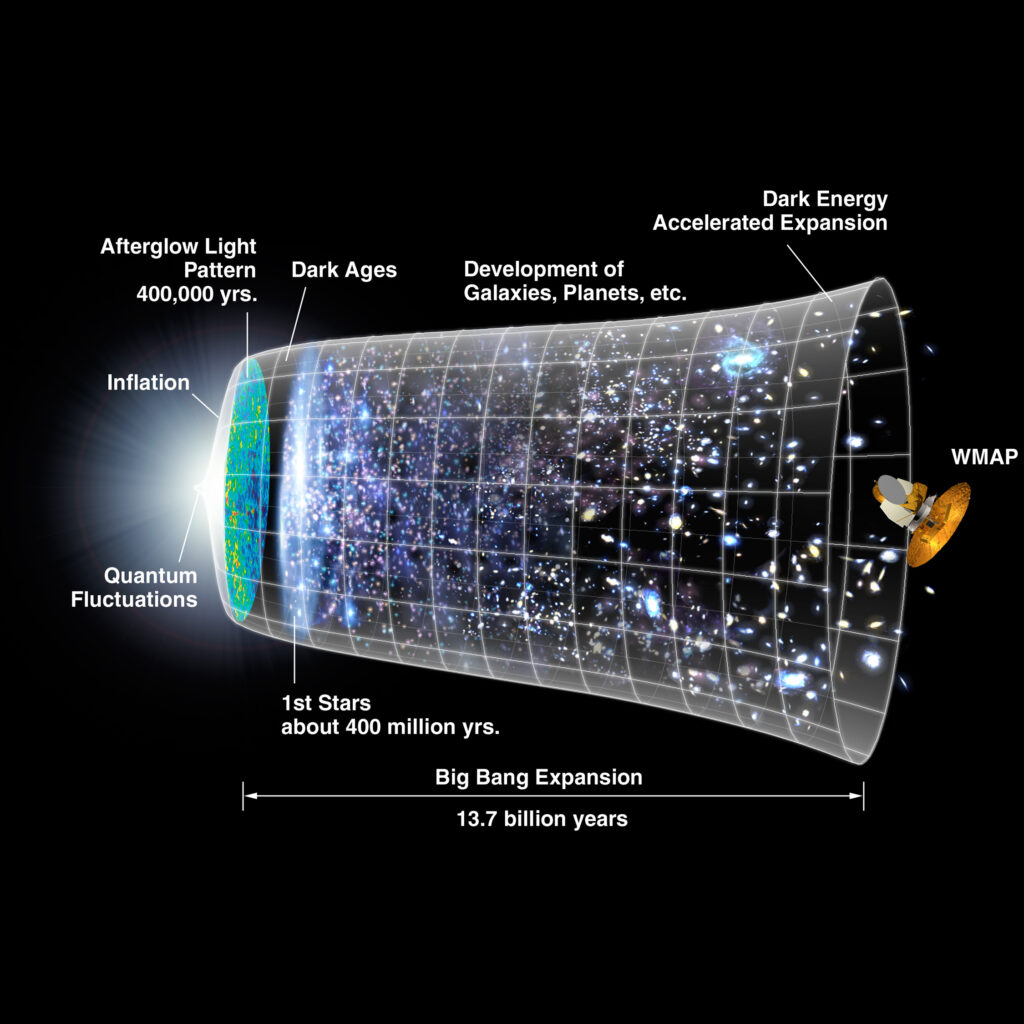
At the very start of the Big Bang, traditional concepts of space and time cease to apply, converging into a singularity characterized by infinite density and temperature. It is within this singularity that the fabric of spacetime-comprising three spatial dimensions and one temporal dimension-was first formed. Prior to this event, spacetime as a distinct entity did not exist. The Big Bang triggered a rapid inflationary phase, an extraordinary expansion that stretched space and allowed time to progress, transitioning the universe from a quantum gravitational state to the large-scale spacetime geometry described by Einstein’s theory of general relativity.
Dimensions of Spacetime and Cosmic Structure
The four-dimensional nature of spacetime began to differentiate immediately after the Big Bang, creating the structural foundation for all physical phenomena. The cosmic microwave background radiation, remarkably uniform across the sky, serves as evidence of this early homogeneity. Minute quantum fluctuations present during this epoch acted as the primordial seeds for the formation of large-scale cosmic structures such as galaxies, clusters, and filaments, linking quantum-scale irregularities to the vast architecture of the universe.
Gravity’s Emergence and Influence in the Early Universe
Gravity arose as a fundamental force shaping the universe’s evolution. Unlike the classical Newtonian view of gravity as a force, Einstein’s general relativity interprets gravity as the curvature of spacetime caused by mass and energy. In the extreme conditions immediately following the Big Bang, gravity exhibited behaviors that challenge current understanding, influenced by an exotic state of matter-energy where gravitational interactions were closely connected with other fundamental forces, as predicted by grand unification theories.
Interconnection Between Spacetime and Gravity
The relationship between spacetime and gravity is deeply intertwined. Gravity sculpts the curvature of spacetime, determining the trajectories of matter and light. Initially, this curvature was minimal due to the nearly uniform distribution of mass-energy. However, as tiny quantum irregularities grew under gravitational attraction, regions of higher density formed, eventually giving rise to stars, galaxies, and larger cosmic structures. This process of gravitational clustering drives cosmic evolution and links the universe’s fate to the geometry of spacetime.
The Inflationary Epoch and Primordial Gravitational Waves
Shortly after the Big Bang, the universe underwent an inflationary period-a brief but critical phase of exponential expansion. This rapid stretching of spacetime also generated gravitational waves, ripples propagating through the cosmic fabric. These primordial gravitational waves carry invaluable information about the universe’s earliest moments, revealing energy scales and interactions beyond the reach of conventional astrophysical observations. Detecting these waves remains a key objective in contemporary cosmology.
Cosmic Horizon and the Universe’s Geometry
The synthesis of spacetime and gravity also explains important cosmological concepts such as the cosmic horizon and the universe’s overall shape. The cosmic horizon defines the maximum distance light has traveled since the Big Bang, setting the limits of the observable universe. The curvature of spacetime, influenced by gravitational dynamics, determines whether the universe is open, closed, or flat, which in turn affects its long-term evolution. Current evidence points to a nearly flat universe, suggesting a precise balance between its density and expansion rate.
Quantum Gravity and Theoretical Perspectives on Spacetime
Modern theories like quantum gravity and string theory explore the origins and nature of spacetime beyond classical descriptions. Concepts such as spacetime foam, additional spatial dimensions, and quantum entanglement propose that spacetime and gravity emerge from more fundamental, pre-geometric entities. These advanced frameworks aim to unify gravity with quantum mechanics, offering a comprehensive explanation that begins at the Big Bang and extends across all cosmic scales.
Significance of Understanding Spacetime and Gravity from the Big Bang
Grasping how the Big Bang gave rise to spacetime and gravity is crucial not only for astrophysics but also for addressing profound questions about the universe’s birth, development, and ultimate fate. The integration of observational data-from measurements of the cosmic microwave background to gravitational wave detections-with theoretical progress continues to enhance our understanding of these fundamental phenomena.
Conclusion: The Enduring Legacy of Spacetime and Gravity in Cosmology
As the universe expands and evolves, the intertwined story of spacetime and gravity, initiated in the earliest moments of the Big Bang, remains central to modern physics and cosmology. This narrative, enriched by empirical discoveries and theoretical insights, provides a deep understanding of the origins of reality and the forces that govern all existence.
FAQ
What is the Big Bang?
The Big Bang is the leading explanation for the origin of the universe, describing an event that created space, time, and all matter.
How does the Big Bang relate to spacetime?
The Big Bang established the fabric of spacetime, with three spatial dimensions and one temporal dimension emerging from a singularity.
What role does gravity play in the universe's evolution?
Gravity shapes the curvature of spacetime, influencing the formation of cosmic structures and the evolution of the universe.


Leave a Reply