
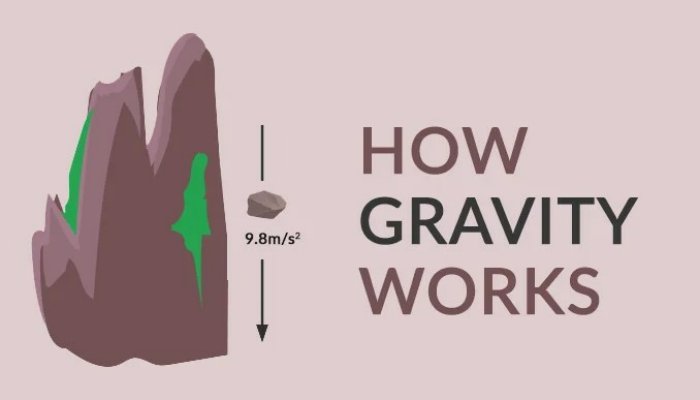
Short Answer
Definition of Gravity Beyond Directional Terms
Gravity is a fundamental interaction that governs the behavior of matter and energy throughout the universe. Rather than being a mere force pulling objects “down,” gravity is best understood as the influence that mass exerts on the fabric of spacetime, causing it to curve. This curvature shapes the motion of objects, guiding them along natural paths without invoking familiar directional concepts like “up” or “down.”
- Mass and Spacetime:
Every object with mass distorts the surrounding spacetime, creating a geometric deformation that affects how other objects move. - Geodesics:
Objects travel along geodesics, which are the shortest or most natural routes in curved spacetime, rather than being pulled by a force in a specific direction.
Conceptual Framework: Moving Beyond “Up” and “Down”
Our everyday experiences condition us to think of gravity in terms of vertical directions-“up” and “down”-because of Earth’s dominant gravitational influence. However, these notions are context-dependent and lose meaning in environments without a fixed gravitational center, such as deep space. In such settings, gravity is not a directional force but a relational property emerging from the interaction between masses and the geometry of spacetime.
- Terrestrial Orientation:
On Earth, gravity creates a consistent “downward” pull toward the planet’s center, shaping our perception of verticality. - Weightlessness in Orbit:
Astronauts experience weightlessness not due to the absence of gravity, but because they are in free fall along curved spacetime paths, eliminating a fixed “down.”
Einstein’s General Relativity: The Geometric Nature of Gravity
Albert Einstein revolutionized our understanding of gravity by introducing the general theory of relativity, which describes gravity not as a force but as the curvature of spacetime caused by mass and energy. This framework replaces Newton’s concept of a force acting at a distance with a geometric interpretation.
- Spacetime Curvature:
Mass and energy determine the shape of spacetime, and this curvature dictates how objects move. - Free Fall and Geodesics:
Objects in free fall follow geodesics, experiencing no force but moving along the straightest possible paths in curved spacetime.
Gravity’s Influence Across Different Scales
Gravity’s effects vary depending on the scale and distribution of mass. On Earth, the nearly spherical shape of the planet creates a familiar gravitational environment. However, in more complex systems or at cosmic scales, gravity’s role becomes multifaceted and less intuitive.
- Local Effects:
Earth’s mass shapes the local curvature of spacetime, producing the sensation of weight and vertical orientation. - Complex Mass Distributions:
When multiple massive bodies interact, gravitational directions become intertwined, and simple “up” or “down” concepts no longer apply. - Cosmic Scale:
Galaxies, stars, and clusters interact through gravity, creating a vast cosmic web where gravity manifests as a pervasive curvature affecting matter and light.
Gravitational Phenomena in Space
Gravity’s geometric nature explains several phenomena observed in space, highlighting its role beyond a simple force.
- Orbital Motion:
Satellites and planets orbit massive bodies by following geodesics in curved spacetime, not because they are pulled “down.” - Gravitational Lensing:
Light bends around massive objects due to spacetime curvature, producing lensing effects that reveal gravity’s influence on photons. - Time Dilation:
Near massive bodies, time slows relative to regions farther away, a direct consequence of gravitational curvature affecting the flow of time.
Mathematical Framework: Gravity and Spacetime Geometry
General relativity mathematically formulates gravity through Einstein’s field equations, which relate the geometry of spacetime to the energy and momentum of matter and radiation.
- Einstein Field Equations:
( G_{munu} + Lambda g_{munu} = frac{8pi G}{c^4} T_{munu} )
Where ( G_{munu} ) is the Einstein tensor describing spacetime curvature, ( Lambda ) is the cosmological constant, ( g_{munu} ) is the metric tensor, ( T_{munu} ) is the stress-energy tensor, ( G ) is the gravitational constant, and ( c ) is the speed of light. - Geodesic Equation:
( frac{d^2 x^mu}{d tau^2} + Gamma^mu_{alphabeta} frac{d x^alpha}{d tau} frac{d x^beta}{d tau} = 0 )
Describes the motion of particles along geodesics, where ( Gamma^mu_{alphabeta} ) are Christoffel symbols representing spacetime connection coefficients.
Common Misconceptions About Gravity
Gravity is a force pulling objects downward.
Gravity is the curvature of spacetime caused by mass, guiding objects along geodesics without a directional pull.
Weightlessness means absence of gravity.
Weightlessness occurs during free fall in curved spacetime, where gravity is still present but no normal force is felt.
“Up” and “down” are universal directions.
These directions depend on local gravitational fields and lose meaning in the absence of a dominant mass.
Significance of Understanding Gravity Without Directional Bias
Reconceptualizing gravity beyond the simplistic notions of “up” and “down” enriches our comprehension of the universe’s structure and dynamics. This perspective is crucial for advancing physics, astronomy, and cosmology, as it aligns with the reality of how spacetime and matter interact on all scales.
- Scientific Insight:
Enables accurate modeling of celestial mechanics, black holes, and cosmological phenomena. - Technological Applications:
Essential for satellite navigation, GPS accuracy, and space exploration missions. - Philosophical Impact:
Challenges anthropocentric views, positioning humanity as participants in a vast, curved spacetime continuum rather than at a fixed center.
Conclusion: Embracing Gravity as Spacetime Curvature
Viewing gravity without the constraints of “up” or “down” invites a profound shift in understanding. It reveals gravity as an elegant geometric property of the universe, shaping the paths of matter and the flow of time itself. This conceptual evolution not only deepens scientific knowledge but also inspires a broader appreciation of our place within the cosmic fabric.
FAQ
What is gravity?
Gravity is the curvature of spacetime caused by mass, influencing the motion of objects.
How does gravity work in space?
In space, gravity acts as a relational property between masses, guiding objects along geodesics without a fixed 'up' or 'down.'
What is weightlessness?
Weightlessness occurs during free fall, where objects experience no normal force, but gravity is still present.


Leave a Reply