
Short Answer
Definition of Nonlinear Optics
Nonlinear optics is a specialized branch of optics that investigates how light interacts with materials when the response of the medium deviates from a simple proportional relationship with the light’s electric field. Unlike linear optics, where the medium’s properties remain constant regardless of light intensity, nonlinear optics explores phenomena that arise when intense light alters the medium’s refractive index or induces new frequencies. This field is essential for advancing both theoretical physics and practical optical technologies.
- Linear vs. Nonlinear Response:
In linear optics, the polarization of a material is directly proportional to the electric field of the light. In nonlinear optics, this proportionality breaks down at high intensities, leading to complex interactions. - Key Phenomena:
Effects such as harmonic generation, self-focusing, and the Kerr effect are hallmark nonlinear optical processes.
Fundamental Principles and Theoretical Background
The foundation of nonlinear optics lies in classical electromagnetism combined with quantum mechanical insights. While linear optics assumes a constant refractive index, nonlinear optics recognizes that the refractive index can vary with light intensity, leading to a host of new behaviors. Mastery of vector field theory and wave propagation is crucial to understanding these effects.
Mathematically, nonlinear optics extends Maxwell’s equations by incorporating nonlinear polarization terms. These additions complicate the equations, often requiring sophisticated analytical and numerical methods to solve. The nonlinear Schrödinger equation is a central tool used to describe the evolution of light pulses in nonlinear media, capturing phenomena such as soliton formation and modulation instability.
Mathematical Framework and Key Equations
The mathematical description of nonlinear optics involves nonlinear differential equations that model the interaction between light and matter. A primary example is the nonlinear Schrödinger equation:
i∂ψ/∂z + (1/2)β₂∂²ψ/∂t² + γ|ψ|²ψ = 0
- ψ: The complex envelope of the electric field
- z: Propagation distance
- t: Time in a frame moving with the pulse
- β₂: Group velocity dispersion parameter
- γ: Nonlinear coefficient related to the medium’s response
This equation models how the pulse shape evolves due to dispersion and nonlinear effects, enabling predictions of phenomena like self-phase modulation and soliton propagation.
Experimental Challenges in Nonlinear Optics
Conducting experiments in nonlinear optics involves overcoming significant technical hurdles. High-intensity laser sources are required to induce nonlinear effects, which demand careful handling due to safety and stability concerns. Precise alignment of optical components and control over environmental variables such as temperature and vibration are critical for reproducible results.
Advanced diagnostic tools, including time-resolved spectroscopy and frequency-resolved optical gating, are often employed to capture the ultrafast dynamics of nonlinear interactions. These techniques require expertise in both instrumentation and data interpretation, adding layers of complexity to experimental work.
Prominent Nonlinear Optical Phenomena
Nonlinear optics encompasses a variety of distinct effects, each with unique theoretical and practical considerations:
- Second-Harmonic Generation (SHG):
The process of converting photons from one frequency to twice that frequency, requiring precise phase matching within nonlinear crystals. - Self-Phase Modulation (SPM):
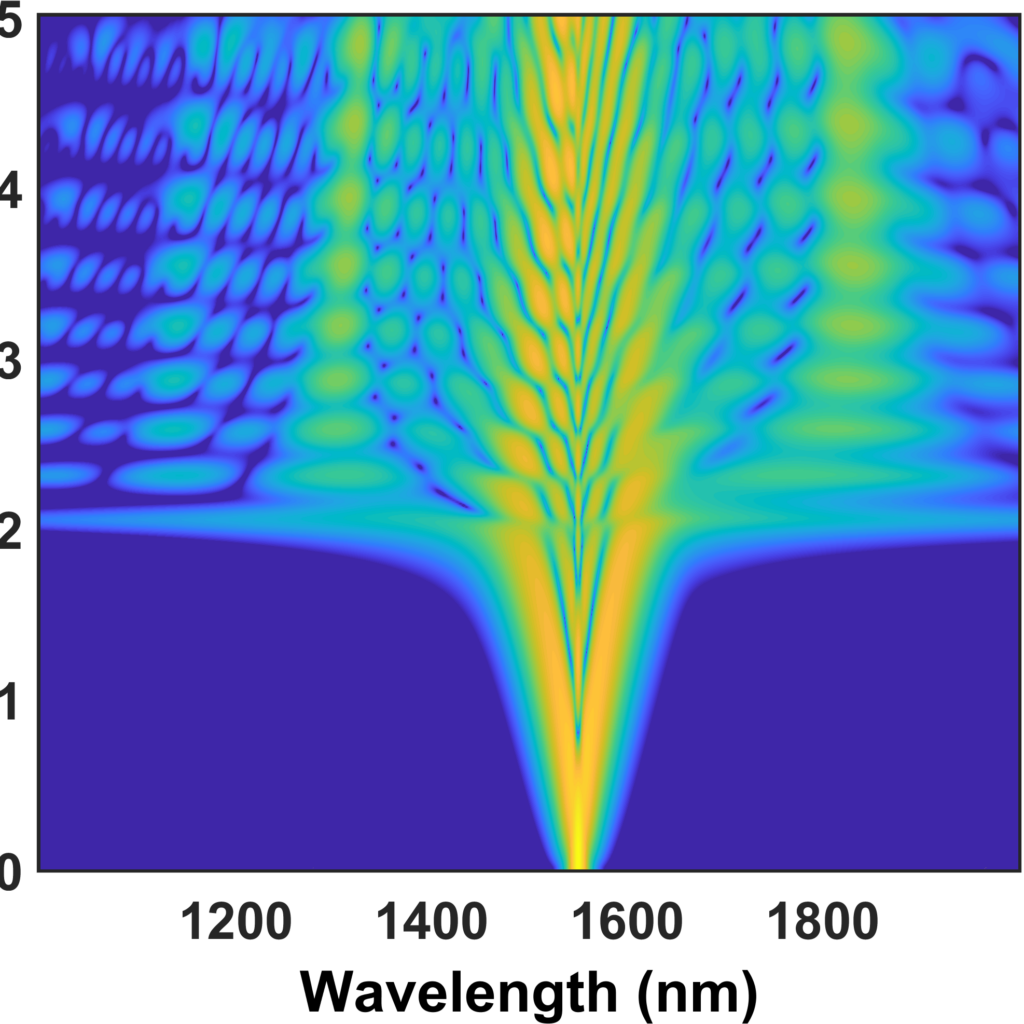
A phenomenon where the phase of a light pulse is modulated by its own intensity, leading to spectral broadening. - Four-Wave Mixing (FWM):
An interaction where three waves combine to generate a fourth wave, useful in wavelength conversion and signal processing.
Applications and Technological Impact
Nonlinear optics plays a vital role in numerous cutting-edge technologies and scientific fields. In telecommunications, nonlinear effects enable soliton-based data transmission, enhancing signal integrity over long distances. Medical imaging benefits from nonlinear contrast agents that improve resolution and specificity.
Other applications include:
- Material Processing:
High-power lasers utilizing nonlinear effects for precision cutting and fabrication. - Metrology:
Frequency combs generated through nonlinear processes provide ultra-precise measurements of time and distance. - Quantum Information Science:
Nonlinear optics facilitates photon-pair generation, crucial for secure quantum communication and advanced computational protocols.
Emerging Trends and Research Directions
The field of nonlinear optics is rapidly evolving, with new frontiers such as topological photonics and quantum nonlinear optics reshaping traditional understanding. These areas explore how topological states of light and quantum effects can be harnessed to create novel devices and systems, pushing the boundaries of what is achievable with light-matter interactions.
Common Misconceptions About Nonlinear Optics
Nonlinear optics is just an extension of linear optics with minor adjustments.
Nonlinear optics introduces fundamentally different behaviors and requires entirely new theoretical and experimental approaches.
Nonlinear effects occur at any light intensity.
Nonlinear phenomena typically manifest only at high light intensities, often necessitating specialized laser sources.
Significance of Nonlinear Optics
The importance of nonlinear optics extends beyond academic curiosity, influencing a broad spectrum of scientific and technological domains. By enabling control over light in ways impossible under linear assumptions, it opens pathways to innovations in communication, imaging, and quantum technologies. Understanding and mastering nonlinear optical principles is therefore crucial for advancing modern photonics and related disciplines.
FAQ
What is nonlinear optics?
Nonlinear optics is the study of how light interacts with materials in ways that are not proportional to the intensity of the light, leading to complex behaviors and applications.
What are some key applications of nonlinear optics?
Applications include telecommunications, medical imaging, material processing, and quantum information science.





Leave a Reply