
Short Answer
Definition of Proton Spin
Proton spin refers to an intrinsic form of angular momentum inherent to protons, fundamental particles residing in the nucleus of atoms. Unlike classical spinning objects, proton spin is a quantum mechanical property that manifests as a magnetic moment, enabling protons to behave like tiny magnets. This spin can exist in one of two discrete orientations, commonly labeled as “spin-up” or “spin-down,” which are essential to the behavior of particles at the quantum scale.
- Intrinsic Angular Momentum:
Proton spin is a built-in quantum characteristic, not caused by physical rotation but by the particle’s quantum nature. - Magnetic Moment:
The spin generates a magnetic field, making protons responsive to external magnetic influences. - Binary Spin States:
Protons can occupy one of two spin states, forming the basis for quantum bit (qubit) representation.
Quantum Mechanical Principles Behind Proton Spin
Proton spin is governed by the principles of quantum mechanics, including superposition and entanglement. Unlike classical objects, a proton’s spin state can exist simultaneously in multiple configurations until measured, a phenomenon known as superposition. This leads to fundamental questions about the nature of reality, as the spin state is not definitively determined until observation collapses the superposition into a specific state.
- Superposition:
Protons can be in a combination of spin-up and spin-down states simultaneously. - Measurement Collapse:
Observing the spin forces the proton into one definite state, highlighting the observer’s role in quantum systems. - Entanglement:
Proton spins can become linked with other particles, influencing each other instantaneously over distances.
Techniques for Manipulating Proton Spins
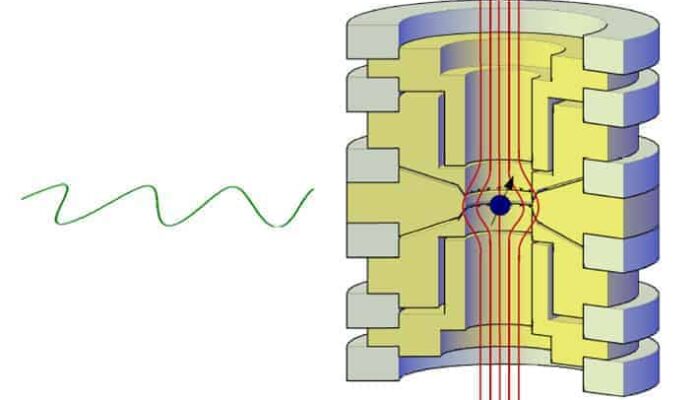
Advances in experimental physics have enabled precise control over proton spins, primarily through nuclear magnetic resonance (NMR) and related resonance techniques. When exposed to an external magnetic field, the spin orientation of a proton can be flipped or aligned by applying specific frequencies of electromagnetic radiation. This ability to manipulate spins at the atomic level has profound implications for both scientific research and practical applications.
- Nuclear Magnetic Resonance (NMR):
Uses magnetic fields and radio waves to alter proton spin states, foundational for imaging and spectroscopy. - Spin Flipping:
Controlled inversion of proton spin from up to down or vice versa, enabling quantum state manipulation. - Atomic-Level Imaging:
Techniques that visualize and control individual proton spins with high precision.
Role of Proton Spin in Quantum Computing
Proton spin manipulation is central to the development of quantum computing, where quantum bits or qubits exploit superposition to represent both 0 and 1 simultaneously. Unlike classical bits, which are strictly binary, qubits enable exponentially faster processing for certain computational tasks. The ability to flip proton spins extends quantum coherence times, which is critical for maintaining qubit stability and reducing errors in quantum circuits.
- Qubits:
Quantum bits that utilize proton spin states to encode information in superposition. - Quantum Coherence:
The duration over which qubits maintain their quantum state, essential for reliable computation. - Error Correction:
Improved coherence times facilitate advanced error correction techniques, enhancing quantum processor performance.
Philosophical and Conceptual Implications of Spin Flipping
The phenomenon of flipping proton spins transcends physical mechanics, touching on deep philosophical questions about the nature of information, observation, and reality. The act of measurement in quantum mechanics not only determines the spin state but also challenges classical notions of objective reality. This interplay between observer and system has sparked extensive debate regarding the role of consciousness and the fundamental structure of the universe.
- Observer Effect:
Measurement influences the quantum state, collapsing superpositions into definite outcomes. - Duality and Dichotomy:
Spin flipping exemplifies contrasts such as certainty versus uncertainty and control versus randomness. - Quantum Reality:
Raises questions about whether quantum states exist independently of observation.
Analogies and Broader Quantum Concepts
The concept of proton spin flipping can be likened to other quantum dualities, such as the wave-particle duality of light. Just as light exhibits both wave-like and particle-like properties, proton spins embody dual states that reflect the complex and often paradoxical nature of quantum phenomena. These analogies help contextualize the abstract principles of quantum mechanics within more familiar frameworks.
- Wave-Particle Duality:
Light’s dual nature parallels the binary spin states of protons. - Quantum Dichotomies:
Spin flipping illustrates fundamental oppositions inherent in quantum systems. - Conceptual Frameworks:
Analogies aid in understanding the non-intuitive aspects of quantum behavior.
Applications in Medical Imaging and Material Science
Manipulating proton spins has significant practical applications, especially in medical diagnostics through magnetic resonance imaging (MRI). The magnetic properties of proton spins enable non-invasive visualization of soft tissues, providing critical information for clinical assessments. Emerging technologies that refine spin manipulation at the individual proton level promise to enhance imaging resolution and diagnostic accuracy. Additionally, these techniques contribute to material science by revealing atomic-scale properties of substances.
- Magnetic Resonance Imaging (MRI):
Utilizes proton spin alignment to generate detailed images of biological tissues. - Enhanced Imaging Techniques:
Advanced spin control could improve resolution and diagnostic capabilities. - Material Characterization:
Spin manipulation aids in understanding structural and magnetic properties of materials.
Significance and Future Prospects
The exploration of proton spin flipping extends beyond theoretical physics, influencing technological innovation and philosophical inquiry. As research progresses, the ability to control and understand proton spins will drive advancements in quantum computing, medical imaging, and fundamental science. This expanding knowledge base not only deepens our grasp of the quantum world but also paves the way for transformative applications that could redefine multiple fields.
In summary, the study of proton spin and its manipulation represents a critical frontier in modern physics, bridging abstract quantum concepts with tangible technological breakthroughs. The ongoing investigation into this phenomenon promises to unlock new dimensions of understanding and capability, marking a pivotal chapter in the evolution of science and technology.
FAQ
What is proton spin?
Proton spin refers to an intrinsic form of angular momentum inherent to protons, functioning as a quantum mechanical property that manifests as a magnetic moment.
How does proton spin relate to quantum computing?
Proton spin manipulation is crucial for quantum computing as it allows for the creation of qubits that can represent both 0 and 1 simultaneously.





Leave a Reply