
Short Answer
Definition of Matter and Antimatter
Matter constitutes the physical substance that forms the observable universe, composed of particles such as protons, neutrons, and electrons. Antimatter, its counterpart, consists of particles with identical mass but opposite electric charges and quantum numbers. This fundamental opposition creates a fascinating duality central to modern physics.
- Matter:
Made up of atoms formed by positively charged protons, neutral neutrons, and negatively charged electrons. - Antimatter:
Composed of antiparticles like antiprotons (negatively charged) and positrons (positively charged electrons), which combine to form antimatter atoms analogous to ordinary atoms but with reversed charges.
Intrinsic Properties and Structure
Atoms of matter and antimatter share structural similarities but differ in charge orientation. For example, a hydrogen atom consists of a proton and an electron, whereas its antimatter equivalent, antihydrogen, contains an antiproton and a positron. Despite their mirrored composition, these particles exhibit opposite electrical charges, which is a defining characteristic distinguishing matter from antimatter.
Mechanism of Matter-Antimatter Interaction
When matter and antimatter particles meet, they undergo a process called annihilation. This interaction converts their mass into energy, releasing photons, often in the form of gamma rays. The energy output from this annihilation is described by Einstein’s mass-energy equivalence formula, E=mc², highlighting the immense energy potential locked within even small amounts of antimatter.
Mathematical Explanation: Energy from Annihilation
The energy released during matter-antimatter annihilation can be quantified by the equation:
E = mc²
- E: Energy produced (joules)
- m: Mass of matter and antimatter annihilated (kilograms)
- c: Speed of light in vacuum (~3 × 10⁸ meters/second)
This formula illustrates that even a tiny mass can yield a tremendous amount of energy, making antimatter a potent energy source in theory.
Asymmetry in the Universe: The Matter-Antimatter Imbalance
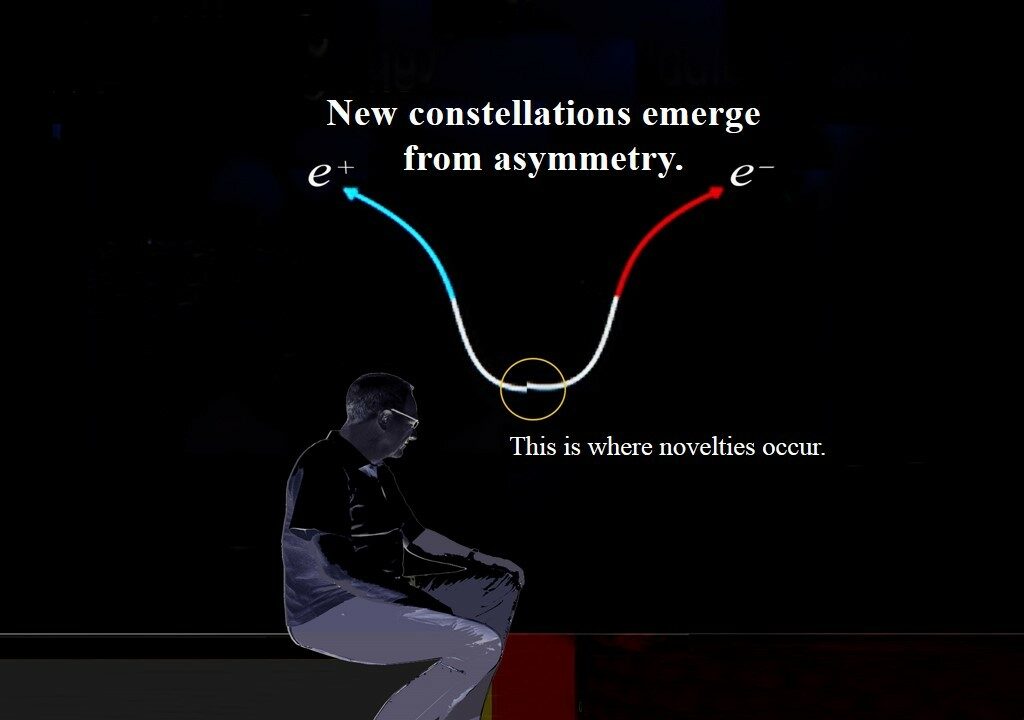
One of the most profound puzzles in cosmology is why the universe is predominantly composed of matter despite the theoretical expectation of equal amounts of matter and antimatter after the Big Bang. This discrepancy is studied under the concept of baryogenesis, which explores mechanisms that could have favored matter over antimatter.
- CP Violation:
A phenomenon where certain particle interactions violate charge-parity symmetry, potentially explaining why matter was produced in excess during the early universe. - Experimental Research:
Facilities like CERN conduct experiments to investigate these asymmetries, testing the limits of the Standard Model and searching for new physics.
Cosmological Significance and Search for Antimatter
The dominance of matter shapes the large-scale structure and evolution of the cosmos. If significant antimatter regions existed, their interactions with matter would produce detectable gamma-ray signatures. Despite extensive astronomical surveys, direct evidence of large antimatter concentrations remains elusive, fueling ongoing research into the universe’s composition and origins.
Practical Applications of Antimatter
Beyond theoretical interest, antimatter has found practical use in medical imaging, particularly in positron emission tomography (PET). This technique utilizes positrons emitted by radioactive tracers; when these positrons annihilate with electrons in the body, gamma rays are emitted and detected to create detailed images of metabolic activity.
Production and Containment Challenges
Antimatter is produced artificially in particle accelerators and certain nuclear reactions but exists only fleetingly on Earth due to rapid annihilation upon contact with matter. Containment requires sophisticated methods such as magnetic traps in ultra-high vacuum environments to prevent contact with ordinary matter, enabling detailed study of antimatter’s properties.
Economic and Technological Considerations
The generation of antimatter is currently prohibitively expensive, limiting its availability and practical applications. However, ongoing advancements in accelerator technology and containment methods may reduce costs, potentially unlocking new scientific and technological opportunities.
Future Prospects: Antimatter in Space Exploration
Antimatter’s immense energy density presents a promising avenue for propulsion in deep-space missions. Harnessing matter-antimatter annihilation could revolutionize spacecraft propulsion, drastically reducing travel times to distant celestial bodies. Nonetheless, significant technical and safety challenges remain before such applications become feasible.
Summary: The Importance of Understanding Matter and Antimatter
The study of matter and antimatter reveals fundamental insights into the nature of the universe, from particle physics to cosmology. Their contrasting properties and interactions not only deepen our comprehension of the cosmos but also inspire innovative technologies in medicine and space travel. As research continues, unraveling the mysteries of this duality remains a central quest in modern science.
FAQ
What is matter?
Matter is the physical substance that makes up the observable universe, consisting of particles like protons, neutrons, and electrons.
What is antimatter?
Antimatter is composed of antiparticles, which have the same mass as particles of matter but opposite electric charges.
What happens when matter and antimatter meet?
They undergo annihilation, converting their mass into energy, often producing gamma rays.
Why is there more matter than antimatter in the universe?
This imbalance is a key question in cosmology, studied under baryogenesis and CP violation.
How is antimatter used in medicine?
Antimatter is used in positron emission tomography (PET) for medical imaging.



Leave a Reply