
Short Answer
Definition of Cosmic Texture
Cosmic texture refers to the subtle irregularities or variations in the fabric of spacetime during the universe’s earliest moments. Rather than being perfectly smooth and uniform, the primordial universe may have exhibited a complex pattern of fluctuations and distortions. These variations are thought to have played a crucial role in shaping the large-scale structure of the cosmos as we observe it today.
- Primordial Texture:
The initial unevenness in energy density and spacetime geometry shortly after the Big Bang. - Topological Defects:
Imperfections such as cosmic strings or monopoles that could arise from phase transitions in the early universe, contributing to its textured nature.
Origins of Texture in the Early Universe
The early universe underwent a rapid expansion phase known as inflation, driven by a hypothetical inflaton field. This process generated quantum fluctuations-minute variations in energy density-that seeded the texture of spacetime. These fluctuations can be likened to ripples formed when a pebble disturbs a calm pond, representing the initial perturbations that later evolved into galaxies, clusters, and cosmic voids.
Following inflation, the universe cooled and transitioned through various phases, potentially leading to the formation of topological defects. These defects are analogous to imperfections in a crystal as it solidifies, manifesting as cosmic strings, monopoles, or domain walls that disrupted the otherwise smooth cosmic fabric.
Cosmic Microwave Background as a Window into Texture
The cosmic microwave background (CMB) radiation offers a snapshot of the universe approximately 380,000 years after the Big Bang. This relic radiation contains tiny temperature fluctuations that correspond to the primordial density variations-essentially the texture imprinted on the early universe. By analyzing these minute anisotropies, scientists gain insight into the initial conditions and the degree of irregularity present in the early cosmos.
Topological Defects and Their Role
During the cooling of the early universe, phase transitions may have produced topological defects-localized disruptions in the field configurations. These defects include:
- Cosmic Strings:
One-dimensional defects resembling thin tubes of energy that could influence matter distribution and gravitational fields. - Monopoles:
Hypothetical point-like defects carrying magnetic charge, predicted by certain grand unified theories. - Domain Walls:
Two-dimensional defects acting as boundaries between regions of differing field orientations.
The presence of such defects could have significantly impacted cosmic evolution, affecting the formation of structures and possibly altering cosmic ray paths.
Interplay Between Quantum Mechanics and Gravity
The early universe existed under extreme conditions where quantum effects and gravitational forces were deeply intertwined. Quantum fluctuations in the inflaton field, governed by quantum field theory, interacted with the curvature of spacetime described by general relativity. This complex relationship shaped the universe’s texture and remains a key area of research in theoretical physics, highlighting the challenges in unifying these fundamental forces.
Scientific Significance of Cosmic Texture
Understanding the texture of the early universe is vital for refining cosmological models and theories. It helps constrain parameters within the inflationary framework and informs hypotheses about dark matter and dark energy. Recognizing that the universe’s initial state was not perfectly homogeneous challenges the cosmological principle of isotropy and homogeneity, prompting the development of more nuanced models that accommodate structural variations.
Observational Techniques and Future Prospects
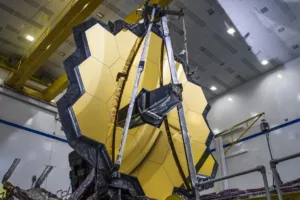
Advancements in observational astronomy and cosmology are enhancing our ability to detect and analyze cosmic texture. Instruments like the James Webb Space Telescope and detailed studies of the CMB through missions such as the Planck satellite employ methods including gravitational lensing and high-resolution temperature mapping. These technologies aim to reveal finer details of the universe’s early irregularities, offering deeper insights into its formative processes.
Philosophical and Cosmological Implications
The study of cosmic texture extends beyond scientific inquiry, touching on profound questions about the nature of existence and the universe’s evolution. The presence of wrinkles in spacetime suggests a dynamic, non-linear progression of cosmic history, where small initial variations can lead to vastly different outcomes. This perspective enriches our understanding of the cosmos as a complex, evolving tapestry rather than a static, uniform expanse.
Summary and Ongoing Exploration
Research into the texture of the early universe continues to inspire interdisciplinary collaboration and theoretical innovation. As new data emerges and analytical techniques improve, our comprehension of the universe’s initial conditions and their impact on cosmic evolution will become increasingly sophisticated. Embracing the concept of a textured early universe invites a richer appreciation of the intricate processes that have shaped the cosmos from its inception to the present day.
FAQ
What are topological defects?
Topological defects are localized disruptions in field configurations, including cosmic strings, monopoles, and domain walls, that arose during phase transitions in the early universe.
Why is the study of cosmic texture important?
Understanding cosmic texture helps refine cosmological models, inform hypotheses about dark matter and dark energy, and challenges the cosmological principle of homogeneity.



Leave a Reply