
Short Answer
Definition of Electron Tunneling
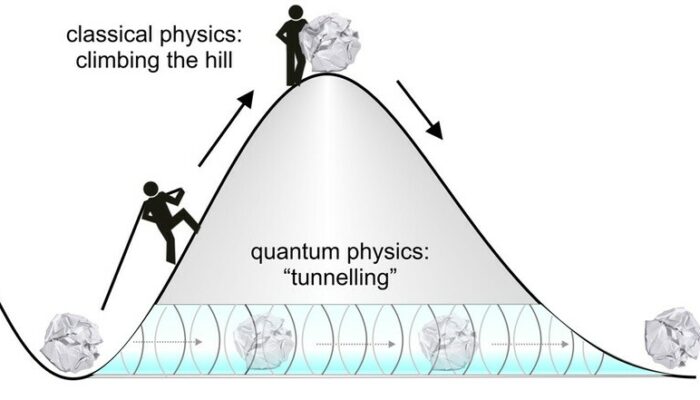
Electron tunneling is a fundamental quantum mechanical phenomenon where particles, such as electrons, pass through energy barriers that they classically should not be able to overcome due to insufficient energy. This counterintuitive effect arises from the wave-like nature of particles at the quantum scale, allowing them to exist with a certain probability on the opposite side of a barrier. Electron tunneling plays a critical role in numerous physical processes and technologies, ranging from nuclear reactions to modern electronics.
- Quantum Barrier Penetration:
Unlike classical particles, electrons can “tunnel” through potential barriers without the need to possess the energy required to climb over them. - Wave-Particle Duality:
The electron’s behavior is described by a wave function, which provides a probabilistic description of its location and enables tunneling.
Historical Background and Theoretical Foundations
The concept of tunneling was first introduced in the 1920s by physicists such as George Gamow, who applied it to explain alpha decay in radioactive nuclei. This discovery marked a pivotal expansion of quantum theory, challenging classical physics and opening new avenues for understanding subatomic phenomena. Over the decades, advancements in experimental methods have brought the direct observation of tunneling within reach, transforming it from a theoretical curiosity into an observable reality.
Mechanism of Electron Tunneling
Electron tunneling occurs due to the probabilistic nature of quantum mechanics. The electron’s wave function extends beyond the confines of a potential barrier, allowing a finite probability that the electron can be detected on the other side. This phenomenon defies classical expectations, which dictate that particles lacking sufficient energy cannot cross barriers. The tunneling probability depends on factors such as the barrier’s width, height, and the electron’s energy.
Mathematical Description of Tunneling
The tunneling process can be quantitatively described using the Schrödinger equation. The probability of tunneling, often expressed as the transmission coefficient ( T ), is given by:
T approx e^{-2 gamma d}
where:
- ( gamma ): Decay constant inside the barrier, defined as ( gamma = frac{sqrt{2m(U – E)}}{hbar} ), with ( m ) being the electron mass, ( U ) the barrier height, ( E ) the electron energy, and ( hbar ) the reduced Planck constant.
- ( d ): Width of the potential barrier.
This exponential dependence illustrates how tunneling probability decreases sharply with increasing barrier width and height.
Techniques for Observing Electron Tunneling
One of the most powerful tools for visualizing electron tunneling is Scanning Tunneling Microscopy (STM). STM employs a conductive tip positioned extremely close to a material’s surface, enabling electrons to tunnel between the tip and the sample. By measuring variations in the tunneling current as the tip scans across the surface, STM produces atomic-scale images and reveals electronic properties.
Enhancements such as time-resolved spectroscopy integrated with STM have allowed scientists to capture the dynamics of tunneling events, providing insights into transient processes and interactions during tunneling.
Factors Influencing Electron Tunneling Dynamics
The rate and characteristics of electron tunneling are influenced by several environmental and material parameters:
- Temperature:
Thermal vibrations can affect tunneling probabilities by modifying the barrier properties. - Barrier Width and Height:
Thicker or higher energy barriers reduce tunneling likelihood exponentially. - Phonon Interactions:
Lattice vibrations (phonons) can assist tunneling by providing additional energy pathways, a process known as phonon-assisted tunneling.
Time Scale and Quantum Coherence in Tunneling
A key question in the study of electron tunneling is whether the process occurs instantaneously or over a finite time interval. Experimental evidence indicates that tunneling happens on extremely short timescales, but it is not instantaneous. The electron’s quantum state evolves as it traverses the barrier, maintaining causality and preventing faster-than-light information transfer.
Moreover, the phenomenon of decoherence-where interactions with the environment cause the collapse of the electron’s wave function-plays a significant role. Decoherence limits the preservation of quantum superposition states during tunneling, influencing the transition from quantum to classical behavior.
Applications in Quantum Technology
Electron tunneling is foundational to the operation of quantum devices, particularly quantum computers. Qubits, the fundamental units of quantum information, often rely on tunneling effects to perform logic operations and maintain coherence. Real-time observation and control of tunneling dynamics can improve qubit stability and reduce errors caused by decoherence, advancing the development of scalable quantum computing systems.
Challenges and Future Directions
Studying electron tunneling presents significant experimental challenges, primarily due to the delicate nature of quantum states and the perturbative effect of measurement. Innovative approaches, such as non-invasive measurement techniques and indirect inference through auxiliary systems, are being developed to overcome these obstacles.
Continued research aims to deepen our understanding of tunneling times, coherence thresholds, and environmental influences, which will not only enrich fundamental physics but also drive technological breakthroughs in nanoelectronics, quantum sensing, and beyond.
Significance of Electron Tunneling
Electron tunneling is a cornerstone of modern quantum mechanics, illustrating the limitations of classical physics and enabling a wide array of scientific and technological advancements. Its study enhances our grasp of the quantum world, informs the design of cutting-edge devices, and underpins innovations in fields such as semiconductor technology, nuclear physics, and quantum information science.
FAQ
What is electron tunneling?
Electron tunneling is a quantum mechanical phenomenon where electrons pass through energy barriers that they classically should not be able to overcome.
What role does electron tunneling play in technology?
Electron tunneling is fundamental to the operation of quantum devices, including quantum computers, where it is used to perform logic operations.





Leave a Reply