Could Hidden Civilizations Exist in Dark Matter?

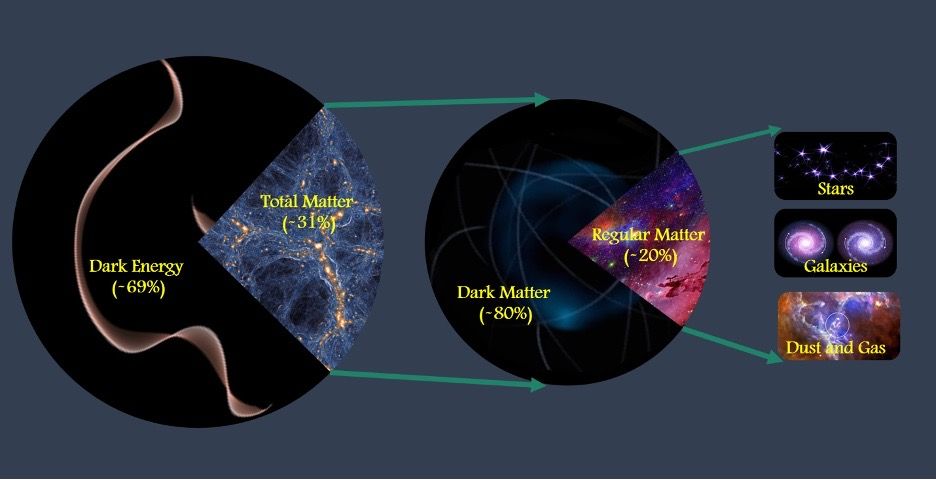
Definition of Dark Matter and Its Cosmic Role Dark matter constitutes an invisible and mysterious component of the universe, accounting for roughly 85% of all matter. Unlike ordinary matter, it neither emits nor absorbs light, making it undetectable through conventional electromagnetic observations. Instead, its presence is inferred from gravitational effects on visible cosmic structures such […]

Read More →

What Happens If Dark Matter Touches Normal Matter?

Definition of Dark Matter Dark matter constitutes a mysterious and invisible component of the universe, serving as an unseen framework upon which the observable cosmos is structured. Unlike ordinary, or baryonic, matter-which includes everything we can see and interact with, such as stars, planets, and living beings-dark matter cannot be detected through electromagnetic radiation. Instead, […]

Read More →

How Particle Colliders Are Hunting Invisible Matter

Understanding Invisible Matter in Particle Physics Particle colliders represent the forefront of contemporary physics research, enabling scientists to investigate the universe’s most fundamental building blocks with extraordinary accuracy. A central focus of these experiments is the pursuit of invisible matter-particles that evade direct observation yet exert significant influence on the structure and evolution of the […]

Read More →

Can We Watch Stars Being Born in Real Time?

Definition of Star Formation Star formation refers to the complex astrophysical process through which dense regions within molecular clouds collapse under gravity to give birth to new stars. These stellar nurseries, composed primarily of gas and dust, serve as the cradles where stars gradually emerge over extensive periods, ranging from thousands to millions of years. […]

Read More →