
Short Answer
Definition of a Neutron Star
A neutron star is an extraordinarily dense stellar remnant formed from the gravitational collapse of a massive star after it has exhausted its nuclear fuel. These compact objects typically measure about 20 kilometers in diameter but contain a mass exceeding that of our Sun. Their extreme density and unique composition make them some of the most fascinating and extreme environments in the cosmos.
Formation and Structure of Neutron Stars
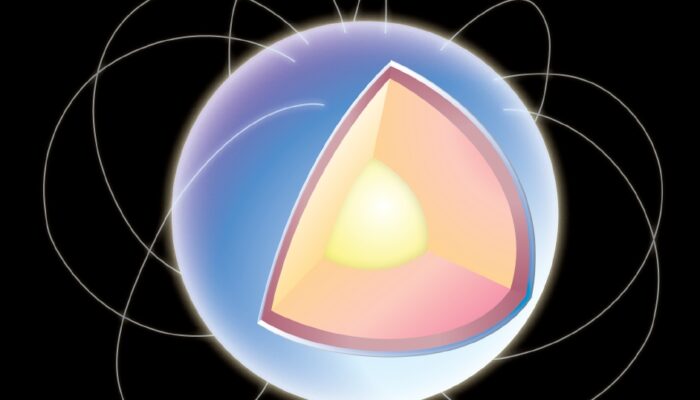
Neutron stars originate from the catastrophic death of massive stars, which undergo supernova explosions. During this process, the star’s core collapses under gravity, compressing matter to densities so high that protons and electrons merge to form neutrons. This transformation results in a compact object with layers of distinct composition and density.
Layered Composition
- Crust:
The outermost layer is a thin crust composed of a lattice of exotic nuclei and free electrons, subjected to immense pressure. - Outer Core:
Beneath the crust, densities increase dramatically, causing electrons and protons to combine into neutrons through neutronization, eliminating conventional atomic structures. - Inner Core:
The deepest region remains largely theoretical, with hypotheses suggesting the presence of exotic matter such as superfluid neutrons, hyperons, or quark-gluon plasma, where quarks exist freely outside of protons and neutrons.
Physical Conditions Inside a Neutron Star
The environment within a neutron star is characterized by extreme gravity, magnetic fields, and radiation. Surface gravity can be approximately 200 billion times that of Earth, creating forces that would instantly obliterate ordinary matter. Additionally, intense radiation and magnetic fields produce conditions utterly hostile to known biological or mechanical systems.
Challenges to Survival Within Neutron Stars
Considering survival inside a neutron star requires confronting the overwhelming physical forces at play. Any conventional matter or life form would be crushed by the immense gravitational pull and destroyed by radiation long before reaching the star’s surface. The extreme density and pressure dismantle atomic and molecular structures, making traditional survival impossible.
Hypothetical Survival Scenarios
While classical survival is implausible, some speculative ideas propose the existence of exotic forms of matter or life that could endure these conditions. For instance, entities composed of neutron-rich matter or strange quark conglomerates might theoretically persist within the star’s interior. These concepts, though currently beyond empirical verification, open intriguing possibilities about the diversity of matter and life in the universe.
Quantum and Relativistic Phenomena in Neutron Stars
Neutron stars are natural laboratories for extreme physics, where quantum mechanics and relativity intersect. Inside, phenomena such as neutron superfluidity and proton superconductivity may occur, indicating that matter exists in phases fundamentally different from those found elsewhere. The intense gravitational field also warps spacetime, influencing particle interactions under relativistic conditions.
Redefining Survival: Beyond Biological Limits
Survival within a neutron star might be better understood not as biological endurance but as the persistence of information or structural integrity within exotic quantum states. If survival encompasses the stability of such states or the existence of exotic matter configurations, it broadens the concept beyond traditional life forms and materials.
Why Survival Inside a Neutron Star Is Physically Implausible
From the standpoint of current scientific knowledge, no known material or technology can withstand the crushing gravity, intense radiation, and extreme density gradients of a neutron star. This reality underscores the delicate balance required for life on Earth and highlights the vast gulf between terrestrial conditions and the universe’s most extreme environments.
Scientific Significance of Neutron Stars
Neutron stars challenge our understanding of physics by pushing known laws to their limits. They serve as cosmic crucibles where theorized states of matter may exist and where the interplay of gravity, quantum mechanics, and relativity can be studied. Exploring these objects expands our knowledge of the universe and stimulates scientific curiosity about the nature of matter and existence.
Common Misconceptions About Neutron Stars and Survival
Neutron stars are simply dense balls of neutrons.
They have a complex, layered structure with varying compositions, including exotic states of matter in their cores.
Some form of life or matter could survive inside a neutron star.
Conventional life and matter cannot survive the extreme gravity, radiation, and density; only hypothetical exotic matter might persist.
Conclusion: The Profound Implications of Survival Questions
The question of whether anything can survive inside a neutron star invites us to explore the boundaries of physics, matter, and existence. While traditional survival is impossible, considering exotic forms of persistence challenges our understanding and expands the horizons of scientific inquiry. Neutron stars thus represent not only physical extremes but also profound opportunities to deepen our grasp of the universe’s complexity and wonder.
FAQ
What is a neutron star?
A neutron star is a compact, dense remnant of a massive star that has undergone a supernova explosion.
Can anything survive inside a neutron star?
No conventional matter or life can survive due to extreme gravity and radiation; only exotic forms of matter might theoretically persist.



Leave a Reply