

Short Answer
Definition of Black Holes
Black holes are extraordinary cosmic phenomena defined by regions in spacetime where gravitational forces are so overwhelmingly strong that nothing, including light, can escape their pull. These enigmatic objects represent some of the most profound mysteries in astrophysics, challenging our understanding of the universe and pushing the boundaries of scientific inquiry. Far from being mere empty voids, black holes are complex entities that distort the fabric of space and time, compelling scientists to explore realms where classical physics intersects with quantum theory.
Formation and Structure
The genesis of black holes is closely tied to the life cycle of massive stars. When such stars exhaust their nuclear fuel, they undergo a catastrophic gravitational collapse, compressing their core into an infinitely dense point known as a singularity. Surrounding this singularity is the event horizon, a critical boundary beyond which escape is impossible. This region marks the limits of conventional physics, necessitating a synthesis of Einstein’s general relativity and quantum mechanics to fully comprehend the phenomena occurring within.
- Singularity:
The core of a black hole where matter is compressed to infinite density. - Event Horizon:
The invisible boundary that marks the point of no return for anything approaching the black hole.
Physical Characteristics and Cosmic Influence
Black holes are often described metaphorically as cosmic abysses, not because they are empty, but because they serve as repositories of immense gravitational influence and information. Their presence warps spacetime, affecting the motion of nearby objects and the flow of time itself. This distortion creates a paradoxical scenario where objects can vanish from observable reality yet continue to exert significant gravitational effects on their surroundings.
Observational Breakthroughs
The study of black holes has entered a revolutionary phase thanks to cutting-edge observational tools like the Event Horizon Telescope (EHT). In a landmark achievement, the EHT captured the first-ever image of a supermassive black hole located at the center of the galaxy M87. This image revealed the shadow cast by the black hole’s event horizon, providing direct visual evidence that confirmed decades of theoretical predictions and opened new avenues for research into the nature of these cosmic giants.
Dynamic Role in Galactic Evolution
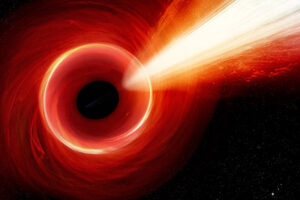
Beyond their gravitational pull, black holes actively shape the evolution of galaxies. As matter spirals into a black hole, it heats up and emits intense radiation, often producing powerful jets that extend far beyond the host galaxy. These energetic emissions influence star formation rates and the structural development of galaxies, making black holes key players in the cosmic lifecycle of creation and destruction.
Hawking Radiation and Theoretical Implications
In the 1970s, physicist Stephen Hawking proposed a groundbreaking theory suggesting that black holes are not entirely black but emit radiation due to quantum effects near the event horizon. Known as Hawking radiation, this phenomenon implies that black holes can gradually lose mass and potentially evaporate over astronomical timescales. This concept challenges traditional views on thermodynamics and entropy in the universe, introducing profound questions about the ultimate fate of black holes and the nature of information in the cosmos.
Philosophical and Cultural Significance
Black holes have transcended scientific discourse to become powerful symbols in popular culture and philosophy. They embody the tension between light and darkness, knowledge and mystery, serving as metaphors for the unknown aspects of existence and human mortality. Their depiction in science fiction and media often amplifies their awe-inspiring and fearsome qualities, helping to popularize complex astrophysical ideas and stimulate public interest in the cosmos.
Common Misconceptions About Black Holes
Black holes are cosmic vacuum cleaners that suck in everything around them.
Black holes only attract matter that crosses their event horizon; objects can orbit safely at a distance without being pulled in.
Black holes are completely invisible.
While black holes themselves emit no light, their presence can be detected by observing the effects on nearby matter and the radiation emitted from accretion disks.
Why Understanding Black Holes Is Crucial
Studying black holes is vital for advancing our comprehension of fundamental physics, including gravity, quantum mechanics, and the nature of spacetime. They serve as natural laboratories for testing theories under extreme conditions unattainable on Earth. Moreover, black holes influence the formation and evolution of galaxies, thereby shaping the large-scale structure of the universe. Their investigation not only deepens scientific knowledge but also enriches our philosophical perspective on existence and the cosmos.
Summary
The exploration of black holes through modern astronomical techniques marks a significant leap in our quest to understand the universe. These gravitational titans reveal essential truths about the interplay of matter, energy, and spacetime, challenging and expanding the horizons of human knowledge. As research progresses, black holes continue to inspire awe and curiosity, inviting us to confront the profound mysteries that lie at the heart of the cosmos.
FAQ
What is a black hole?
A black hole is a region in space where gravity is so strong that nothing, including light, can escape from it.
How are black holes detected?
Black holes are detected indirectly by observing their effects on nearby matter, such as the emission of X-rays from accreting material or the gravitational influence on star orbits.
What is the significance of the Event Horizon Telescope?
It provided the first direct visual evidence of a black hole by imaging the shadow of the supermassive black hole in galaxy M87.
What is Hawking radiation?
Hawking radiation is a theoretical quantum phenomenon where black holes can emit particles, suggesting they may slowly lose mass and eventually evaporate.
Why are black holes important in astrophysics?
Black holes help scientists understand gravity, spacetime, and the lifecycle of stars, and they play a key role in the evolution of galaxies.



Leave a Reply