
Short Answer
Definition of Dark Matter and Negative Energy
Within the fields of cosmology and theoretical physics, two enigmatic phenomena-dark matter and negative energy-pose significant challenges to our comprehension of the universe. These concepts, while distinct, provoke questions about their possible interconnection and the broader implications for cosmic understanding.
Dark Matter
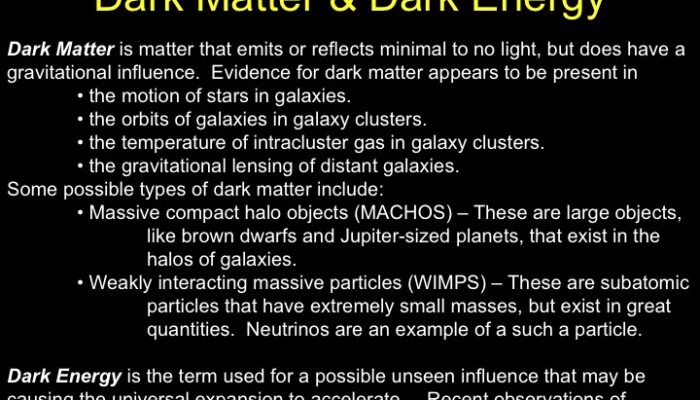
Dark matter is a form of matter that makes up roughly 27% of the universe’s total mass-energy content. It is characterized primarily by its gravitational effects, as it neither emits nor interacts with electromagnetic radiation, rendering it invisible to traditional detection methods. Its existence is inferred from observations such as the anomalous rotation speeds of galaxies, gravitational lensing of light around massive objects, and the large-scale structure of the cosmos. Leading theoretical candidates for dark matter include Weakly Interacting Massive Particles (WIMPs) and axions, which suggest physics beyond the Standard Model.
Negative Energy
Negative energy is a theoretical concept often arising in the context of general relativity and quantum field theory. It refers to energy states that are lower than the vacuum energy baseline, potentially enabling exotic phenomena like traversable wormholes or faster-than-light travel. The idea of negative mass, a related notion, implies matter with properties opposite to normal mass, which could have profound effects on gravitational interactions. However, negative energy introduces complex theoretical challenges, including potential violations of causality and the emergence of paradoxical time loops.
Mechanisms and Theoretical Foundations
How Dark Matter Influences the Universe
Dark matter exerts gravitational forces that shape the formation and evolution of galaxies and galaxy clusters. Its presence explains why stars in galaxies orbit at speeds inconsistent with the visible mass alone. By bending light through gravitational lensing, dark matter reveals its distribution indirectly. Despite extensive experimental efforts, direct detection of dark matter particles remains elusive, fueling ongoing research and debate.
The Role of Negative Energy in Physics
Negative energy arises in theoretical models that extend beyond classical physics, such as solutions to Einstein’s field equations permitting exotic spacetime geometries. It is hypothesized to enable phenomena like stable wormholes or warp drives by counteracting gravitational collapse. However, the existence of negative energy is speculative and constrained by principles like the quantum inequalities, which limit its magnitude and duration.
Exploring the Relationship Between Dark Matter and Negative Energy
While dark matter and negative energy appear to be separate cosmic mysteries, some speculative theories suggest potential links. For example, certain models propose that dark matter might exhibit properties analogous to negative mass, which could influence gravitational behavior in unexpected ways. Additionally, the concept of dark energy-the force accelerating the universe’s expansion-sometimes incorporates ideas related to negative energy densities, hinting at a deeper connection between these phenomena.
Hypothetical Interactions and Implications
If negative energy and dark matter coexist, their interaction could alter gravitational dynamics on cosmic scales. Negative energy might produce repulsive gravitational effects, potentially modifying the distribution and behavior of dark matter within galaxies. Such interactions could challenge current cosmological models and inspire new approaches to understanding the universe’s structure and evolution.
Cosmological Significance and Future Directions
The interplay between dark matter and negative energy holds profound implications for cosmology. Integrating both concepts into unified models could help resolve inconsistencies in observations of the cosmic microwave background and the formation of large-scale structures. Furthermore, insights into their relationship might shed light on fundamental questions about the origins of the universe, cosmic inflation, and the ultimate fate of cosmic expansion.
Advancements in observational technology and theoretical physics may eventually clarify whether these phenomena are interconnected or independent. Such breakthroughs could revolutionize our grasp of the cosmos and open pathways to novel technologies based on manipulating exotic energy states.
Common Misconceptions
Dark matter emits light and can be seen directly.
Dark matter does not interact with electromagnetic radiation, making it invisible to telescopes; its presence is inferred through gravitational effects.
Negative energy is proven to exist and can be harnessed for practical applications.
Negative energy remains a theoretical concept with no experimental confirmation and is subject to strict physical constraints.
Dark matter and negative energy are the same phenomenon.
They are distinct concepts with different theoretical bases, though some hypotheses explore possible connections.
Why Understanding These Concepts Is Crucial
Comprehending dark matter and negative energy is vital for advancing our knowledge of the universe’s composition, behavior, and destiny. Dark matter explains gravitational phenomena that visible matter cannot, while negative energy challenges and extends the boundaries of physics. Together, they represent frontiers in cosmology and theoretical physics, driving innovation and deepening our understanding of reality.
Summary
Dark matter and negative energy remain two of the most intriguing and unresolved puzzles in modern physics. While their exact nature and potential interrelation are still subjects of active research and debate, exploring these concepts enriches our grasp of the cosmos. Continued investigation promises to illuminate the dark corners of the universe and may ultimately transform our scientific worldview.
FAQ
What is dark matter?
Dark matter is a type of matter that makes up about 27% of the universe and is inferred through its gravitational effects.
What is negative energy?
Negative energy is a theoretical concept that refers to energy states lower than the vacuum energy baseline, allowing for exotic phenomena.
Are dark matter and negative energy the same?
No, they are distinct concepts with different theoretical frameworks, although some theories explore potential connections.





Leave a Reply