
Short Answer
Understanding the Accelerating Expansion of the Universe
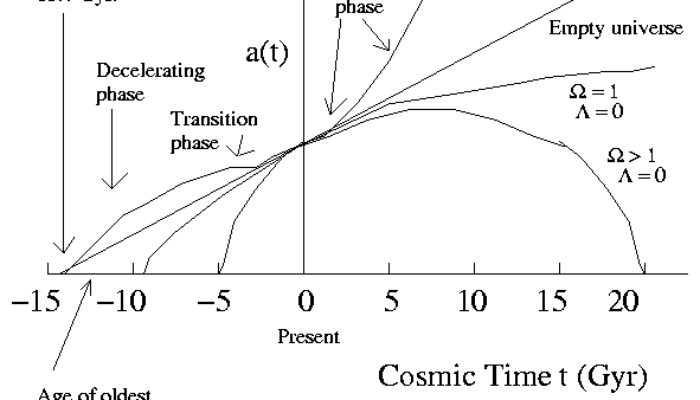
Over the past several decades, astronomers have uncovered a remarkable cosmic phenomenon: the universe is not only expanding but doing so at an increasing pace. This discovery, supported by evidence such as observations of distant supernovae and measurements of the cosmic microwave background radiation, has profound implications that extend beyond theoretical astrophysics. The accelerating expansion challenges our comprehension of the cosmos and influences the trajectory of technological innovation, engineering possibilities, and fundamental physics.
Definition and Evidence of Cosmic Acceleration
The accelerating expansion refers to the observation that galaxies are moving away from each other at speeds that increase over time, rather than slowing down as once expected. This phenomenon is primarily attributed to a mysterious entity called dark energy, which constitutes a significant portion of the universe’s total energy density.
- Supernova Observations:
Type Ia supernovae serve as “standard candles” for measuring cosmic distances, revealing that distant galaxies are receding faster than predicted by models without acceleration. - Cosmic Microwave Background (CMB):
Fluctuations in the CMB provide a snapshot of the early universe, supporting models that include dark energy to explain the current accelerated expansion.
Mechanisms Behind the Accelerating Universe
The acceleration is thought to arise from dark energy, a form of energy with repulsive gravitational effects that counteracts the attractive force of matter. Unlike matter and radiation, dark energy’s density remains roughly constant as the universe expands, causing the expansion rate to increase over time. This dynamic reshapes the large-scale structure of the cosmos and influences the future interactions between celestial bodies.
Impact on Technological Development and Engineering
The accelerating expansion of the universe imposes unique challenges on the future of technology and engineering. As galaxies drift further apart, the increasing cosmic distances could hinder communication, travel, and resource sharing on an interstellar scale. This evolving cosmic environment necessitates a reevaluation of technologies that depend on stable, predictable physical laws and accessible cosmic resources.
- Quantum and Electromagnetic Technologies:
Many current technologies rely on principles assuming a uniform and stable universe. The growing isolation of cosmic structures may require new models to sustain these technologies. - Energy Systems:
The gradual recession of solar systems from one another limits the potential for interstellar energy exchange, emphasizing the need for advanced, localized sustainable energy solutions. - Computational and AI Technologies:
Increasing distances between data centers and computational nodes could degrade network efficiency, prompting the development of algorithms resilient to latency and localized AI systems capable of autonomous operation.
Technological Adaptations in an Expanding Cosmos
To address the constraints imposed by cosmic acceleration, interdisciplinary approaches combining astrophysics, engineering, and information science are essential. Innovations such as quantum entanglement communication, advanced propulsion technologies, and teleportation concepts may offer pathways to overcome the barriers of vast cosmic distances.
- Quantum Communication:
Utilizing quantum entanglement could enable instantaneous data transfer, circumventing delays caused by expanding space. - Advanced Propulsion:
Developing propulsion systems capable of near-light-speed travel may mitigate the effects of increasing interstellar separation. - Localized AI Systems:
Designing AI that operates independently within localized environments can sustain technological progress despite reduced interconnectivity.
Philosophical and Scientific Significance
The accelerating universe not only challenges technological paradigms but also invites profound philosophical reflection on humanity’s place in an ever-changing cosmos. The realization that the universe is expanding at an accelerating rate instills a sense of urgency in scientific inquiry and innovation. It raises critical questions about the adaptability of human progress and the potential need to rethink conventional approaches to technology and knowledge sharing.
Future Outlook and Challenges
As cosmic expansion continues, future generations will face the dual challenge of navigating increasing isolation and resource scarcity on a universal scale. The imperative will be to engineer solutions that counteract or adapt to these cosmological constraints, ensuring the persistence of technological advancement and human resilience. The accelerating universe thus serves as both a challenge and an inspiration, driving innovation at the intersection of science, technology, and philosophy.
FAQ
What is cosmic expansion and why is it accelerating?
Cosmic expansion refers to the increasing distance between galaxies in the universe, accelerated by an unknown force called dark energy.
How might cosmic expansion affect interstellar communication?
As distances grow, communication delays increase, making real-time interstellar data exchange more difficult, possibly requiring new communication methods.
What challenges does cosmic expansion pose for energy technology?
It limits access to external resources and energy sharing, making local and sustainable energy innovation crucial.
Can future propulsion systems overcome the limits of cosmic expansion?
Advanced propulsion and quantum technologies are proposed as potential solutions, but remain speculative.
Why is interdisciplinary collaboration important for addressing cosmic expansion's tech impact?
Combining astrophysics, engineering, and information science can foster technologies that adapt to cosmic constraints.


Leave a Reply