

Short Answer
Definition of Black Holes
Black holes are extraordinary cosmic objects formed from the gravitational collapse of massive stars, resulting in regions of spacetime where gravity is so intense that nothing, not even light, can escape. These enigmatic entities have fascinated both scientists and the public due to their mysterious nature and the paradoxes they present within the framework of physics.
Classification of Black Holes
Black holes are primarily divided into three main categories based on their mass and formation processes:
- Stellar Black Holes:
These are the most prevalent type, originating from the remnants of massive stars after supernova explosions. Their masses typically range from about three to several tens of times that of our Sun. - Supermassive Black Holes:
Found at the centers of most galaxies, these black holes contain millions to billions of solar masses. Their exact formation mechanisms remain a subject of ongoing research, with theories including the direct collapse of massive gas clouds or the gradual merging of smaller black holes. - Intermediate Black Holes:
Occupying a mass range between stellar and supermassive black holes, these objects are less understood but are increasingly supported by observational evidence, challenging existing models of cosmic evolution.
Rotating Black Holes and Frame Dragging
A notable subclass of black holes is the rotating or Kerr black hole, distinguished by possessing angular momentum. This rotation causes a phenomenon known as frame dragging, where the intense gravitational field twists the surrounding spacetime. As a result, matter and light near the black hole are compelled to spiral around its axis, influencing the dynamics of accretion disks and the motion of particles in the vicinity.
Naked Singularities: Challenging Conventional Physics
Typically, the singularity at a black hole’s core-where density becomes infinite and classical physics breaks down-is hidden behind an event horizon. However, the theoretical concept of a naked singularity proposes a singularity exposed to the outside universe without this protective boundary. If such objects exist, they could violate causality and challenge the fundamental understanding of gravity and spacetime.
Black Hole Thermodynamics and Hawking Radiation
The study of black holes has revealed surprising connections to thermodynamics and quantum mechanics. Pioneering work by physicists like Jacob Bekenstein and Stephen Hawking introduced the idea that black holes possess entropy proportional to the surface area of their event horizons. This insight led to the prediction that black holes emit thermal radiation, now known as Hawking radiation, implying that black holes can slowly lose mass and energy over time. This discovery bridges gravity with quantum theory, opening new avenues in theoretical physics.
White Holes and Wormholes: Theoretical Extensions
Beyond black holes, theoretical physics explores related phenomena such as white holes and wormholes. White holes are hypothesized as the temporal opposites of black holes, expelling matter and energy rather than absorbing them. Wormholes, on the other hand, are speculative tunnels connecting disparate points in spacetime, potentially linking black holes and white holes. While these constructs offer fascinating possibilities for shortcuts through the universe, their stability remains highly uncertain.
Advances in Observational Techniques: Gravitational Wave Astronomy
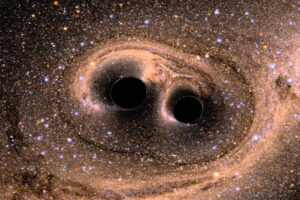
The detection of gravitational waves, ripples in spacetime caused by massive accelerating bodies, has revolutionized black hole research. Instruments like LIGO have observed waves generated by black hole mergers, providing unprecedented data on their properties, formation, and interactions. This breakthrough has inaugurated a new era in astrophysics, enabling scientists to study black holes dynamically and in greater detail than ever before.
Future Directions in Black Hole Research
Ongoing and future investigations aim to uncover further complexities in black hole behavior. Enhanced observational tools and refined theoretical models may reveal new black hole types or unique interactions, such as those involving dark matter or novel gravitational wave signatures. Integrating quantum mechanics more deeply into black hole physics holds the promise of transformative insights into the fundamental laws governing the cosmos.
Significance of Black Holes in Science and Cosmology
Black holes serve as natural laboratories for testing the limits of physics, from general relativity to quantum theory. Their study not only deepens our understanding of gravity and spacetime but also informs models of galaxy formation and evolution. As research progresses, black holes continue to challenge and expand our comprehension of the universe, making them central to both theoretical and observational astrophysics.
FAQ
What is a black hole?
A black hole is a region in space where gravity is so intense that nothing, not even light, can escape.
What causes black holes?
Black holes are formed by the gravitational collapse of massive stars.
What is Hawking radiation?
Hawking radiation is the thermal radiation predicted to be emitted by black holes, suggesting they can lose mass over time.



Leave a Reply