
Short Answer
Definition of Planetary Gravity
Gravity is the fundamental force of attraction that exists between any two masses. On planetary surfaces, gravity determines how strongly objects are pulled toward the center of the planet. This force depends primarily on the planet’s mass and radius, influencing everything from atmospheric retention to the behavior of objects and potential human activities on the surface.
- Gravitational acceleration (g):
The acceleration experienced by an object due to gravity, typically measured in meters per second squared (m/s²). - Planetary mass (M):
The total amount of matter contained within a planet, affecting the strength of its gravitational pull. - Planetary radius (R):
The distance from the planet’s center to its surface, which inversely affects surface gravity.
How Planetary Gravity Is Determined
The gravitational force on a planet’s surface is calculated using Newton’s law of universal gravitation. The formula is:
g = G × M / R²
where:
- G is the gravitational constant (6.67430 × 10⁻¹¹ N·m²/kg²),
- M is the planet’s mass,
- R is the radius of the planet.
This equation shows that surface gravity increases with greater mass but decreases with a larger radius squared. Therefore, a planet’s density and size both play crucial roles in determining its gravitational pull.
Gravity Characteristics of Mercury
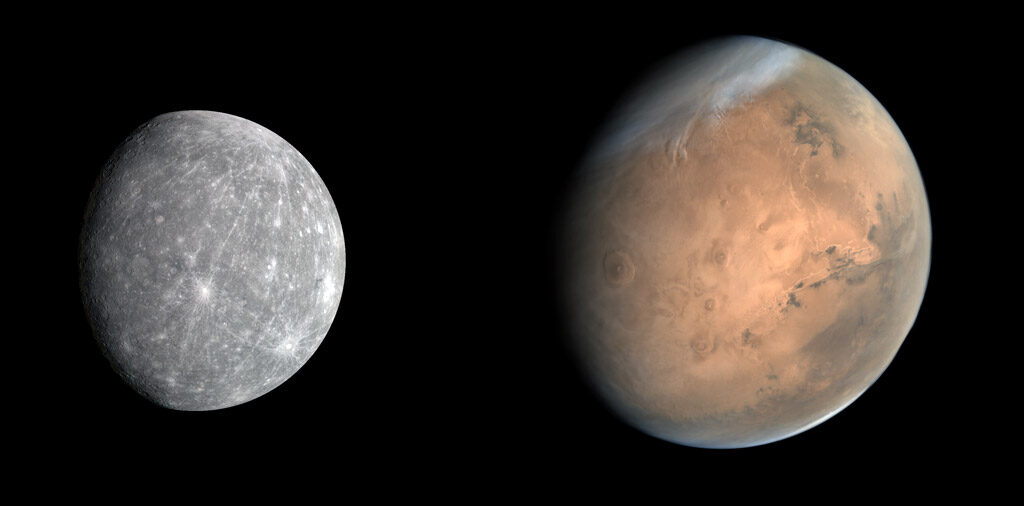
Mercury, the closest planet to the Sun, is relatively small with a radius of about 2,440 kilometers. Despite its modest size, it has a dense composition, largely due to a substantial metallic core, giving it a mass of approximately 3.3 × 10²³ kilograms. This high density results in a surface gravity near 3.7 m/s², which is roughly 38% of Earth’s gravity.
While Mercury’s proximity to the Sun affects its temperature extremes and surface conditions, it does not influence its gravitational acceleration. The planet’s compact radius combined with its dense interior creates a gravitational force that is stronger than might be expected for its size but still significantly weaker than Earth’s.
Gravity Characteristics of Mars
Mars, known for its distinctive red appearance and potential for past life, is larger than Mercury with a radius close to 3,390 kilometers and a mass around 6.4 × 10²³ kilograms. Although Mars has nearly double Mercury’s mass, its larger volume results in a lower overall density. This balance produces a surface gravity of about 3.71 m/s², slightly higher than Mercury’s but still only about 38% of Earth’s gravity.
The larger radius of Mars moderates the effect of its greater mass, leading to a gravitational pull that is comparable to Mercury’s. This subtle difference influences the planet’s ability to maintain a thin atmosphere and affects surface phenomena such as dust storms and temperature regulation.
Comparative Overview: Mars vs. Mercury Gravity
When comparing the two planets, Mars exhibits a marginally stronger gravitational acceleration (3.71 m/s²) than Mercury (3.7 m/s²). Although the difference is minimal, it has significant implications for planetary science and exploration.
- Atmospheric retention:
Mars’ slightly stronger gravity helps it retain a thin atmosphere, whereas Mercury’s weaker gravity contributes to its almost nonexistent atmosphere. - Surface conditions:
The difference in gravity affects geological activity and surface processes, with Mars supporting weather phenomena and Mercury experiencing extreme temperature fluctuations. - Exploration challenges:
Gravity influences the design and operation of landers, rovers, and potential human missions, affecting energy requirements and astronaut health considerations.
Impact of Gravity on Planetary Atmospheres and Surface Environments
Gravity plays a pivotal role in shaping a planet’s atmosphere and surface environment. Mercury’s low gravity is insufficient to hold a substantial atmosphere, leading to rapid atmospheric loss due to solar wind and a weak magnetic field. This results in harsh surface conditions with extreme temperature variations and high exposure to radiation.
In contrast, Mars’ marginally higher gravity supports a tenuous atmosphere primarily composed of carbon dioxide. This atmosphere enables dynamic surface weather patterns, including dust storms, and contributes to temperature moderation, although it remains much thinner than Earth’s atmosphere.
Significance of Gravity Differences for Space Exploration
Understanding the subtle variations in gravity between Mars and Mercury is essential for planning future missions. Lower gravity environments reduce the energy needed for landing and takeoff, but they also pose challenges for long-term human health, such as muscle atrophy and bone density loss.
Mercury’s environment demands specialized engineering solutions to cope with its low gravity, intense temperature swings, and solar radiation. Mars, with its slightly stronger gravity and more stable conditions, presents a more promising candidate for human colonization, though it still requires adaptation to reduced gravity compared to Earth.
Future Directions in Gravitational Research and Exploration
Ongoing and upcoming missions to Mercury and Mars continue to refine our understanding of their gravitational fields. Instruments such as gravimeters and inertial sensors provide detailed gravitational maps, aiding in the design of spacecraft and habitats. These insights are crucial for optimizing mission safety, efficiency, and the well-being of astronauts.
As humanity advances toward interplanetary travel, comprehending the nuances of planetary gravity will remain a cornerstone of successful exploration and settlement strategies.
Summary
In conclusion, Mars exhibits a slightly stronger surface gravity than Mercury, with values of approximately 3.71 m/s² and 3.7 m/s² respectively. This difference arises from their distinct masses, radii, and densities. Both planets have gravitational forces significantly weaker than Earth’s, influencing their atmospheric characteristics, surface environments, and suitability for exploration.
Recognizing these gravitational distinctions enhances our knowledge of planetary physics and informs the development of technologies and strategies for future space missions, ultimately supporting humanity’s quest to explore and inhabit new worlds.
FAQ
What is the gravity of Mars?
Mars has a surface gravity of approximately 3.71 m/s².
What is the gravity of Mercury?
Mercury has a surface gravity of approximately 3.7 m/s².

Leave a Reply