
Short Answer
Definition of a Main Sequence Star
A main sequence star is a type of star that is in the longest and most stable phase of its life cycle, characterized primarily by the fusion of hydrogen into helium in its core. This process generates the energy that balances the inward pull of gravity, maintaining the star’s structural integrity and steady luminosity. Main sequence stars vary widely in mass, temperature, and brightness, but all share this fundamental mechanism of energy production.
- Hydrogen Fusion:
The core process where hydrogen nuclei combine to form helium, releasing energy. - Hydrostatic Equilibrium:
The balance between gravitational collapse and outward pressure from fusion reactions. - Stellar Diversity:
Includes stars from small, cool red dwarfs to massive, hot blue giants.
The Sun’s Classification and Position on the Main Sequence
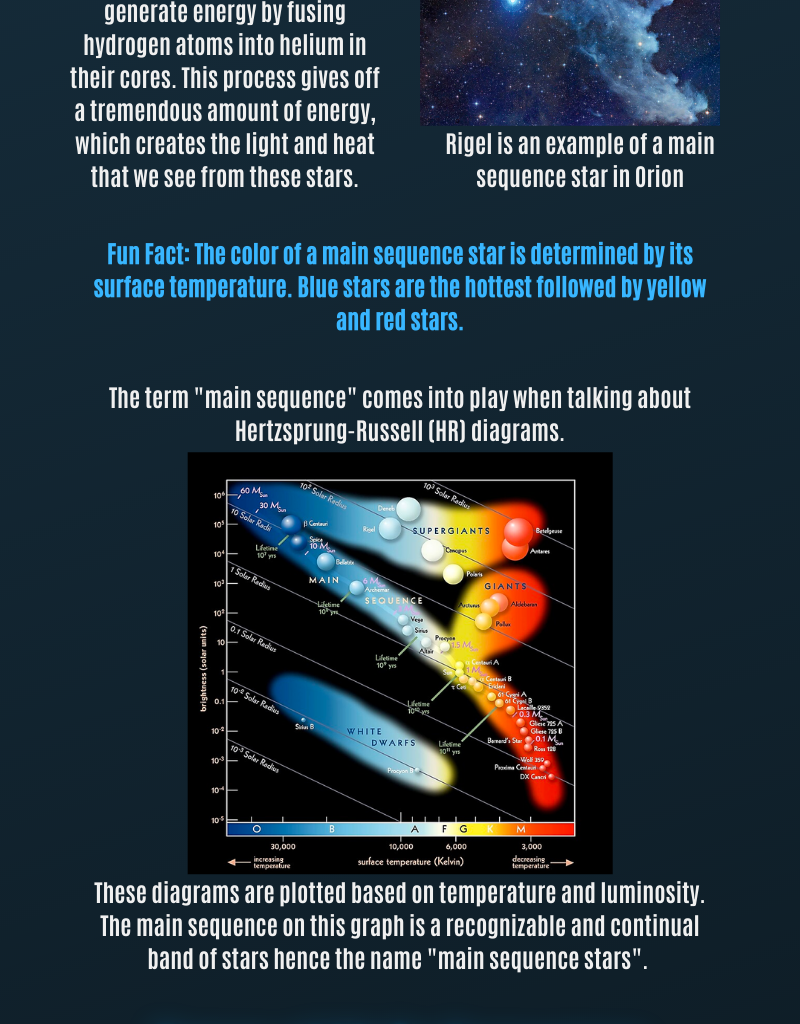
The Sun is classified as a G2V star, commonly referred to as a yellow dwarf. This classification places it in the middle of the main sequence on the Hertzsprung-Russell diagram, a graphical tool that plots stars according to their luminosity and temperature. The “G2” indicates a surface temperature near 5,778 Kelvin, giving the Sun its characteristic yellow-white glow. The “V” denotes its status as a main sequence star, confirming that it is currently undergoing stable hydrogen fusion in its core.
- Spectral Type G2:
Reflects the Sun’s surface temperature and color. - Luminosity Class V:
Indicates the star is in the main sequence phase. - Age and Lifespan:
The Sun is approximately 4.6 billion years old and expected to remain on the main sequence for about another 5 billion years.
Stellar Evolution: From Birth to Main Sequence and Beyond
Stars undergo a complex evolutionary journey, beginning as protostars and progressing through various stages depending on their mass. Before reaching the main sequence, stars like T Tauri objects are still contracting and have not yet initiated sustained hydrogen fusion. After the main sequence phase, stars exhaust their core hydrogen and evolve into red giants or supergiants, undergoing significant changes in size, brightness, and spectral properties. The final stages vary, resulting in white dwarfs, neutron stars, or black holes based on the star’s initial mass.
Pre-Main Sequence Stars
These young stars are still in the process of gravitational contraction and have not started stable hydrogen fusion.
Post-Main Sequence Stars
Stars that have depleted their core hydrogen fuel and are expanding into red giants or supergiants, eventually ending as compact remnants.
Mass and Temperature Variations Within the Main Sequence
The main sequence encompasses a broad spectrum of stars, categorized primarily by their mass and surface temperature. At the high-mass end are O and B type stars, which are extremely hot, luminous, and short-lived. Conversely, M type stars, or red dwarfs, are smaller, cooler, and can persist for trillions of years. The Sun’s intermediate position as a G-type star provides a balance of moderate luminosity and longevity, which is essential for sustaining life on Earth.
Mechanisms of Energy Production in the Sun
At the heart of the Sun’s energy generation lies the proton-proton chain reaction, a nuclear fusion process that converts hydrogen nuclei into helium. This reaction releases enormous amounts of energy in the form of gamma rays and neutrinos. The energy produced in the core travels outward through the Sun’s radiative and convective zones before escaping as sunlight. This continuous fusion process not only powers the Sun’s brightness but also prevents gravitational collapse by maintaining internal pressure.
Scientific Evidence Supporting the Sun’s Main Sequence Status
Observations of the Sun’s stable luminosity, consistent spectral features, and sunspot activity align with the characteristics expected of a main sequence star. Additionally, helioseismology-the study of solar oscillations-provides detailed insights into the Sun’s internal structure, confirming the presence of a hydrogen-fusing core and the dynamic processes typical of main sequence stars.
Future Evolution of the Sun
Eventually, the Sun will exhaust the hydrogen fuel in its core, causing the cessation of core hydrogen fusion. The core will contract and heat up, while hydrogen fusion continues in a surrounding shell. This transition will cause the Sun’s outer layers to expand dramatically, transforming it into a red giant with increased luminosity and altered spectral characteristics. Ultimately, the Sun will shed its outer layers and leave behind a dense white dwarf, marking the end of its active fusion phase.
Significance of the Sun’s Main Sequence Phase
The Sun’s current main sequence status is vital for the stability and sustainability of life on Earth. Its steady energy output over billions of years has created the conditions necessary for biological evolution. Understanding the Sun’s place in stellar evolution also connects our local star to the broader cosmic processes that govern the birth, development, and death of stars throughout the universe.
Summary
In summary, the Sun is definitively a main sequence star at this stage of its life. Its spectral classification, energy generation through hydrogen fusion, and stable physical characteristics confirm this. While it will eventually evolve into later stages, the Sun’s current phase ensures a consistent supply of energy essential for life on our planet and provides a window into the universal principles of stellar astrophysics.


Leave a Reply