
Short Answer
Definition of Dark Energy
Dark energy is a mysterious and pervasive force that permeates the universe, driving its accelerated expansion. Unlike ordinary matter or energy, dark energy cannot be directly observed but is inferred from its gravitational effects on cosmic scales. It acts as a repulsive influence, counteracting gravity and causing galaxies to move away from each other at an increasing rate.
- Invisible yet influential:
Dark energy cannot be detected through electromagnetic radiation but reveals itself through the universe’s expansion dynamics. - Ubiquitous presence:
It is believed to fill all of space uniformly, affecting the cosmos on the largest scales.
Historical Context and Theoretical Background
The concept of dark energy emerged from observations in the late 20th century that the universe’s expansion is accelerating, a discovery that challenged previous assumptions of a decelerating cosmos dominated by gravity. This acceleration suggested the existence of a repulsive force or energy intrinsic to space itself. The cosmological constant, originally introduced by Einstein as a modification to his equations of general relativity, was later reinterpreted as a possible representation of dark energy.
How Dark Energy Influences the Universe
Dark energy acts as a counterbalance to gravity on cosmic scales. While gravity pulls matter together, dark energy pushes space apart, causing the expansion of the universe to speed up over time. This repulsive effect becomes dominant only at vast distances, beyond the scale of galaxy clusters, where gravitational attraction weakens.
- Cosmic acceleration:
The increasing rate at which galaxies recede from each other is a direct consequence of dark energy’s influence. - Scale-dependent effects:
On smaller scales, such as within galaxies or solar systems, gravity remains the dominant force, rendering dark energy’s impact negligible.
Mathematical Description and Models
Dark energy is often modeled as a cosmological constant (Λ) in Einstein’s field equations of general relativity. This constant represents a uniform energy density filling space, exerting negative pressure that drives expansion.
The key equation incorporating dark energy is:
Gμν + Λgμν = (8πG/c⁴) Tμν
- Gμν: Einstein tensor describing spacetime curvature
- Λ: Cosmological constant representing dark energy density
- gμν: Metric tensor of spacetime
- Tμν: Energy-momentum tensor of matter and radiation
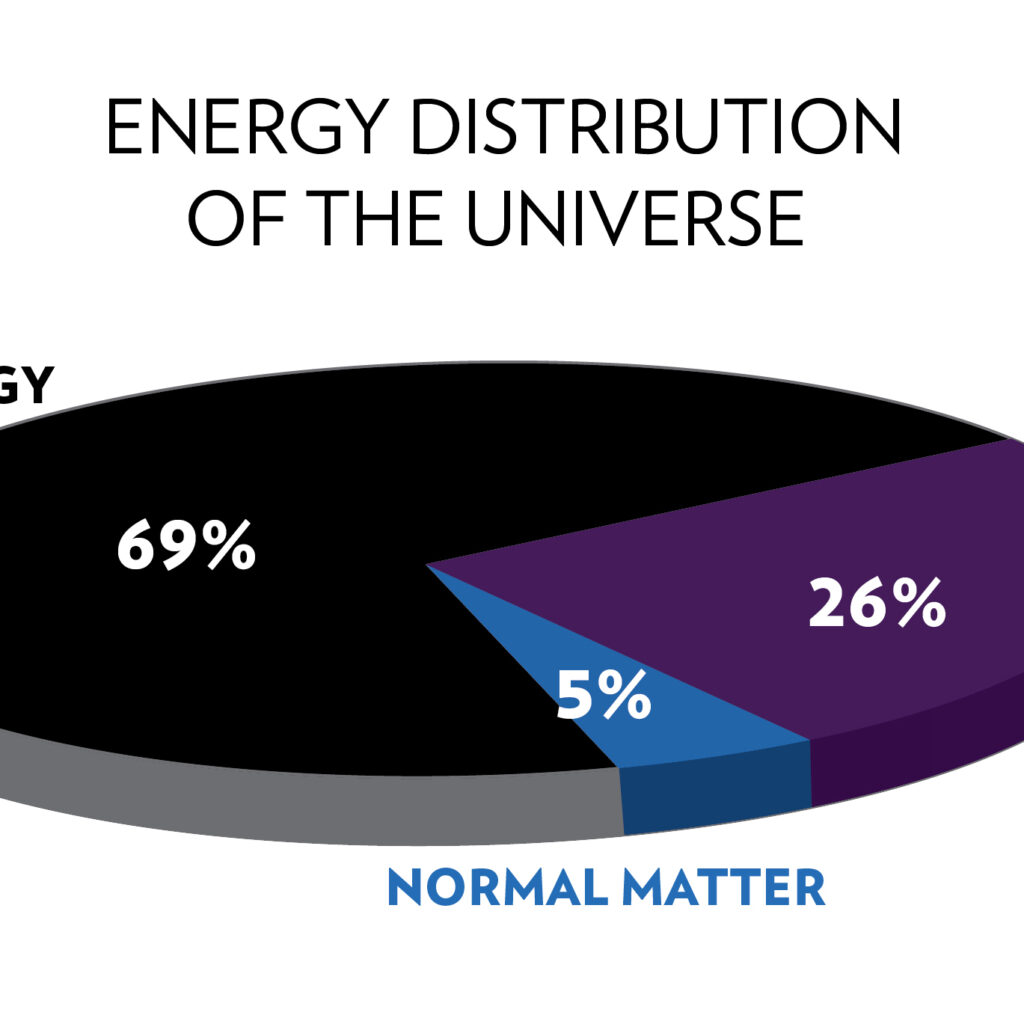
In cosmology, the density parameter for dark energy, ΩΛ, quantifies its contribution to the total energy density of the universe, currently estimated to be about 68%.
Uniformity and Distribution of Dark Energy
Current observations suggest that dark energy is nearly uniform throughout the cosmos, maintaining a constant density regardless of local matter concentrations. This uniformity implies that dark energy is an intrinsic property of space itself, unaffected by the clumping of galaxies or the emptiness of cosmic voids.
An analogy often used is that of an infinite pearl necklace, where each pearl represents a galaxy and the invisible thread between them symbolizes dark energy. As the necklace stretches, the distance between pearls increases steadily due to the tension of the thread, illustrating how dark energy uniformly drives cosmic expansion.
Competing Theories and Open Questions
While the cosmological constant remains the simplest explanation, alternative theories propose that dark energy might be dynamic, varying over time or space. These include:
- Quintessence:
A hypothetical scalar field that changes in intensity, potentially causing fluctuations in dark energy density. - Modified gravity theories:
Proposals that alter general relativity on large scales to account for accelerated expansion without invoking dark energy. - Vacuum energy:
The energy inherent in empty space, predicted by quantum field theory, though its calculated magnitude vastly exceeds observed values.
These competing models highlight the profound challenges in fully understanding dark energy’s nature and behavior.
Impact on Cosmic Evolution and Fate
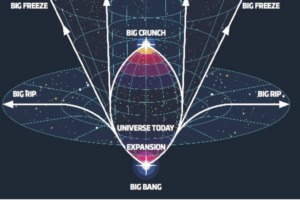
Dark energy’s dominance shapes the ultimate destiny of the universe. If it remains constant, the cosmos will continue expanding indefinitely, leading to a cold, dilute state where galaxies recede beyond observable horizons and star formation ceases. Alternatively, if dark energy evolves or intensifies, it could trigger dramatic scenarios such as the “Big Rip,” where the expansion accelerates to the point of tearing apart galaxies, stars, and even atomic structures.
Dark Energy in the Context of Local and Large-Scale Structures
Despite its overwhelming influence on the universe’s expansion, dark energy exerts negligible effects on gravitationally bound systems like galaxies, clusters, and solar systems. Within these structures, gravity’s pull is strong enough to counteract the repulsive force of dark energy, allowing matter to remain clustered and form complex cosmic architectures.
This duality creates a universe where local cohesion coexists with global dispersal, enabling the formation of stars, planets, and life amid an ever-expanding cosmic backdrop.
Scientific Endeavors to Understand Dark Energy
Unraveling the mysteries of dark energy is a central goal of modern cosmology. Advanced observational projects employ telescopes and space probes to measure the universe’s expansion history with increasing precision. Techniques include:
- Supernova surveys:
Observing distant exploding stars to trace cosmic acceleration. - Cosmic microwave background studies:
Analyzing relic radiation from the early universe to infer energy components. - Baryon acoustic oscillations:
Mapping large-scale galaxy distributions to measure expansion rates.
These efforts aim to determine whether dark energy is truly constant or exhibits subtle variations, potentially unlocking new physics beyond the current paradigm.
Common Misconceptions About Dark Energy
Dark energy is the same as dark matter.
Dark energy and dark matter are distinct; dark matter exerts gravitational attraction and clumps, while dark energy causes repulsive expansion and is uniformly distributed.
Dark energy affects all scales equally.
Its influence is significant only on very large scales, with negligible effects within galaxies or smaller systems.
Dark energy is fully understood.
Despite extensive study, dark energy’s fundamental nature remains one of the biggest open questions in physics.
Significance of Dark Energy in Cosmology and Beyond
Dark energy is a cornerstone of contemporary cosmology, fundamentally altering our understanding of the universe’s composition, structure, and fate. Its discovery has reshaped theoretical physics, prompting new models and inspiring profound philosophical questions about the nature of space, time, and existence. Beyond academic interest, dark energy influences the ultimate conditions for life and the long-term evolution of cosmic environments.
Conclusion: The Cosmic Role of Dark Energy
Dark energy stands as an invisible yet omnipresent force, quietly orchestrating the universe’s expansion and shaping its destiny. Whether as a constant energy density or a dynamic entity, it challenges our comprehension of reality and beckons further exploration. As we peer into the cosmos, the silent expanse of dark energy envelops every star and galaxy, a vast ocean upon which the universe’s grand narrative unfolds.
FAQ
What is dark energy?
Dark energy is a form of energy that is thought to make up about 68% of the universe and is responsible for its accelerated expansion.
How does dark energy influence the universe?
Dark energy counteracts gravity, causing galaxies to move away from each other at an increasing rate.
Is dark energy the same as dark matter?
No, dark energy causes the universe to expand, whereas dark matter exerts gravitational attraction and clumps together.


Leave a Reply