
Short Answer
Definition of Dark Energy and Its Cosmic Role
Dark energy is a mysterious and pervasive force that constitutes about 68% of the universe’s total energy content. Traditionally, it is understood as a repulsive pressure responsible for the accelerated expansion of the cosmos. Rather than simply pushing galaxies apart, dark energy may play a more profound role as an active agent in the continuous creation of space itself, effectively shaping the very fabric of the universe. This concept challenges conventional cosmological views and invites deeper inquiry into the nature of space, time, and energy.
Dark Energy in the Standard Cosmological Model
Within the widely accepted Lambda Cold Dark Matter (ΛCDM) framework, dark energy is modeled as the cosmological constant (Λ). This constant represents an inherent property of space that exerts a uniform negative pressure, counteracting gravitational attraction on large scales and driving cosmic acceleration. While this static interpretation simplifies dark energy as a constant energy density filling space, it may obscure its dynamic potential. Reimagining dark energy as a creative force that generates new spatial dimensions offers a transformative perspective on cosmic expansion.
The Expansion of the Universe and Space Creation
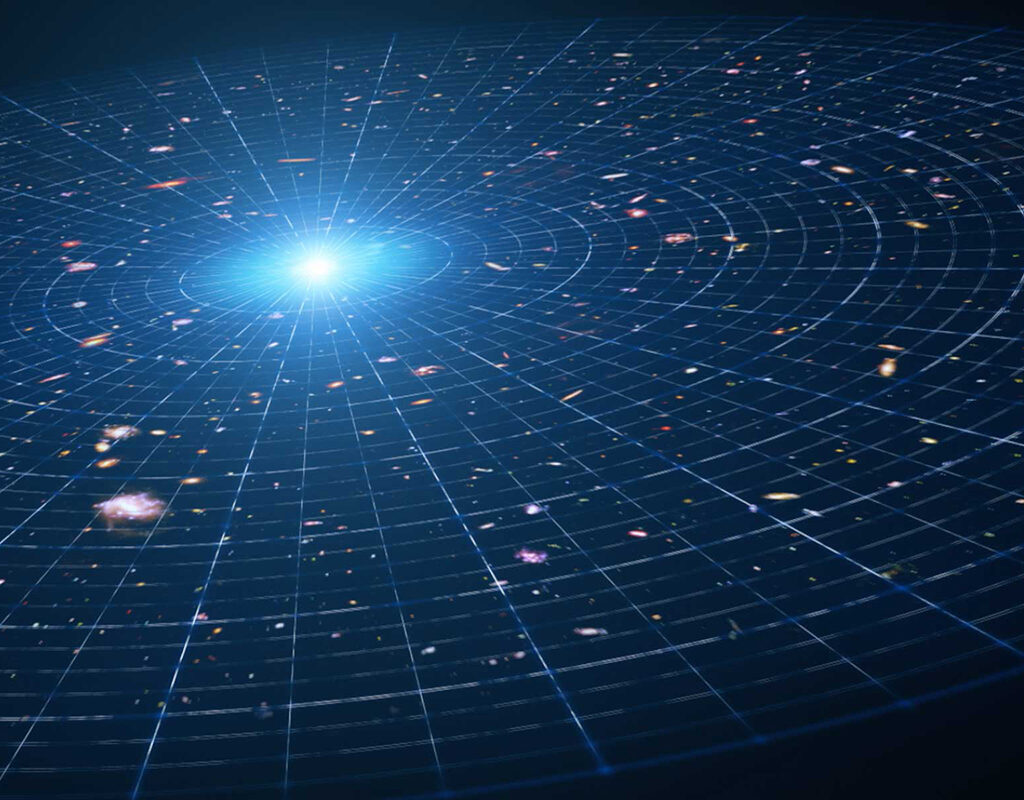
Since Edwin Hubble’s groundbreaking discovery in the 1920s that galaxies are receding from each other, it has been understood that the universe is expanding. Crucially, this expansion is not due to galaxies moving through a fixed void but rather the stretching of space itself-the metric that defines distances between points in the universe is increasing. This raises the possibility that dark energy is the driving mechanism behind this metric expansion, continuously producing new space rather than merely enlarging existing boundaries. In this view, cosmic expansion is intrinsically linked to the genesis of space.
Quantum Vacuum and the Origin of Space
Quantum field theory and emerging ideas in quantum gravity provide a fertile theoretical backdrop for understanding dark energy’s role in space creation. The vacuum of space is not empty but teeming with quantum fluctuations-temporary appearances and disappearances of particles and fields. If dark energy corresponds to vacuum energy, it suggests that the vacuum is an active, dynamic medium capable of spawning new space. This quantum vacuum energy could serve as a reservoir fueling the continuous emergence of spatial dimensions, a concept that diverges sharply from classical views of empty space as inert and uniform.
Cosmological Horizons and the Growth of the Universe
The concept of the cosmological horizon-the boundary beyond which events cannot affect an observer-intersects intriguingly with dark energy-driven expansion. As dark energy accelerates the universe’s growth, this horizon recedes, effectively unveiling new regions of space that become causally disconnected. This process implies the ongoing creation of fresh cosmic volumes, suggesting a universe in perpetual flux, constantly unfolding space by space. Dark energy, in this sense, acts as a cosmic architect, revealing ever-expanding realms beyond our observational reach.
Theoretical Challenges: Energy Conservation and Dynamic Dark Energy
One of the major theoretical hurdles in interpreting dark energy as a creator of space is the apparent violation of energy conservation on cosmological scales. While classical physics demands energy conservation, general relativity permits global energy non-conservation in an expanding universe. This paradox may indicate that space creation driven by dark energy operates under unique spacetime geometric principles, circumventing traditional energy accounting.
Additionally, alternative models propose that dark energy is not constant but dynamic, as in quintessence theories. Here, dark energy is a field whose intensity varies over time, potentially linked to the amount or geometry of space. Such variability could mean that space creation is not uniform but fluctuates across cosmic epochs, influencing the ultimate fate of the universe-whether it expands indefinitely or eventually contracts.
Emergent Space and Information-Theoretic Perspectives
Some speculative frameworks suggest that space itself may be an emergent phenomenon tied to entropy maximization and holographic principles. According to these ideas, dark energy could be a manifestation of fundamental information-theoretic laws encoded on cosmic horizons, governing the universe’s expansion and the birth of space. This approach attempts to unify gravity, quantum mechanics, and thermodynamics, offering a profound but still tentative explanation for the nature of dark energy and spacetime.
Observational Efforts and Future Prospects
Understanding whether dark energy actively generates space or remains a static cosmological constant is a central goal of modern cosmology. Upcoming observational campaigns targeting distant supernovae, galaxy distributions, and cosmic microwave background fluctuations aim to refine measurements of the universe’s expansion rate and dark energy’s properties. These data will be crucial in distinguishing between competing models and deepening our grasp of dark energy’s true nature.
Philosophical and Scientific Significance
The question of whether dark energy is creating space itself transcends empirical science, touching on metaphysical considerations about the universe’s essence. If dark energy continuously births new space, the cosmos is not merely expanding but perpetually renewing itself, with space as a dynamic, evolving entity shaped by subtle cosmic forces. This perspective may herald a paradigm shift in our understanding of reality, inspiring new theoretical frameworks and experimental inquiries.
Summary
Dark energy remains one of the most profound mysteries in cosmology, potentially serving not only as the driver of accelerated expansion but also as the creative force behind the continuous generation of space. While theoretical and observational challenges persist, exploring this possibility enriches our comprehension of the universe’s structure, origin, and destiny. The ongoing quest to decode dark energy exemplifies humanity’s enduring fascination with the cosmos and its fundamental laws.
FAQ
What is dark energy?
Dark energy is a mysterious force that constitutes about 68% of the universe’s energy content, driving its accelerated expansion.
How does dark energy relate to space creation?
Dark energy may actively generate new space, rather than just expanding existing space, reshaping our understanding of cosmology.
What are the theoretical implications of dark energy?
Theories suggest dark energy could violate traditional energy conservation laws, operating under unique spacetime principles.
What observational efforts are underway regarding dark energy?
Upcoming campaigns will target distant supernovae and cosmic microwave background fluctuations to refine measurements of dark energy.


Leave a Reply