
Short Answer
Understanding the Darkness of Space
Imagine entering a magnificent cathedral where sunlight filters through stained-glass windows, casting colorful patterns that softly illuminate the vast interior. The light is present but not overpowering, creating an intimate and gentle glow rather than a harsh brightness. This scenario parallels the cosmic paradox: although space is flooded with light from innumerable stars and celestial bodies, it appears overwhelmingly dark to us. Why doesn’t the universe shine with relentless brilliance despite this abundance of light? The explanation lies in a complex combination of physical laws, human perception, and the immense scale of the cosmos.
Definition of Cosmic Illumination
Cosmic illumination refers to the presence and behavior of light emitted by stars, galaxies, and other luminous objects throughout the universe. Despite the vast number of light sources, the universe is predominantly perceived as dark due to the unique conditions of space and the limitations of human vision.
- Light Sources:
Stars and galaxies emit photons that travel across space, creating pockets of intense brightness. - Perception of Darkness:
The vast distances and absence of light-scattering mediums result in large regions of darkness between these luminous points.
The Role of Vacuum and Light Propagation
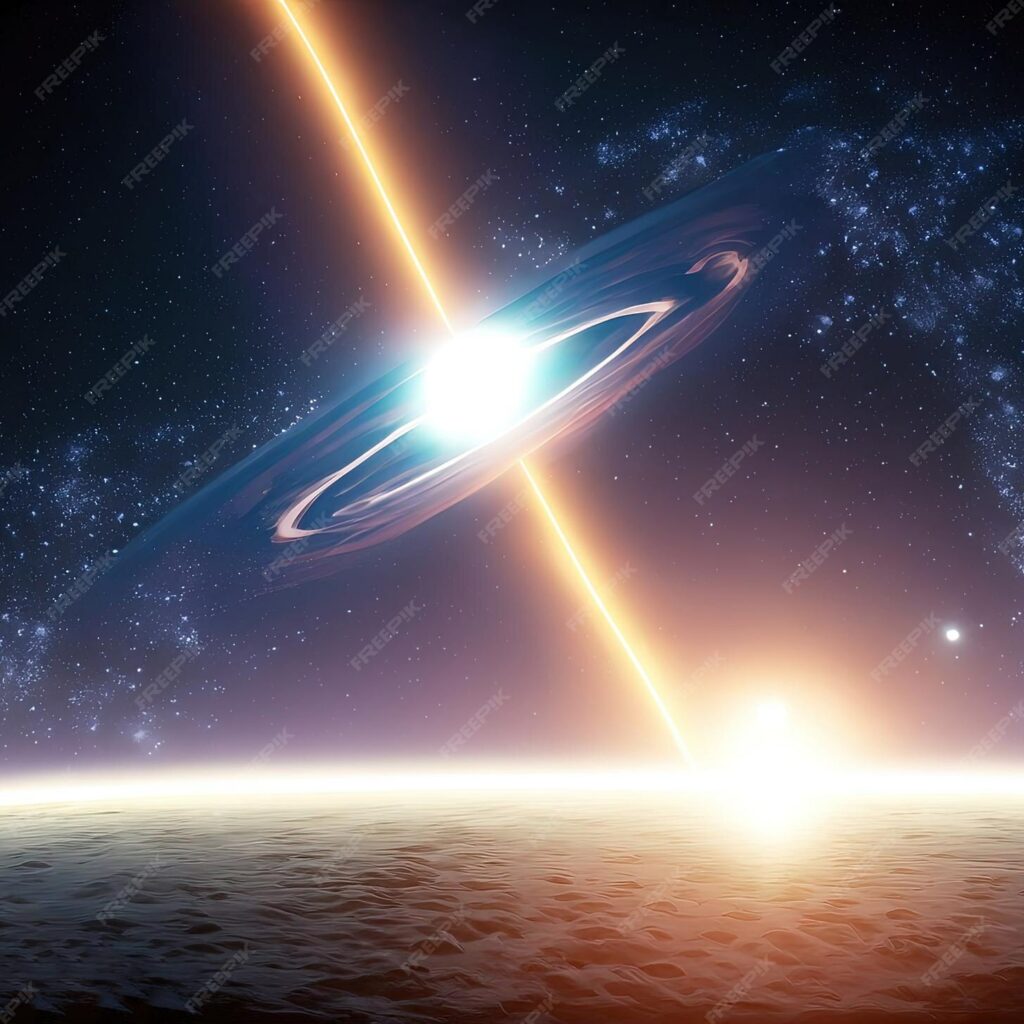
Space is almost a perfect vacuum, lacking the particles and molecules that scatter light in Earth’s atmosphere. On our planet, sunlight is diffused by air molecules, producing a bright, blue sky. In contrast, the near-empty vacuum of space allows light to travel in straight, narrow beams without spreading out. This means that unless you are directly in the path of a light source, you will perceive darkness.
Visualize photons as ripples in a vast, calm ocean with no wind to carry them outward. Each photon moves independently, confined to its beam, without creating an ambient glow. Consequently, space is characterized by isolated points of brightness separated by immense stretches of darkness.
Impact of Cosmic Scale and Light Travel Time
The universe’s age, approximately 13.8 billion years, limits how far light has traveled to reach us. This creates a cosmic horizon beyond which light has not yet arrived, meaning we cannot see all the light ever emitted. Additionally, the enormous distances cause light intensity to diminish drastically due to the inverse-square law, where brightness decreases proportionally to the square of the distance from the source.
- Cosmic Horizon:
The maximum observable distance light has traveled since the Big Bang. - Inverse-Square Law:
Light intensity weakens as it spreads over larger spherical areas with increasing distance.
Human Vision and Perception in Space
Our eyes evolved to function optimally under Earth’s atmospheric conditions, where scattered light creates a continuous ambient glow. In space, the absence of such scattering and the presence of only point-like light sources mean that unless directly looking at a star or other luminous object, the eye perceives darkness. The brain interprets this lack of diffuse light as a black backdrop punctuated by distant stars.
Cosmic Microwave Background Radiation
Beyond visible light, space is permeated by the cosmic microwave background (CMB) radiation, a faint glow left over from the early universe shortly after the Big Bang. Although this radiation fills all of space, it exists in the microwave spectrum, invisible to human eyes. The CMB serves as a subtle reminder that space is not entirely devoid of light, but this light is beyond our sensory detection.
Olbers’ Paradox and the Darkness of the Night Sky
Olbers’ paradox questions why the night sky is dark if the universe is infinite and filled uniformly with stars. The resolution lies in the universe’s dynamic nature: it is expanding, has a finite age, and stars are not evenly distributed. The expansion stretches light to longer, less visible wavelengths (redshift), and the finite speed of light limits the observable universe. These factors prevent the sky from being uniformly bright.
Philosophical and Aesthetic Significance of Cosmic Darkness
The darkness between stars is more than just an absence of light; it is a profound canvas that inspires wonder and contemplation. This vast void accentuates the brilliance of celestial bodies, creating striking contrasts that define the structure and beauty of galaxies, nebulae, and planetary systems. The interplay of light and shadow in space evokes a sense of mystery and grandeur, enriching our appreciation of the universe.
Why the Darkness of Space Matters
The darkness of space is essential for both scientific understanding and human experience. It allows astronomers to observe faint celestial objects without overwhelming background light, enabling discoveries about the universe’s origins and structure. For humanity, the night sky’s darkness fosters imagination, exploration, and a connection to the cosmos, highlighting the delicate balance between light and shadow that shapes our perception of the universe.
Summary: The Paradox of Cosmic Light and Darkness
In essence, the universe is a vast cathedral where light exists abundantly yet does not illuminate indiscriminately. Photons travel unimpeded through immense voids, but the absence of scattering, the finite speed of light, and the vast distances between sources preserve the profound darkness of space. This paradox underscores the intricate relationship between physical laws, cosmic scale, and human perception, reminding us that sometimes, it is the absence of light that reveals the most captivating wonders.

Leave a Reply