
Short Answer
Definition of Gravity and Its Discovery
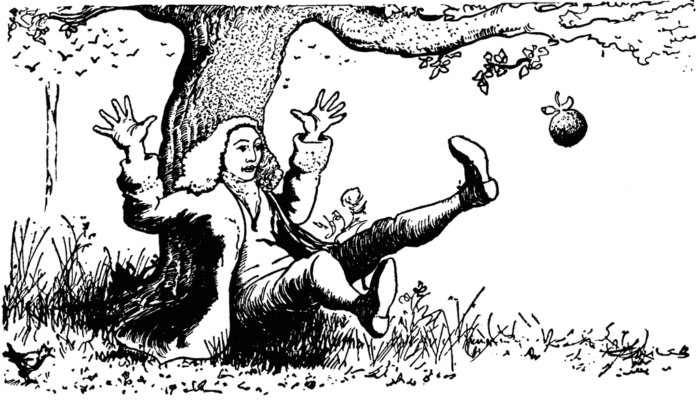
Gravity is a fundamental natural force that causes objects with mass to attract one another. The discovery of gravity is famously linked to Isaac Newton, whose work transformed our understanding of both earthly and celestial phenomena. Contrary to popular myth, Newton’s insight was not a sudden revelation triggered by an apple falling on his head, but rather the result of years of intellectual exploration and scientific inquiry.
Historical Context and Intellectual Foundations
Isaac Newton, born in 1643, was a polymath whose curiosity spanned mathematics, physics, and optics. His gravitational theory emerged from a rich background of prior scientific achievements. The experiments of Galileo Galilei on falling bodies and Johannes Kepler’s laws describing planetary motion laid the groundwork for Newton’s revolutionary ideas. These earlier discoveries hinted at a unifying principle that could explain both terrestrial and celestial movements, a challenge Newton embraced with exceptional rigor.
Newton’s Formative Years and the “Annus Mirabilis”
Newton’s most productive period, often called his “annus mirabilis” (year of wonders) during 1665-1666, occurred while he was isolated at his family estate in Woolsthorpe due to the Great Plague. It was during this time that the iconic apple incident is said to have occurred. Rather than focusing on the apple itself, Newton’s curiosity centered on why the apple fell straight down toward the Earth, prompting him to hypothesize an invisible force pulling objects toward the planet’s center.
Development of the Universal Law of Gravitation
Newton’s key breakthrough was the realization that the force causing the apple to fall was the same force governing the moon’s orbit around the Earth. To express this concept mathematically, he developed calculus, a novel mathematical framework capable of describing continuous change and motion. His law of universal gravitation states:
- Universal Gravitation Law:
Every mass attracts every other mass with a force proportional to the product of their masses and inversely proportional to the square of the distance between their centers.
This inverse-square law unified the physics of the heavens and the Earth, replacing centuries-old Aristotelian distinctions between terrestrial and celestial realms.
Mathematical Explanation of Newton’s Law
The formula for Newton’s law of universal gravitation is:
F = G × (m₁ × m₂) / r²
- F: Gravitational force between two masses
- G: Gravitational constant, a proportionality factor
- m₁ and m₂: The masses of the two objects
- r: Distance between the centers of the two masses
This equation quantifies how gravitational attraction diminishes with distance and increases with mass, providing a precise tool for predicting planetary orbits and the behavior of falling objects.
Empirical Validation and Scientific Impact
Newton’s theory was not merely theoretical; it was rigorously tested against astronomical data, including observations by Tycho Brahe. The remarkable accuracy of Newton’s calculations in predicting planetary motions solidified gravity as a foundational principle in classical physics. His work marked a turning point in science, ushering in the Enlightenment era where empirical evidence and rational thought became central to understanding the natural world.
Broader Significance and Legacy
The discovery of gravity had profound implications beyond physics and astronomy. It demonstrated the universe’s inherent order and predictability, inspiring confidence in human reason and scientific methodology. Newton’s insights laid the groundwork for future scientific advancements, influencing figures such as Albert Einstein, who later refined gravitational theory with his general relativity, and quantum physicists exploring the fundamental forces of nature.
The Interplay of Observation and Abstraction
Newton’s discovery exemplifies how everyday observations, like a falling apple, can lead to profound scientific breakthroughs when combined with creative thinking and rigorous analysis. This process highlights the importance of integrating empirical data with abstract reasoning to uncover universal laws governing the cosmos.
Common Misconceptions About Newton’s Discovery
Newton discovered gravity solely because an apple fell on his head.
The apple story is symbolic; Newton’s discovery was the result of extensive study and mathematical innovation.
Gravity only affects objects on Earth.
Gravity is a universal force acting between all masses, governing planetary orbits and cosmic structures.
Why Understanding Gravity Is Crucial
Gravity is essential for explaining a wide range of natural phenomena, from why objects fall to the ground to the motion of planets and galaxies. Its discovery revolutionized science by revealing that the universe operates according to consistent, discoverable laws. This understanding continues to underpin modern physics, engineering, space exploration, and many technologies that shape our daily lives.



Leave a Reply