
Short Answer
Definition of Stellar Size
Stellar size refers to the physical dimensions and mass of a star, encompassing its radius and total mass relative to other stars. It is a fundamental characteristic that influences a star’s brightness, lifespan, and evolutionary path. Understanding how large a star can grow involves examining the interplay between gravitational forces, radiation pressure, and the star’s chemical composition.
Formation and Growth of Stars
Stars originate within vast molecular clouds composed of gas and dust. Under the influence of gravity, these clouds collapse, forming protostars that accumulate mass by drawing in surrounding material. This accretion phase is rapid initially but is eventually limited by several physical processes that prevent indefinite growth.
- Gravity:
The inward pull that causes gas and dust to coalesce and form a star. - Radiation Pressure:
The outward force generated by the star’s intense light and energetic particles, which counteracts gravity as the star becomes more luminous.
The Eddington Limit: Theoretical Mass Boundary
The maximum mass a star can attain is often described by the Eddington limit, a critical luminosity threshold where the outward radiation pressure balances the inward gravitational force. Surpassing this limit causes the star to lose mass through powerful stellar winds, preventing further growth.
- Mass Cap:
Stars are generally believed to have an upper mass limit around 150 to 200 times that of the Sun, although this remains an area of active research. - Observational Evidence:
Some stars in regions like the Tarantula Nebula approach these upper mass limits, suggesting that extremely massive stars may exist, albeit briefly.
Radius Versus Mass: Understanding Stellar Dimensions
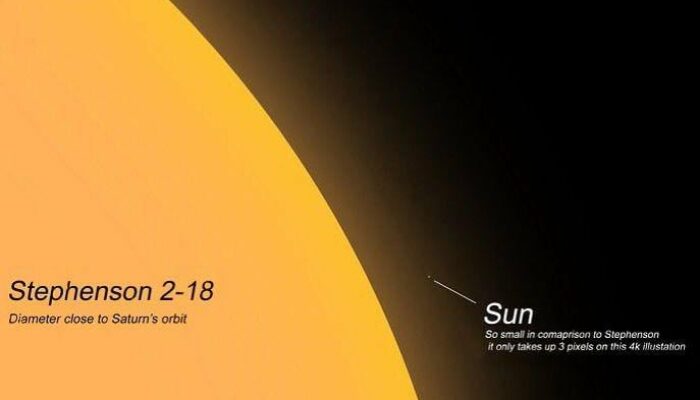
While mass is a key factor, a star’s radius-the measure of its physical size-does not always scale directly with mass. Certain stars, such as supergiants and hypergiants, exhibit enormous radii that can be hundreds or even thousands of times larger than the Sun’s diameter, despite not being the most massive.
- Supergiants:
These stars have expanded outer layers, resulting in vast volumes. For example, Betelgeuse, a red supergiant, has a radius approximately 1,000 times that of the Sun, large enough to engulf the orbit of Mars if placed at the center of our solar system. - Massive Stars:
Some stars with greater mass may have smaller radii due to denser, more compact structures.
Stellar Lifespan and Size Limitations
The internal nuclear fusion processes in massive stars burn fuel at an accelerated rate, leading to shorter lifespans-often only a few million years. This rapid consumption of fuel means that extremely large stars are rare and transient, making them difficult to observe and study.
Exotic and Early Universe Stars
Theoretical models propose the existence of Population III stars, the first generation of stars formed shortly after the Big Bang. These stars, composed almost entirely of hydrogen and helium, are thought to have been extraordinarily massive, potentially hundreds of times the mass of the Sun. Their immense size and energy output played a crucial role in shaping the early universe, contributing to cosmic reionization and the formation of early black holes.
Influence of Metallicity on Stellar Growth
Metallicity, or the abundance of elements heavier than helium in a star, significantly affects its ability to grow. Stars with low metallicity experience weaker stellar winds, which reduces mass loss and allows them to accumulate more mass before radiation pressure halts further growth. This phenomenon suggests that stars in metal-poor environments can become larger than those in metal-rich regions.
Gravity’s Role in Limiting Stellar Size
Gravity is the fundamental force that maintains a star’s structural integrity by balancing the outward pressure from nuclear fusion and radiation. Without gravity’s stabilizing influence, a star would disperse or fragment. This delicate equilibrium imposes a natural upper limit on how large a star can become, preventing infinite growth.
End Stages of Massive Stars
Most extremely large stars conclude their life cycles in dramatic events. Their cores collapse under intense gravitational pressure, triggering supernova explosions or the formation of black holes-objects characterized by immense density rather than size. These cataclysmic events disperse heavy elements into space, seeding the formation of new stars, planets, and potentially life.
Why Understanding Stellar Size Matters
Exploring the limits of stellar size deepens our comprehension of astrophysics and the forces shaping the cosmos. The diversity in star sizes-from small red dwarfs to colossal supergiants-illustrates the complex balance of physical laws governing the universe. Studying these giants enhances our knowledge of stellar evolution, cosmic recycling, and the origins of elements essential for life.
Common Misconceptions About Stellar Size
Stars can grow infinitely large if gravity is overcome.
Gravity is essential for maintaining a star’s structure; without it, the star would disintegrate rather than expand indefinitely.
The most massive stars are always the largest in size.
Some stars with enormous radii are not the most massive, as radius and mass do not always correlate directly.
Real-World Examples of Massive Stars
Several known stars exemplify the extremes of stellar size and mass:
- Betelgeuse:
A red supergiant with a radius about 1,000 times that of the Sun, notable for its immense size and brightness. - Stars in the Tarantula Nebula:
Some of the most massive stars observed, approaching the theoretical upper mass limits. - Population III Stars (Hypothetical):
Early universe stars believed to have been extraordinarily massive, influencing cosmic evolution.



Leave a Reply