
Short Answer
Definition of Gravity on Planets
Gravity is a fundamental natural force that causes all objects with mass or energy to attract one another. This force is responsible for the orbital motions of planets around stars, moons around planets, and the behavior of objects on planetary surfaces. Every planet, regardless of its size, possesses gravity due to its mass, making gravity a universal characteristic of planetary bodies.
Fundamental Principles of Planetary Gravity
Isaac Newton’s law of universal gravitation forms the basis for understanding how gravity operates between two masses. The gravitational force is directly proportional to the product of the masses involved and inversely proportional to the square of the distance separating their centers. For a planet, the gravitational acceleration at or near its surface is determined by its mass and radius, expressed mathematically as:
g = GM / R²
- g: gravitational acceleration at the planet’s surface
- G: universal gravitational constant
- M: mass of the planet
- R: radius of the planet
This formula explains why planets with larger masses and smaller radii exert stronger gravitational pulls, while smaller or less dense planets have weaker gravity.
Variations in Gravity Among Different Types of Planets
Terrestrial Planets
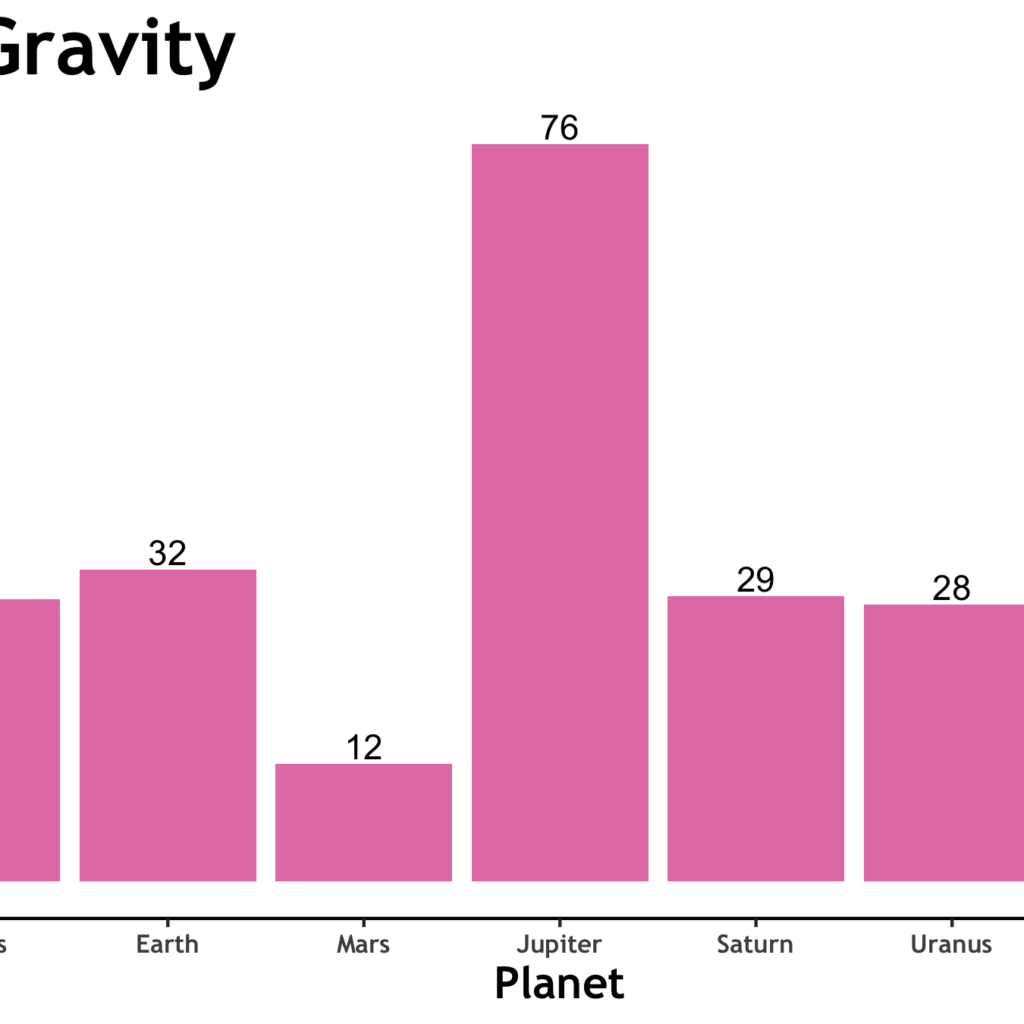
Terrestrial planets, such as Earth, Mars, Venus, and Mercury, are primarily composed of rock and metal, resulting in dense structures. Despite their relatively smaller sizes compared to gas giants, their dense composition leads to significant surface gravity. For example, Earth’s gravity is approximately 9.8 m/s², a force that influences everything from falling objects to atmospheric retention. Mars, with about 38% of Earth’s gravity, demonstrates how reduced mass and radius diminish gravitational strength, which in turn affects its thin atmosphere.
Gas Giants
Gas giants like Jupiter and Saturn are massive planets mainly made up of hydrogen and helium. Their enormous size and mass generate strong gravitational fields at or near their cloud tops. Jupiter’s surface gravity is about 24.79 m/s², more than double that of Earth. However, since these planets lack solid surfaces, the experience of gravity differs from terrestrial planets, adding complexity to how their gravity influences their environments.
Dwarf and Icy Planets
Dwarf planets and icy bodies, including Pluto, Eris, and Ceres, have much smaller masses and radii, resulting in weaker gravitational forces. Pluto’s gravity, for instance, is roughly 0.62 m/s², which is insufficient to retain a thick atmosphere and leads to unique surface processes like the sublimation of ice directly into gas. These low-gravity worlds provide valuable insights into planetary formation and evolution under different gravitational conditions.
Impact of Gravity on Planetary Atmospheres and Habitability
The strength of a planet’s gravity plays a crucial role in its ability to hold onto an atmosphere, which is essential for potential habitability. Planets with weak gravity struggle to maintain gaseous envelopes, often resulting in thin or nonexistent atmospheres. Mercury exemplifies this, with its minimal gravity and exposure to solar wind causing it to have almost no atmosphere. In contrast, Earth’s gravity supports a dense atmosphere conducive to life, while Mars’ weaker gravity contributes to its sparse atmospheric conditions. Understanding these gravitational effects is vital in fields like planetary science and astrobiology, as they influence climate, geological activity, and the possibility of life.
Gravity Beyond Planets: Other Celestial Bodies
Gravity is not exclusive to planets; all objects with mass, including moons, asteroids, and comets, generate gravitational fields. For example, Earth’s moon has enough gravity to affect tides and maintain a surface environment. The gravitational interactions among these bodies create complex orbital dynamics and shape their physical characteristics.
Gravity in Exoplanetary Systems
With the discovery of thousands of exoplanets orbiting stars beyond our solar system, it is evident that gravity is a universal force acting on all planetary bodies. These exoplanets exhibit a wide range of masses, sizes, and compositions, leading to diverse gravitational strengths. Studying gravity in these distant systems broadens our understanding of planetary environments and the potential for habitability in the universe.
Common Misconceptions About Planetary Gravity
Only large planets have gravity.
All objects with mass, regardless of size, exert gravitational force, including small planets, moons, and asteroids.
Gravity is the same on all planets.
Gravity varies widely depending on a planet’s mass, radius, and density, resulting in different gravitational strengths.
Significance of Understanding Planetary Gravity
Grasping the nature of gravity on planets is essential for comprehending the structure and behavior of celestial bodies. Gravity influences planetary formation, atmospheric retention, climate, and the potential for life. It also governs orbital mechanics and interactions within solar systems and beyond. By studying gravity, scientists gain deeper insights into the forces shaping the cosmos and the conditions that make planets hospitable or hostile to life.
FAQ
Do smaller planets have gravity?
Yes, all planets, regardless of size, have gravity due to their mass.
How does gravity affect atmospheric retention?
A planet's gravity influences its ability to hold an atmosphere; weaker gravity can lead to thinner atmospheres.

Leave a Reply