
Short Answer
Definition of Dark Energy
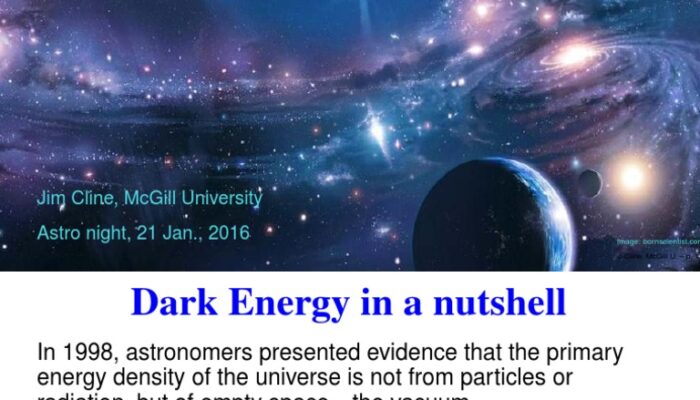
Dark energy is a mysterious and invisible force believed to be responsible for the accelerated expansion of the universe. Unlike ordinary matter and energy, it cannot be directly observed but is inferred through its gravitational effects on cosmic structures and the large-scale dynamics of spacetime. It constitutes approximately 68% of the total energy content of the cosmos, making it a dominant yet enigmatic component of the universe.
Historical Context and Discovery
Initially, scientists assumed that the universe’s expansion was decelerating due to gravitational attraction among matter. However, observations in the late 20th century, particularly from distant supernovae, revealed that the expansion rate is actually increasing. This unexpected acceleration led to the postulation of dark energy as the driving force behind this phenomenon, fundamentally altering our understanding of cosmology.
Characteristics and Observational Evidence
Dark energy exerts a repulsive pressure that counterbalances gravitational attraction, causing the universe to expand at an accelerating pace. Its density is extraordinarily low, roughly 10⁻²⁹ grams per cubic centimeter, making its direct detection nearly impossible. Instead, scientists rely on indirect measurements such as:
- Supernova Luminosity Surveys:
Observations of Type Ia supernovae serve as “standard candles” to measure cosmic distances and expansion rates. - Cosmic Microwave Background (CMB):
Fluctuations in the CMB provide insights into the early universe’s composition and expansion history. - Baryon Acoustic Oscillations (BAO):
Patterns in the distribution of galaxies reveal the scale of cosmic expansion over time.
These datasets collectively form a complex puzzle that challenges current experimental precision and theoretical models.
Theoretical Challenges: The Cosmological Constant Problem
One of the most profound theoretical dilemmas is the discrepancy between quantum field theory predictions and cosmological observations, known as the “cosmological constant problem.” Quantum mechanics suggests a vacuum energy density (zero-point energy) that is about 10¹²⁰ times larger than what is observed through cosmology. This vast mismatch exposes significant gaps in our understanding of fundamental physics and the nature of vacuum energy.
Dark Energy and General Relativity
Dark energy also prompts a reevaluation of Einstein’s theory of general relativity. The cosmological constant, originally introduced by Einstein and later abandoned, has been revived as a mathematical representation of dark energy. However, whether dark energy is a constant or varies over time remains uncertain. Alternative theories propose dynamic fields or modifications to gravity that extend beyond the standard model of particle physics, each introducing complex new mathematics and concepts that have yet to be empirically confirmed.
Scale and Measurement Difficulties
Dark energy’s effects manifest predominantly on cosmic scales, far exceeding the reach of terrestrial or solar system experiments. The immense scale of the universe dilutes its influence, requiring observations that span billions of light-years. Additionally, the accelerated expansion is a relatively recent cosmic event, complicating efforts to measure dark energy’s impact across different epochs. This temporal and spatial vastness introduces significant uncertainties in data interpretation.
Philosophical and Epistemological Implications
The enigma of dark energy challenges not only scientific models but also philosophical perspectives on reality and knowledge. It implies that the majority of the universe’s energy content is composed of an entity that remains largely incomprehensible. This raises fundamental questions about the limits of human understanding, the nature of observation, and the frameworks through which we interpret the cosmos.
Relationship Between Dark Energy and Dark Matter
Dark energy coexists with dark matter, another unseen component that makes up about 27% of the universe. While dark matter clusters to form gravitational wells that shape galaxies and cosmic structures, dark energy appears to act uniformly, driving the expansion of space itself. The interaction and coexistence of these two mysterious substances remain an open area of research, hinting at a deeper, unified theory yet to be discovered.
Interdisciplinary Nature of Dark Energy Research
Understanding dark energy requires integrating knowledge from multiple scientific disciplines, including cosmology, quantum mechanics, particle physics, string theory, and quantum gravity. Each field contributes unique concepts and mathematical frameworks, often involving complex computational models and simulations. This interdisciplinary approach is essential but also adds layers of complexity to the quest for a comprehensive theory.
Human Endeavor and Scientific Progress
The pursuit of understanding dark energy exemplifies human curiosity and intellectual resilience. It highlights the provisional nature of scientific knowledge, where each breakthrough often reveals new questions rather than definitive answers. This ongoing investigation drives technological innovation, inspires the development of more advanced telescopes and instruments, and fosters global collaboration among scientists.
Why Understanding Dark Energy Is Crucial
Deciphering the nature of dark energy is vital for comprehending the ultimate fate and origin of the universe. It challenges the boundaries between observable phenomena and theoretical constructs, pushing the limits of measurement and imagination. Unlocking its secrets could revolutionize physics, reshape cosmological models, and deepen our grasp of the universe’s fundamental workings.
Future Prospects and Ongoing Research
With upcoming space missions and experimental advancements, there is growing optimism that the mysteries surrounding dark energy will gradually be unveiled. These efforts aim to refine measurements, test new theories, and potentially reveal the true nature of this elusive force. Until then, dark energy remains one of the most profound puzzles in modern science, symbolizing both the vastness of the cosmos and the enduring quest for knowledge.
FAQ
What is dark energy?
Dark energy is a mysterious force believed to be responsible for the accelerated expansion of the universe.
Why is dark energy important?
Understanding dark energy is crucial for comprehending the universe’s ultimate fate and origin.
Leave a Reply