
Short Answer
Definition of the Universe’s Composition
The universe encompasses everything that exists in space and time, including all matter, energy, galaxies, stars, planets, and the vast voids between them. Understanding what constitutes the universe involves identifying its fundamental components, both visible and invisible, and recognizing their roles in shaping cosmic evolution. This knowledge extends beyond scientific inquiry, offering profound insights into our place within the cosmos.
Constituents of the Universe
At first glance, it may appear that the universe is made up solely of the matter we can observe-atoms forming stars, planets, and living beings. However, this visible matter represents only a small fraction of the universe’s total content. The cosmic inventory is primarily composed of three main elements:
- Ordinary Matter:
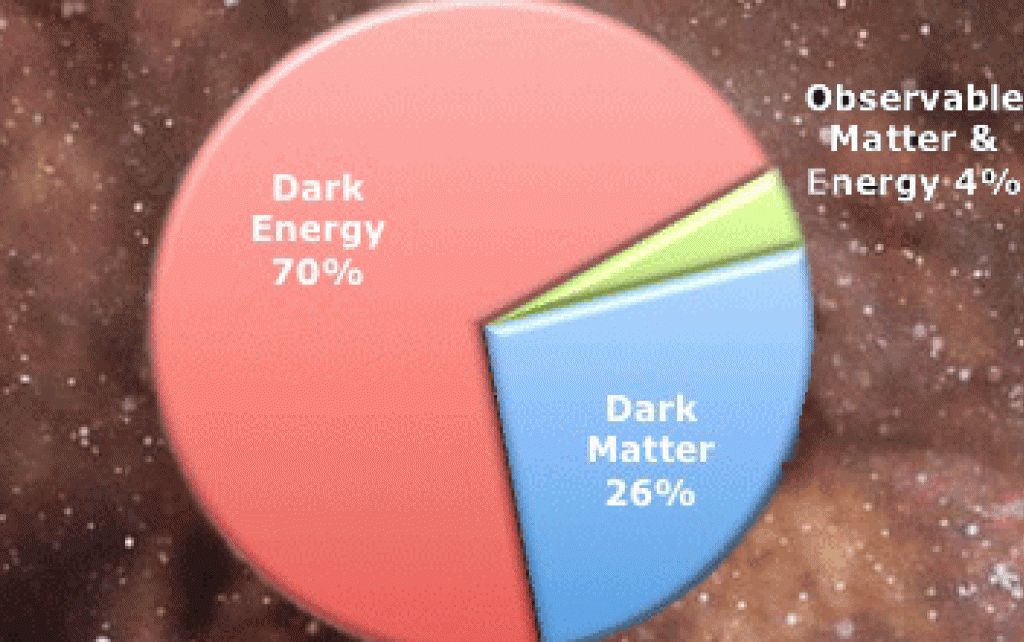
This includes protons, neutrons, and electrons that combine to form atoms and molecules, creating everything from mountains to living organisms. Despite its familiarity, ordinary matter accounts for roughly 5% of the universe. - Dark Matter:
An elusive form of matter that does not emit, absorb, or reflect light, making it invisible to current detection methods. Dark matter constitutes about 27% of the universe and is inferred through its gravitational influence on visible matter and cosmic structures. - Dark Energy:
A mysterious energy permeating all of space, responsible for the accelerated expansion of the universe. Dark energy dominates the cosmic energy budget at approximately 68%, profoundly affecting the universe’s fate.
Understanding Ordinary Matter
Ordinary matter, also known as baryonic matter, is composed of atoms formed by subatomic particles. Protons and neutrons, which reside in atomic nuclei, are themselves made up of quarks held together by the strong nuclear force, mediated by gluons. Electrons belong to the lepton family and are fundamental particles without known internal structure. These particles form the basis of the Standard Model of particle physics, which explains the behavior and interactions of known matter.
The Enigma of Dark Matter
Dark matter remains one of the most profound mysteries in modern physics. It neither emits nor absorbs electromagnetic radiation, rendering it invisible to telescopes. Its existence is inferred from gravitational effects, such as the rotation curves of galaxies and gravitational lensing, where light from distant objects bends around unseen mass. Theories suggest dark matter may consist of exotic particles like Weakly Interacting Massive Particles (WIMPs) or axions, but definitive identification remains elusive.
Dark Energy and Cosmic Expansion
Dark energy is a form of energy intrinsic to space itself, driving the universe’s accelerated expansion. Discovered through observations of distant supernovae, dark energy challenges previous assumptions that gravity would slow cosmic expansion. Instead, it acts as a repulsive force, constituting nearly 68% of the universe’s total energy. Its nature is still speculative, with hypotheses ranging from a cosmological constant to dynamic fields evolving over time.
How Scientists Study the Universe’s Composition
Researchers employ various observational techniques to unravel the universe’s makeup:
- Gravitational Lensing:
The bending of light by massive objects reveals the presence of dark matter by mapping its gravitational influence. - Cosmic Microwave Background (CMB):
The faint afterglow of the Big Bang provides a snapshot of the early universe, allowing precise measurements of its composition and geometry. - Supernova Surveys:
Observations of exploding stars at vast distances have uncovered the accelerating expansion, indicating dark energy’s dominance.
Mathematical Framework: The Cosmic Energy Budget
The universe’s composition is often expressed in terms of density parameters (Ω), representing the fraction of the total energy density contributed by each component:
- Ωordinary ≈ 0.05: Fraction of ordinary (baryonic) matter.
- Ωdark matter ≈ 0.27: Fraction of dark matter.
- Ωdark energy ≈ 0.68: Fraction of dark energy.
The sum of these parameters approximates unity (Ωtotal ≈ 1), consistent with a flat universe as predicted by inflationary cosmology.
Real-World Implications and Examples
The invisible components of the universe have tangible effects on cosmic structures and phenomena:
- Galaxy Formation:
Dark matter’s gravitational pull acts as a scaffold, enabling galaxies to form and maintain their structure. - Cosmic Web:
The large-scale distribution of matter forms a vast network of filaments and voids shaped by dark matter. - Accelerating Universe:
Dark energy influences the ultimate fate of the cosmos, potentially leading to scenarios like the Big Freeze or Big Rip.
Common Misconceptions About the Universe’s Composition
The universe is mostly made of stars and planets.
Visible matter like stars and planets constitutes only about 5% of the universe; the majority is dark matter and dark energy.
Dark matter and dark energy are the same.
Dark matter is a form of matter influencing gravity, while dark energy is a mysterious force causing cosmic acceleration.
Ordinary matter is fully understood.
While well-studied, ordinary matter’s fundamental particles and interactions still leave open questions beyond the Standard Model.
Significance of Understanding the Universe’s Composition
Grasping what the universe is made of is crucial for multiple reasons. Scientifically, it guides the development of theories explaining cosmic evolution, particle physics, and fundamental forces. Technologically, insights into dark matter and dark energy could revolutionize energy and materials science. Philosophically, this knowledge reshapes humanity’s view of its place in the cosmos, fostering a sense of humility and wonder about the vast, largely unseen forces that govern existence.
Future Directions in Cosmic Research
Despite remarkable progress, many questions remain unanswered. Scientists continue to investigate the precise nature of dark matter particles, the properties and variability of dark energy, and the possibility of unknown forces or dimensions. Upcoming experiments and observatories, such as the James Webb Space Telescope and next-generation particle detectors, aim to shed light on these cosmic enigmas, pushing the boundaries of human understanding.
Conclusion: Embracing the Cosmic Mystery
The universe is a complex mosaic of visible matter intertwined with vast, invisible components that dominate its structure and destiny. Recognizing that ordinary matter is a minor player amidst dark matter and dark energy invites us to expand our perspective beyond the tangible. This ongoing quest to decode the universe’s composition exemplifies humanity’s relentless curiosity and the profound journey toward comprehending the extraordinary fabric of reality.



Leave a Reply