
Short Answer
Definition of Dark Matter
Dark matter is a mysterious and invisible form of matter that constitutes a significant portion of the universe’s total mass. Unlike ordinary matter, it does not emit, absorb, or reflect light, making it undetectable through traditional electromagnetic observations. Despite its invisibility, dark matter exerts a powerful gravitational influence that shapes the formation and evolution of galaxies, galaxy clusters, and the large-scale cosmic structure.
- Invisible Nature:
Dark matter cannot be observed directly with telescopes because it does not interact with electromagnetic radiation. - Gravitational Effects:
Its presence is inferred from the gravitational pull it exerts on visible matter and light. - Cosmic Significance:
It acts as the underlying framework that governs the distribution and movement of galaxies across the universe.
Historical Background and Discovery
The concept of dark matter emerged in the early 20th century when astronomers noticed inconsistencies between observed gravitational effects and the amount of visible matter. In the 1930s, Fritz Zwicky studied galaxy clusters and found that the visible mass was insufficient to account for the gravitational forces holding the clusters together. Later, in the 1970s, Vera Rubin’s analysis of galactic rotation curves revealed that stars at the edges of galaxies moved faster than expected, suggesting the presence of an unseen mass component. These pioneering observations laid the foundation for the dark matter hypothesis.
Physical Properties and Interaction
Dark matter is characterized by its lack of interaction with electromagnetic forces, meaning it neither emits nor absorbs light. Its existence is deduced solely through gravitational effects on visible matter, radiation, and the large-scale structure of the universe. This non-interactive nature makes detecting dark matter extremely challenging, requiring innovative experimental and theoretical approaches.
Classification of Dark Matter Types
Dark matter candidates are generally classified based on their velocity and impact on cosmic structure formation:
- Cold Dark Matter (CDM):
Composed of slow-moving particles, CDM supports the formation of galaxies and clusters, aligning with the widely accepted Lambda Cold Dark Matter (ΛCDM) cosmological model. - Warm Dark Matter (WDM):
Consists of particles with intermediate speeds, potentially resolving some small-scale structure issues not fully explained by CDM. - Hot Dark Matter (HDM):
Made up of fast-moving particles such as neutrinos, HDM tends to smooth out smaller cosmic structures.
Potential Dark Matter Candidates
Several hypothetical particles have been proposed as constituents of dark matter, each with unique theoretical motivations and detection challenges:
- Weakly Interacting Massive Particles (WIMPs):
These particles were once the leading candidates due to their predicted mass and weak-scale interactions consistent with supersymmetry theories. - Axions:
Ultra-light particles arising from quantum chromodynamics, axions offer solutions to certain particle physics problems and remain a compelling dark matter candidate. - Sterile Neutrinos:
Hypothetical neutrinos that do not interact via the weak force, potentially contributing to dark matter’s mass. - Other Exotic Particles:
Various other theoretical particles have been suggested, each influencing cosmology and detection strategies differently.
Methods of Detecting Dark Matter
Detecting dark matter involves multiple complementary approaches:
- Direct Detection:
Experiments aim to observe rare collisions between dark matter particles and atomic nuclei using highly sensitive detectors placed deep underground to minimize background noise. - Indirect Detection:
Searches focus on detecting secondary particles such as gamma rays, cosmic rays, or neutrinos produced by dark matter annihilation or decay in space. - Collider Searches:
Particle accelerators attempt to create dark matter particles by replicating the high-energy conditions of the early universe and identifying missing energy signatures.
Dark Matter’s Role in Cosmology
Dark matter is a fundamental component in the standard cosmological model, accounting for approximately 27% of the universe’s total mass-energy content. Its gravitational influence is critical in shaping the cosmic microwave background (CMB) anisotropies, which provide a snapshot of the early universe’s composition and geometry. Observations from satellites like Planck have reinforced the importance of dark matter in cosmic evolution, influencing galaxy formation, gravitational lensing, and the large-scale structure of the cosmos.
Gravitational Lensing and Dark Matter Mapping
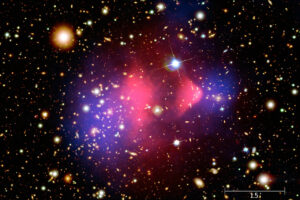
One of the most striking manifestations of dark matter’s presence is gravitational lensing, where massive concentrations of dark matter bend and magnify light from distant celestial objects. This effect allows astronomers to create detailed maps of dark matter distribution in galaxy clusters and halos surrounding galaxies, offering direct evidence of its existence and spatial arrangement over cosmic time.
Challenges and Open Questions
Despite significant progress, several puzzles remain in understanding dark matter fully. Notable issues include:
- Core-Cusp Problem:
Discrepancies between observed density profiles of dwarf galaxies and those predicted by cold dark matter simulations. - Missing Satellites Problem:
The observed number of small satellite galaxies is fewer than predicted by theoretical models.
These challenges suggest the need for refined dark matter models or the inclusion of baryonic physics and feedback processes in simulations.
Current Research and Future Directions
Modern investigations into dark matter integrate multi-messenger astrophysics, sophisticated computational simulations, and cutting-edge detection technologies. Collaborative efforts among ground-based observatories, space missions, and underground laboratories foster a dynamic environment for discovery. This interdisciplinary approach accelerates the quest to identify dark matter’s true nature and its role in the universe.
Significance of Dark Matter in Science and Beyond
Dark matter represents the unseen framework that governs the universe’s structure and dynamics. Its discovery has transformed our understanding of cosmology, gravitation, and particle physics, challenging existing theories and expanding scientific horizons. The ongoing pursuit to decode dark matter is not only a scientific challenge but also a profound journey into the fundamental fabric of reality, with the potential to reshape our comprehension of the cosmos and our place within it.
FAQ
What is dark matter?
Dark matter is an invisible form of matter that makes up a significant portion of the universe’s mass, inferred through its gravitational effects.
Why can't dark matter be seen?
Dark matter does not emit, absorb, or reflect light, making it undetectable through traditional observational methods.
What are the types of dark matter?
Dark matter is generally classified into Cold Dark Matter (CDM), Warm Dark Matter (WDM), and Hot Dark Matter (HDM), based on particle velocity.



Leave a Reply