

Short Answer
Definition of Dark Stars
Dark stars are a hypothesized category of celestial bodies composed primarily of dark matter, an invisible substance that neither emits nor absorbs light. Unlike conventional stars fueled by nuclear fusion, dark stars would derive their energy from the annihilation of dark matter particles within them. These objects, if they exist, represent a unique intersection between astrophysics and particle physics, potentially illuminating the nature of the universe’s elusive dark matter component.
- Dark Matter:
A form of matter that does not interact with electromagnetic radiation, making it invisible to telescopes but detectable through its gravitational effects. - Dark Stars:
Hypothetical stars powered by dark matter annihilation rather than nuclear fusion, possibly faint or invisible in traditional electromagnetic spectra.
Background and Significance of Dark Matter
Dark matter constitutes roughly 27% of the universe’s total mass-energy content, yet it remains one of the most profound mysteries in modern cosmology. Although it cannot be observed directly, its presence is inferred from gravitational influences on visible matter, the cosmic microwave background, and the large-scale structure of the cosmos. The concept of dark stars introduces a new dimension to dark matter research by suggesting that dark matter might clump together into star-like formations, challenging existing paradigms about its distribution and behavior.
Theoretical Foundations of Dark Stars
The idea of dark stars emerged from theoretical models that propose these objects formed in the early universe. Unlike ordinary stars, which generate energy through nuclear fusion of hydrogen and helium, dark stars would be powered by the self-annihilation of dark matter particles, such as weakly interacting massive particles (WIMPs). This process could produce a faint glow in specific electromagnetic wavelengths or render the stars nearly invisible, placing them in a unique astrophysical category that bridges stellar evolution and particle physics.
Observational Evidence from the James Webb Space Telescope
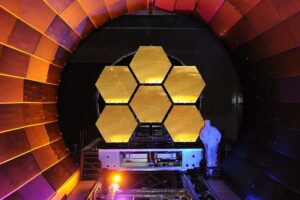
The James Webb Space Telescope (JWST), designed to explore the farthest reaches of space and time, has recently detected unusual astrophysical signals that may correspond to the predicted characteristics of dark stars. These observations include atypical brightness fluctuations and spectral signatures from distant celestial sources that cannot be fully explained by known baryonic matter phenomena. Such findings have sparked renewed interest and debate within the scientific community regarding the existence of dark stars.
Challenges in Identifying Dark Stars
Distinguishing dark stars from other cosmic objects is a complex task due to the subtlety of their expected signals. Conventional stars, nebulae, black holes, and neutron stars each leave distinct imprints on the data collected by JWST. To confirm the presence of dark stars, scientists must rigorously model these signals and critically evaluate alternative explanations, including cosmic dust interference, gravitational lensing effects, and instrumental anomalies. This meticulous process is essential to avoid misinterpretation and confirmation bias.
Implications for Cosmology and Galaxy Formation
The potential existence of dark stars raises fundamental questions about the formation and evolution of cosmic structures. If dark matter can aggregate into star-like bodies, it challenges current models of galaxy formation and the distribution of dark matter within galactic halos. Understanding the mechanisms behind dark star formation and their interaction with ordinary matter could resolve persistent discrepancies in cosmological observations and enhance our comprehension of the universe’s large-scale architecture.
Dark Stars as Probes of Particle Physics
Beyond their astrophysical significance, dark stars could serve as natural laboratories for investigating the properties of dark matter particles. Many theories suggest that dark matter consists of WIMPs, which may annihilate or decay under certain conditions. Observing dark stars powered by such processes could provide direct insights into particle interactions that are currently inaccessible to Earth-based experiments, thereby advancing both cosmology and fundamental physics.
Alternative Explanations and Scientific Caution
While the dark star hypothesis is compelling, alternative explanations must be considered. Other exotic objects, such as primordial black holes, unusual compact objects, or transient cosmic phenomena, might produce observational effects similar to those attributed to dark stars. Disentangling these possibilities requires not only enhanced data from JWST but also coordinated observations across multiple wavelengths and sophisticated computational simulations to validate findings.
Future Prospects and the Quest for Understanding
The preliminary indications from JWST have opened an exciting frontier where cosmology, particle physics, and stellar astronomy converge. Confirming the existence of dark stars would mark a transformative milestone in our understanding of the cosmos, revealing a hidden chapter of cosmic history. As observational technologies advance and analytical methods improve, the scientific community remains poised to unravel this profound cosmic mystery.
Conclusion
Although the concept of dark stars remains speculative, the intriguing data from the James Webb Space Telescope suggest a potential paradigm shift in astrophysics. Whether these signals represent invisible stellar objects composed of dark matter or complex interactions of known cosmic phenomena, ongoing research will be crucial. The universe continues to surprise us, inviting humanity to explore its depths with curiosity and rigor, expanding the boundaries of knowledge beyond what we once imagined possible.
FAQ
What are dark stars?
Dark stars are hypothetical celestial bodies that derive their energy from dark matter annihilation.
What role does the James Webb Space Telescope play in dark matter research?
It is designed to detect signals that may indicate the existence of dark stars.

Leave a Reply