
Short Answer
Definition of Dark Matter and Its Mass
Dark matter is a mysterious and invisible component of the universe that neither emits nor absorbs electromagnetic radiation, making it undetectable by conventional telescopes. Despite its invisibility, it exerts a significant gravitational influence on visible matter, shaping the formation and dynamics of galaxies, stars, and planetary systems. A central question in astrophysics is whether dark matter possesses mass, a property fundamental to its gravitational effects and the structure of the cosmos.
Gravitational Evidence Supporting Dark Matter’s Mass
Mass is intrinsically linked to gravity, as it is the source of gravitational attraction. Dark matter’s presence is inferred primarily through its gravitational effects, which cannot be explained by visible matter alone. For instance, the rotational speeds of stars in galaxies remain unexpectedly high at their outer edges, defying Newtonian predictions if only luminous matter were present. This discrepancy suggests an unseen mass enveloping galaxies, exerting additional gravitational pull.
Another compelling piece of evidence is gravitational lensing, where light from distant celestial bodies bends around massive objects. The observed lensing patterns indicate the presence of substantial, invisible mass distorting spacetime, consistent with Einstein’s theory of General Relativity. These phenomena collectively affirm that dark matter behaves as a mass-bearing entity, influencing the universe’s large-scale structure.
Particle Physics and Theoretical Perspectives on Dark Matter Mass
From the standpoint of particle physics, dark matter candidates such as Weakly Interacting Massive Particles (WIMPs) are hypothesized to carry mass, potentially ranging from fractions to hundreds of times the proton’s mass. These particles interact weakly with ordinary matter, making direct detection challenging despite sophisticated underground and Antarctic experiments designed to capture rare collision events.
However, the nature of dark matter remains elusive, as it does not engage with electromagnetic or strong nuclear forces, limiting detection methods to indirect observations. This has led to alternative theories that question the necessity of dark matter’s mass altogether.
Alternative Theories Challenging the Mass Concept
Some scientific models, such as Modified Newtonian Dynamics (MOND) and emergent gravity, propose that the gravitational anomalies attributed to dark matter might instead arise from modifications to our understanding of gravity itself. These frameworks suggest that the observed galactic rotation curves and cosmic phenomena could be explained without invoking unseen mass, challenging the conventional view that dark matter must possess mass to account for gravitational effects.
Cosmological Importance of Dark Matter’s Mass
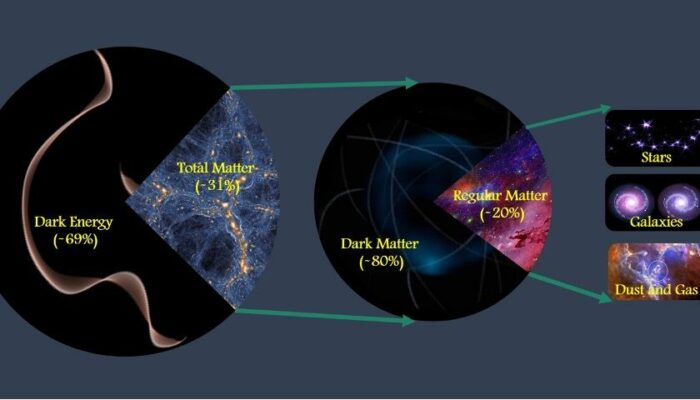
The prevailing cosmological model, Lambda Cold Dark Matter (ΛCDM), relies heavily on the assumption that dark matter has mass. This model successfully explains the formation of large-scale cosmic structures, fluctuations in the cosmic microwave background, and the timeline of galaxy formation. Dark matter’s mass is estimated to constitute about five times the amount of ordinary matter, profoundly influencing the universe’s evolution and ultimate fate.
Its gravitational dominance shapes the cosmic web of filaments and voids, acting as an invisible framework upon which visible matter accumulates. Understanding dark matter’s mass is therefore crucial for comprehending the universe’s architecture and dynamics.
Experimental Searches and Challenges
Efforts to detect dark matter particles directly focus on capturing the subtle interactions between dark matter and ordinary matter. Experiments located deep underground or embedded in polar ice aim to observe rare collisions that would confirm the mass and particle nature of dark matter. Despite decades of research, these experiments have yet to yield definitive results, maintaining the mystery surrounding dark matter’s properties.
Implications of Dark Matter’s Mass for Physics
The question of whether dark matter carries mass extends beyond astrophysics into fundamental physics. Confirming or refuting the mass of dark matter could prompt a paradigm shift in our understanding of gravity, particle physics, and the fundamental forces. Should dark matter be massless or require a redefinition of mass itself, it would necessitate revising established theories and potentially uncovering new physics that bridges gravity and quantum mechanics.
Common Misconceptions About Dark Matter and Mass
Dark matter is simply ordinary matter that is invisible.
Dark matter is fundamentally different from baryonic matter; it does not interact electromagnetically and cannot be detected by light-based instruments.
Dark matter’s gravitational effects can be explained without it having mass.
While alternative theories exist, the majority of evidence supports that dark matter’s gravitational influence arises from its mass.
Why Understanding Dark Matter’s Mass Is Crucial
Recognizing that dark matter possesses mass is vital for explaining the universe’s structure, from the smallest galaxies to the vast cosmic web. It informs models of cosmic evolution, the behavior of gravitational forces, and the distribution of matter throughout space. Moreover, it challenges scientists to refine detection methods and theoretical frameworks, pushing the boundaries of knowledge in both astrophysics and particle physics.
Conclusion: The Ongoing Quest to Unveil Dark Matter’s Nature
While the evidence strongly indicates that dark matter carries mass, its exact nature remains one of the most profound mysteries in modern science. Its mass is inferred through gravitational effects rather than direct observation, making it a silent yet powerful architect of the cosmos. As technology advances and theoretical models evolve, the pursuit to understand dark matter’s mass continues to inspire scientific innovation and philosophical reflection on the universe’s hidden dimensions.
FAQ
What is dark matter?
Dark matter is an invisible component of the universe that exerts gravitational influence but does not emit or absorb light.
Does dark matter have mass?
Current evidence strongly suggests that dark matter possesses mass, inferred from its gravitational effects on visible matter.


Leave a Reply