
Short Answer
Understanding Dark Matter and Its Cosmic Role
Dark matter is a mysterious and invisible form of matter that does not emit, absorb, or reflect light, making it undetectable through electromagnetic observations. Despite this, its presence is inferred from its gravitational effects on visible matter, radiation, and the large-scale structure of the universe. Constituting roughly 27% of the total mass-energy content of the cosmos, dark matter plays a crucial role in shaping galaxies and clusters by acting as an unseen gravitational scaffold around which ordinary matter accumulates.
- Invisible Nature:
Dark matter cannot be observed directly with telescopes because it does not interact with electromagnetic forces. - Gravitational Influence:
Its existence is deduced from phenomena such as galaxy rotation curves, gravitational lensing, and cosmic microwave background fluctuations. - Cosmic Abundance:
It makes up a significant portion of the universe’s total mass, far exceeding the amount of ordinary matter.
Traditional Cosmological Perspective on Dark Matter
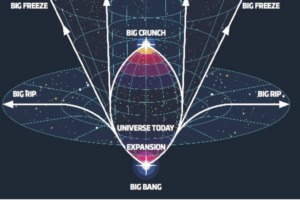
In the standard cosmological model, dark matter is thought to have formed shortly after the Big Bang, emerging from the primordial plasma alongside ordinary matter and radiation. This model treats the Big Bang as the absolute starting point of space, time, matter, and energy. According to this view, dark matter particles originated within the first fractions of a second after the universe began expanding and cooling, eventually influencing the formation of cosmic structures.
Exploring the Possibility of Pre-Big Bang Dark Matter
Challenging the conventional timeline, some theoretical frameworks propose that dark matter might have existed before the Big Bang itself. This idea questions the Big Bang as the ultimate origin and suggests that dark matter could be a primordial entity predating not only galaxies and stars but even the fabric of spacetime. Such speculation arises from advanced theories in physics, including:
- Multiverse Hypothesis:
Proposes multiple or infinite universes, where dark matter could persist across different cosmic cycles. - Cyclic Cosmologies:
Suggests the universe undergoes endless expansions and contractions, allowing dark matter to survive through cosmic bounces. - Quantum Gravity Theories:
Including string theory and loop quantum gravity, these models imply the Big Bang is a transitional phase rather than an absolute beginning.
Theoretical Challenges of Pre-Big Bang Dark Matter
Imagining dark matter existing before the Big Bang confronts profound difficulties, especially regarding the nature of time and space at that epoch. The Planck epoch, occurring within 10-43 seconds after the Big Bang, marks a boundary where classical physics breaks down and spacetime may be quantized or fundamentally discrete. Under such extreme conditions, the form and behavior of dark matter become uncertain:
- Would dark matter retain its particulate nature, or transform into a quantum field intertwined with spacetime geometry?
- How could dark matter interact or persist when conventional concepts of time and space lose meaning?
Empirical Clues and Observational Evidence
While direct evidence for pre-Big Bang dark matter remains elusive, certain cosmological observations hint at phenomena that challenge the standard post-Big Bang origin narrative. Anomalies in the cosmic microwave background radiation, unexpected patterns in large-scale galaxy distributions, and gravitational lensing effects sometimes suggest the influence of primordial dark matter components. Some models even propose that dark matter fields could have played a role in triggering or shaping the inflationary phase of the early universe.
Dark Matter and the Dark Sector
The concept of pre-Big Bang dark matter also connects with broader ideas about a “dark sector” – a hypothesized realm of particles and forces beyond the Standard Model of particle physics. This sector might include dark radiation and other exotic energy forms that influence cosmic evolution across multiple epochs. If dark matter originates from such a dark sector with roots predating the Big Bang, its properties, interactions, and decay mechanisms could differ significantly from current assumptions, opening new avenues for detection and study.
Philosophical and Scientific Implications
Contemplating the existence of dark matter before the Big Bang pushes the boundaries of human understanding and highlights the provisional nature of scientific theories. It suggests that the Big Bang may not be the ultimate beginning but rather a veil concealing a deeper, more complex cosmic history. This perspective encourages the development of new theoretical frameworks that unify quantum mechanics and gravity, potentially revealing a more comprehensive narrative of the universe’s origin and evolution.
Future Prospects for Discovery
Advancements in observational technology and experimental methods hold promise for uncovering evidence related to pre-Big Bang phenomena. Gravitational wave detectors, high-energy particle accelerators, and deep-sky astronomical surveys may one day detect signatures indicative of dark matter’s primordial origins. Such discoveries could revolutionize our understanding of cosmology and the fundamental nature of reality.
Summary: The Significance of Pre-Big Bang Dark Matter Inquiry
The question of whether dark matter existed before the Big Bang transcends mere speculation, representing a frontier in modern cosmology that blends bold theoretical ideas with empirical investigation. Although definitive proof remains out of reach, exploring this possibility enriches scientific discourse and challenges prevailing paradigms. Whether dark matter emerged with the dawn of time or predates it, unraveling its mysteries is essential to comprehending the universe’s deepest secrets and may ultimately reshape our cosmic origin story.
FAQ
What is dark matter?
Dark matter is an invisible form of matter that does not emit, absorb, or reflect light, inferred from its gravitational effects on visible matter.
Can dark matter exist before the Big Bang?
Some theoretical frameworks suggest the possibility of dark matter existing before the Big Bang, challenging traditional cosmological models.
What are the implications of pre-Big Bang dark matter?
Exploring pre-Big Bang dark matter could reshape our understanding of the universe and its origins.

Leave a Reply