
Short Answer
Understanding Dark Matter and Dark Energy
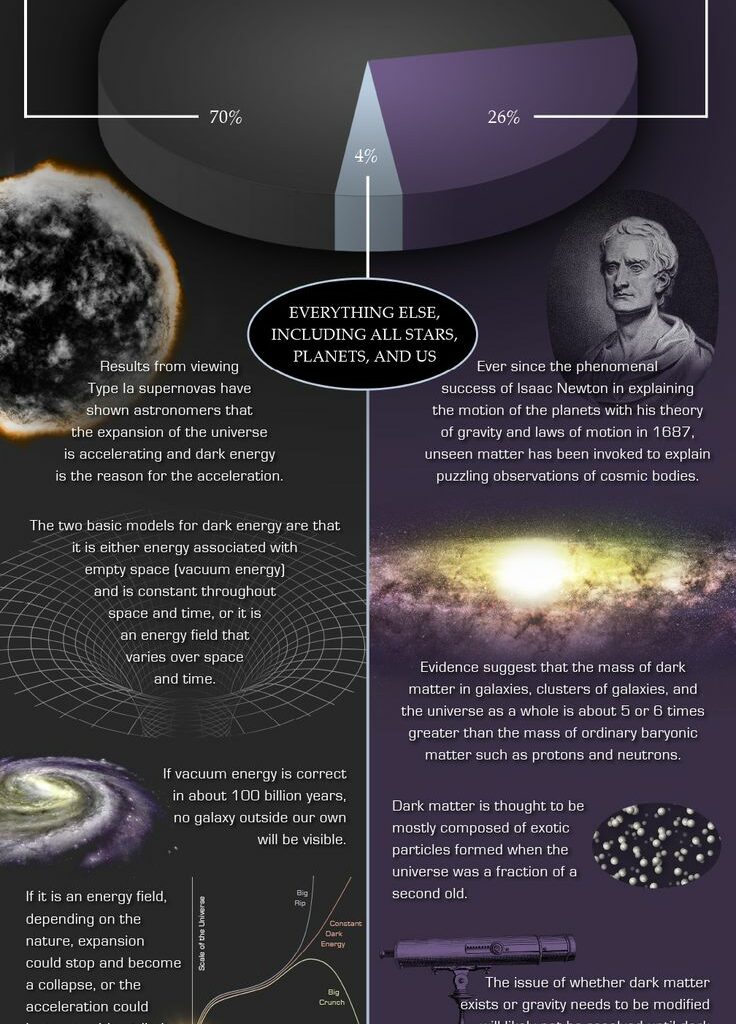
The universe we observe-the stars, planets, and galaxies-represents only a small fraction of the total cosmic composition. Beneath this visible layer lies a vast, unseen realm dominated by dark matter and dark energy. These mysterious entities, invisible to our instruments yet omnipresent, govern the structure and evolution of the cosmos. They hold galaxies together and drive the accelerating expansion of the universe, challenging our fundamental grasp of physics and reality.
Definition and Composition
Dark Matter: A form of matter that does not emit, absorb, or reflect light, making it undetectable by conventional telescopes. It is inferred through its gravitational influence on visible matter, radiation, and the large-scale structure of the universe.
Dark Energy: An enigmatic force responsible for the accelerated expansion of the universe, exerting a repulsive effect that counteracts gravity on cosmic scales.
- Dark Matter:
Constitutes about 27% of the universe’s total mass-energy content, forming an invisible scaffold that supports galaxy formation and clustering. - Dark Energy:
Accounts for nearly 68% of the universe, driving the expansion of space at an increasing rate. - Ordinary Matter:
Makes up roughly 5% of the universe, including all atoms, stars, planets, and living beings.
How Dark Matter Influences the Cosmos
Dark matter acts as the gravitational backbone of the universe. Although it cannot be seen directly, its presence is revealed by the way galaxies rotate and cluster. Observations show that galaxies spin at speeds that would tear them apart if only visible matter were present. Dark matter’s gravity provides the necessary binding force, preventing stars from being flung into space and maintaining the integrity of galactic structures.
Moreover, dark matter forms a cosmic web-an extensive, invisible network that shapes the distribution of galaxies and influences their evolution over billions of years. Its particles interact very weakly with normal matter, primarily through gravity, making it a subtle yet essential component of the universe.
The Role of Dark Energy in Cosmic Expansion
Discovered in the late 1990s through observations of distant supernovae, dark energy is a mysterious phenomenon causing the universe’s expansion to accelerate. Unlike dark matter, which attracts matter through gravity, dark energy exerts a repulsive force that stretches spacetime itself.
This acceleration implies a future where galaxies will drift increasingly farther apart, eventually leading to a cold, isolated cosmos. The nature of dark energy remains one of the greatest puzzles in cosmology. It may be a constant energy density inherent to space, as described by Einstein’s cosmological constant, or a dynamic field that changes over time, as proposed in theories like quintessence.
Scientific Methods for Studying Dark Components
Understanding dark matter and dark energy relies on a combination of observational techniques and theoretical models:
- Gravitational Lensing:
The bending of light from distant galaxies by massive objects allows astronomers to map the distribution of dark matter. - Cosmic Microwave Background (CMB):
Measurements of this relic radiation from the Big Bang provide insights into the early universe’s composition, including the proportions of dark matter and dark energy. - Direct Detection Experiments:
Ground-based and spaceborne detectors aim to identify dark matter particles, such as WIMPs or axions, by observing rare interactions with ordinary matter.
Theoretical Challenges and Emerging Hypotheses
The dominance of dark matter and dark energy in the cosmos presents a profound scientific paradox: while they shape the universe’s fate, their fundamental nature remains elusive. This gap in understanding suggests the need for new physics beyond the Standard Model.
Current hypotheses include:
- Weakly Interacting Massive Particles (WIMPs): Hypothetical particles that could constitute dark matter, interacting primarily through gravity and the weak nuclear force.
- Axions: Ultra-light particles proposed as dark matter candidates.
- Modified Gravity Theories: Alternatives to dark matter that suggest changes to the laws of gravity at large scales.
Philosophical and Existential Implications
Dark matter and dark energy challenge our perception of reality by revealing that much of the universe is composed of unseen and intangible elements. This realization blurs the line between presence and absence, known and unknown, prompting profound philosophical reflection on existence and the limits of human knowledge.
The universe emerges as a complex interplay of light and shadow, where the visible cosmos is only a small part of a vast, mysterious whole. This perspective fosters a deeper appreciation for the cosmos and our place within it.
Why Understanding Dark Matter and Dark Energy Is Crucial
Grasping the nature of dark matter and dark energy is essential for a comprehensive understanding of the universe’s origin, structure, and ultimate destiny. These components influence galaxy formation, cosmic evolution, and the fate of all matter and energy.
Advances in this field could revolutionize physics, leading to new theories that unify gravity with quantum mechanics and expand our knowledge of fundamental forces. Moreover, exploring these cosmic mysteries inspires curiosity and drives technological innovation in observational astronomy and particle physics.
Looking Ahead: The Future of Cosmic Exploration
As technology and theoretical frameworks advance, the quest to unveil the secrets of dark matter and dark energy continues. Upcoming missions and experiments promise to shed light on these elusive phenomena, potentially transforming our understanding of the cosmos.
Until then, dark matter and dark energy remain profound invitations to explore the unknown, encouraging humanity to expand the horizons of knowledge and embrace the wonder of the universe’s hidden depths.
FAQ
What is dark matter?
Dark matter is a form of matter that does not emit, absorb, or reflect light, inferred through its gravitational effects.
What is dark energy?
Dark energy is a mysterious force driving the accelerated expansion of the universe.
Why are dark matter and dark energy important?
They play essential roles in galaxy formation, cosmic evolution, and understanding the universe's fate.




Leave a Reply