

Short Answer
Definition of Dark Matter Clouds
Dark matter clouds are immense, invisible accumulations of dark matter particles that permeate the universe. Unlike ordinary matter, dark matter neither emits nor absorbs light or any form of electromagnetic radiation, making it undetectable by conventional telescopes. Despite this invisibility, dark matter exerts a powerful gravitational influence, playing a crucial role in the formation and structure of galaxies and the cosmic web.
- Dark Matter:
A form of matter that does not interact with electromagnetic forces, rendering it invisible but detectable through gravitational effects. - Dark Matter Clouds:
Vast regions where dark matter is densely concentrated, potentially containing billions of solar masses.
Physical Characteristics and Interaction
Dark matter’s defining trait is its minimal interaction with baryonic (ordinary) matter. It neither produces heat, light, nor sound, and passes through normal matter without friction or resistance. This ghost-like behavior means that entering a dark matter cloud would feel indistinguishable from moving through empty space. However, the immense mass contained within these clouds significantly warps the gravitational field, subtly influencing the environment.
- Non-Interaction with Electromagnetic Forces:
Dark matter does not refract, absorb, or emit light, making it invisible and intangible to human senses. - Gravitational Influence:
Despite its invisibility, dark matter’s mass can be millions or billions of times that of the sun, affecting the motion of stars and galaxies.
Gravitational Effects Within Dark Matter Clouds
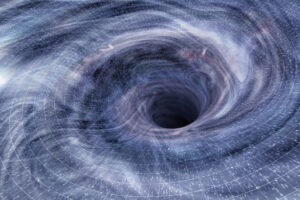
The only tangible way dark matter interacts with the universe is through gravity. Inside a dense dark matter cloud, gravitational fields could be altered, causing subtle distortions in spacetime. These effects might include slight warping of local gravity and measurable time dilation, where time passes marginally slower compared to regions outside the cloud. Although these relativistic phenomena would be subtle, advanced instruments could detect them.
Time Dilation and Spacetime Warping
Time dilation occurs when gravity affects the flow of time, causing clocks within a strong gravitational field to tick more slowly relative to those outside it. In a dark matter cloud, this effect would be faint but present, illustrating the profound influence of dark matter on the fabric of spacetime.
Quantum-Level Interactions and Particle Candidates
While dark matter rarely interacts with ordinary matter, some theoretical models suggest that particles such as Weakly Interacting Massive Particles (WIMPs) or axions might occasionally collide with atoms in a human body. These rare quantum interactions could produce faint energy events, subtle enough to be harmless but potentially significant for understanding dark matter’s nature.
- WIMPs:
Hypothetical particles that interact weakly with normal matter, making them prime dark matter candidates. - Axions:
Another proposed dark matter particle, extremely light and weakly interacting.
Speculative Cosmological Implications
Some cosmologists hypothesize that dark matter and dark energy might be linked to higher-dimensional structures or multiverse theories. Entering a dark matter cloud could metaphorically place one at the boundary of these hidden realms, potentially acting as a gateway to alternate layers of reality. This speculative idea suggests the universe might consist of overlapping membranes or sheets, with dark matter serving as the veil between them.
Internal Structure and Gravitational Landscape
Dark matter clouds may not be uniform; they could contain smaller-scale structures such as clumps, filaments, or knots with varying densities. These gravitational irregularities might produce subtle variations in weight or inertial resistance, creating an invisible cosmic geography. Navigating through such a cloud could be akin to moving through a complex network of gravitational currents, detectable only through precise measurements.
Scientific and Philosophical Significance
Contemplating the experience of entering a dark matter cloud highlights the limits of human perception and technology. Since dark matter constitutes approximately 27% of the universe’s mass-energy content, it shapes cosmic evolution profoundly yet remains largely mysterious. Engaging with this invisible majority challenges our understanding of reality and encourages the pursuit of new physics beyond the visible spectrum.
Why Understanding Dark Matter Clouds Matters
Dark matter clouds are fundamental to the universe’s architecture, influencing galaxy formation, cosmic structure, and the evolution of the cosmos. Studying these clouds deepens our grasp of gravitational dynamics and the unseen forces shaping existence. Moreover, exploring dark matter pushes the boundaries of science, technology, and philosophy, inspiring humanity to expand its knowledge and embrace the universe’s hidden dimensions.
Summary: The Experience of Entering a Dark Matter Cloud
Should one hypothetically enter a dark matter cloud, the experience would be devoid of sensory changes-no shifts in color, temperature, or sound. Instead, the encounter would be defined by subtle gravitational effects and profound intellectual revelations. You would become immersed in an invisible ocean of matter, silently sculpting the cosmos and gently bending spacetime. This journey transcends sensory perception, inviting a deeper understanding of the universe’s hidden forces and the mysterious fabric of reality itself.
FAQ
What is dark matter?
Dark matter is a form of matter that does not interact with electromagnetic forces, making it invisible but detectable through its gravitational effects.

Leave a Reply