
Short Answer
Definition of Dark Matter
Dark matter is a mysterious and invisible form of matter that constitutes approximately 27% of the universe’s total mass-energy composition. Unlike ordinary matter, it does not emit, absorb, or reflect light, making it undetectable by conventional electromagnetic observations. Its existence is inferred primarily through gravitational effects on visible matter, radiation, and the large-scale structure of the cosmos.
- Invisible nature:
Dark matter does not interact with electromagnetic forces, rendering it undetectable by telescopes that rely on light. - Gravitational influence:
Its presence is revealed through phenomena such as galaxy rotation curves and gravitational lensing.
Fundamental Properties and Interaction Mechanisms
Dark matter is believed to interact predominantly via gravity, with negligible or no interaction through electromagnetic, strong, or weak nuclear forces. This limited interaction profile is central to understanding its behavior, especially in environments with intense gravitational fields.
- Primary interaction:
Gravity is the main force through which dark matter influences and is influenced by other matter. - Particle candidates:
Hypothetical particles such as Weakly Interacting Massive Particles (WIMPs), axions, and sterile neutrinos are leading candidates, each with unique interaction characteristics.
Dark Matter in Extreme Gravitational Fields
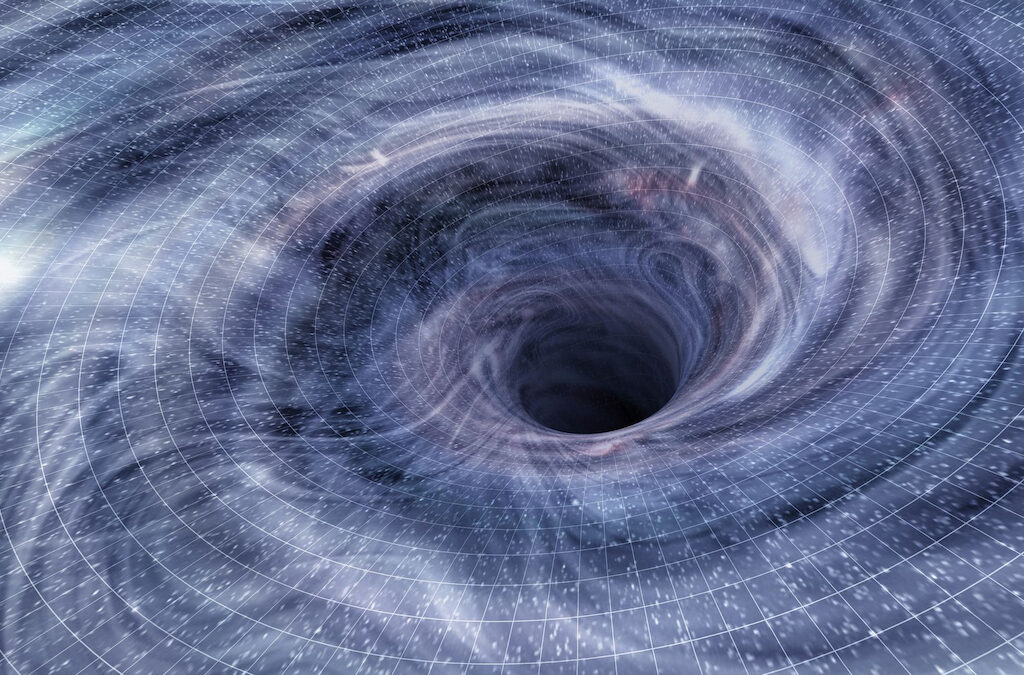
Regions near compact astrophysical objects like black holes and neutron stars present extreme gravitational conditions, characterized by intense spacetime curvature and strong tidal forces. These environments serve as natural laboratories to investigate the stability and behavior of dark matter under such extremes.
Density Profiles Around Compact Objects
Theoretical models predict that dark matter halos surrounding supermassive black holes develop “spikes”-sharp increases in density caused by the gravitational contraction of dark matter. These spikes raise important questions about the stability of dark matter particles when subjected to rapidly varying gravitational gradients and whether processes like annihilation or decay might occur.
Particle Physics Perspectives on Survival
The endurance of dark matter in strong gravitational fields depends on intrinsic particle properties such as mass, interaction cross-sections, and potential self-interactions. For example, WIMPs might accumulate within dense celestial bodies due to weak interactions, whereas axions or sterile neutrinos could exhibit different responses to gravitational compression. Quantum effects, including tunneling and condensation, may also influence dark matter behavior in ultra-dense gravitational wells.
Relativistic Gravity and Quantum Considerations
Near event horizons, the extreme curvature of spacetime leads to phenomena like time dilation and gravitational redshift. Dark matter particles approaching these boundaries may accrete onto black holes, contributing invisibly to their mass. Some quantum gravity theories suggest that non-classical interactions could modify dark matter’s properties or induce particle transformations, challenging traditional views.
Impact on Gravitational Wave Observations
Dark matter’s presence in or near compact binary systems-such as merging neutron stars or black holes-could subtly influence gravitational wave signals detected by observatories like LIGO and Virgo. Changes in mass distribution or hypothesized dark matter self-interactions might alter the emitted waveforms, offering indirect methods to study dark matter under extreme gravitational dynamics.
Thermodynamics and Stability Under Gravitational Compression
Extreme gravitational environments often heat matter to extraordinarily high temperatures, causing phase transitions in ordinary matter. Due to its weakly interacting nature, dark matter may remain stable and resist such transformations. However, some speculative models propose that dark matter could decay or convert into visible matter under these conditions, mediated by the intense compactness of the environment.
Role in Astrophysical Evolution of Compact Objects
Dark matter is thought to influence the formation and growth of compact astrophysical bodies. Simulations incorporating dark matter dynamics suggest it affects accretion processes, stellar evolution, and black hole growth rates. This implies that dark matter not only survives but may actively participate in shaping gravitationally extreme environments through complex feedback mechanisms.
Why Understanding Dark Matter’s Survival Matters
Exploring whether dark matter can withstand the universe’s most intense gravitational fields is crucial for multiple scientific disciplines. It bridges quantum field theory, general relativity, and astrophysics, enhancing our comprehension of fundamental physics and cosmic evolution. Confirming dark matter’s behavior in these conditions could unlock new insights into the nature of matter, gravity, and the large-scale structure of the universe.
Common Misconceptions About Dark Matter in Extreme Gravity
Dark matter interacts strongly with electromagnetic forces.
Dark matter is largely non-interacting electromagnetically, which is why it remains invisible to telescopes.
Dark matter is destroyed near black holes.
Current theories suggest dark matter likely survives near black holes, potentially accreting and contributing to their mass without being destroyed.
Dark matter behaves like ordinary matter under extreme heat.
Due to its weak interactions, dark matter is expected to remain stable and not undergo phase changes like baryonic matter.
Future Directions and Research Prospects
Advancements in high-precision astrophysical observations, gravitational wave astronomy, and particle detection experiments hold promise for unveiling dark matter’s true nature and its response to extreme gravitational forces. Continued interdisciplinary research combining theoretical modeling, observational data, and experimental physics is essential to resolve the enduring mysteries surrounding dark matter’s survival and role in the cosmos.




Leave a Reply