
Short Answer
Definition of the Hubble Space Telescope Launch
The deployment of the Hubble Space Telescope represents a landmark event in space exploration history. This advanced observatory, positioned beyond Earth’s atmospheric layer, has revolutionized our cosmic understanding for over three decades. The process of sending Hubble into orbit involved a complex blend of engineering innovation, logistical precision, and international scientific collaboration, highlighting the intricate efforts required to place such a sophisticated instrument in space.
Design and Preparation for Launch
The initial stage of the mission focused on the careful design and construction of the Hubble Space Telescope. Stretching more than 43 feet in length and featuring a primary mirror 94.5 inches in diameter, Hubble was specifically built to function in the vacuum of space, capturing images without the distortion caused by Earth’s atmosphere. To ensure its safe delivery to an orbit approximately 547 kilometers (340 miles) above Earth, a launch vehicle capable of protecting its delicate components and precisely positioning it was essential.
Launch Vehicle Selection and Mission Planning
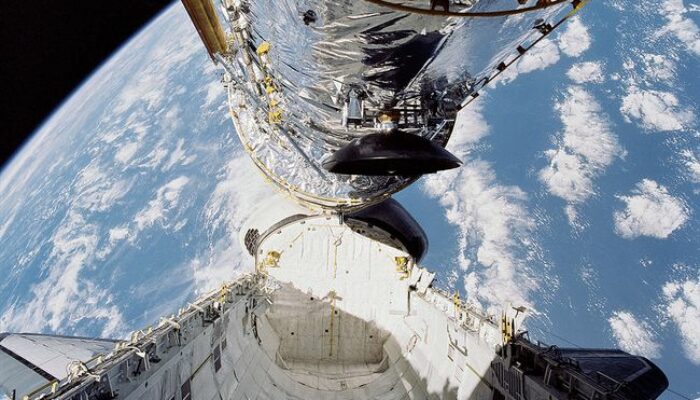
NASA chose the Space Shuttle Discovery for the task, a reusable spacecraft designed to transport both astronauts and cargo into low Earth orbit. The mission, known as STS-31, was tasked with carrying Hubble in Discovery’s cargo bay. The shuttle’s design, featuring a spacious payload bay and a robotic arm, was critical for the telescope’s deployment, enabling astronauts to carefully release and position Hubble once in orbit.
Launch Sequence and Orbital Insertion
Preparations for STS-31 involved meticulous coordination. Prior to launch, Hubble was secured within the Inertial Upper Stage (IUS), a two-stage solid-fuel rocket designed to propel payloads from the shuttle’s orbit to higher altitudes. This additional propulsion was vital to elevate Hubble from the shuttle’s initial orbit to nearly 600 kilometers above Earth, minimizing atmospheric interference and optimizing observational clarity.
On April 24, 1990, Discovery lifted off from Kennedy Space Center, Florida. The shuttle’s twin solid rocket boosters and main engines worked in unison to accelerate the spacecraft to speeds exceeding 28,000 kilometers per hour (17,500 miles per hour), achieving a precise orbital insertion. In this microgravity environment, Hubble was prepared for deployment.
Deployment Mechanism and Procedures
Once in orbit, astronauts aboard Discovery initiated the deployment process. Using the shuttle’s remote manipulator system (robotic arm), they carefully extracted Hubble from the cargo bay. This delicate operation required precise handling to avoid any mechanical stress or collisions. After positioning the telescope clear of the shuttle, the crew and ground control coordinated the ignition of the Inertial Upper Stage to propel Hubble into its final orbit.
The IUS executed a two-stage burn: the first stage pushed Hubble away from the shuttle and raised its altitude, while the second stage completed the orbital insertion, placing the telescope into a stable, near-circular orbit. This propulsion sequence was a technological achievement, ensuring Hubble’s isolation from atmospheric disturbances and granting it an unobstructed view of the cosmos.
Initial Activation and Calibration
Following deployment, astronauts conducted essential system checks. The telescope’s solar arrays were deployed and oriented toward the Sun to provide power. Subsequently, Hubble’s onboard computers and communication systems were activated and calibrated to enable data transmission back to Earth. These initial calibrations were critical; any misalignment or malfunction could have compromised the mission’s scientific objectives.
Challenges and Subsequent Servicing Missions
Although the launch and deployment were successful, Hubble’s primary mirror was later found to have a slight spherical aberration, affecting image quality. This flaw necessitated a pioneering servicing mission to correct the optics. Over the years, multiple servicing missions have been conducted by shuttle astronauts to upgrade and repair Hubble, reflecting an ongoing commitment to maintaining its scientific capabilities.
Significance of Hubble’s Orbital Position
Placing Hubble in low Earth orbit was revolutionary because it allowed the telescope to observe the universe without atmospheric distortion. Unlike ground-based telescopes, Hubble can capture light across ultraviolet, visible, and near-infrared wavelengths with exceptional clarity. This vantage point has enabled groundbreaking discoveries, from the formation of galaxies to insights into dark energy, solidifying Hubble’s role as a cornerstone of modern astronomy.
Why the Hubble Launch Matters
The launch of the Hubble Space Telescope exemplifies the fusion of advanced aerospace engineering, human ingenuity, and strategic mission planning. It is not merely a story of a spacecraft launch but a testament to humanity’s enduring quest to explore and understand the universe. The successful deployment and continued operation of Hubble have inspired generations of scientists and engineers, demonstrating the profound impact of technological innovation on expanding our cosmic horizons.
Additional Insights and Resources
- Technical Aspects:
Detailed explanations of the shuttle’s propulsion systems, robotic arm mechanics, and orbital dynamics provide deeper understanding of the mission’s complexity. - Astronaut Experiences:
Personal accounts from the crew involved in the deployment offer human perspectives on the challenges and triumphs of the mission. - Visual Documentation:
Photographic sequences of the launch, diagrams of Hubble’s instruments, and mission timelines help bridge technical concepts with accessible storytelling.
FAQ
What is the significance of Hubble's orbital position?
Hubble's low Earth orbit allows it to observe the universe without atmospheric distortion, enabling groundbreaking discoveries across various wavelengths.


Leave a Reply