
Short Answer
Definition of Cosmic Constituents
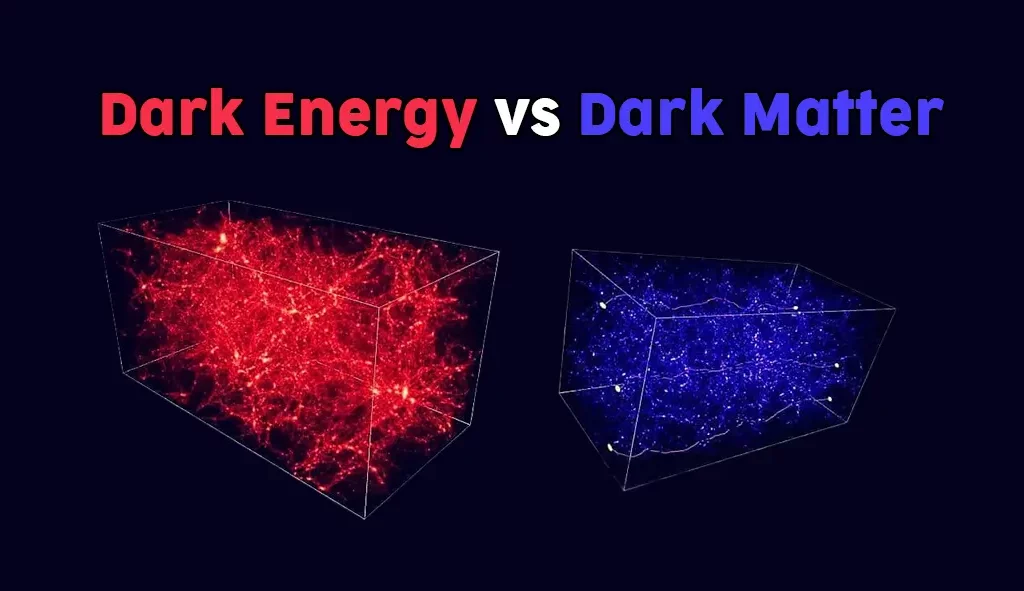
The universe is composed of three primary components that shape its structure and evolution: normal matter, dark matter, and dark energy. Each plays a distinct role in the cosmic framework and possesses unique properties.
- Normal Matter (Baryonic Matter):
This is the familiar matter made up of atoms, including protons, neutrons, and electrons. It forms stars, planets, and all visible structures, including life. - Dark Matter:
An invisible form of matter that does not emit, absorb, or reflect light, making it undetectable by electromagnetic observations. Despite this, it exerts gravitational forces that influence the motion of galaxies and the formation of cosmic structures. - Dark Energy:
A mysterious, repulsive energy permeating all of space, responsible for the accelerated expansion of the universe. Unlike matter, it acts as a property of spacetime rather than a particle-based substance.
Chronology of the Universe’s Fundamental Components
The timeline of the universe’s evolution reveals a sequence in which these components emerged and influenced cosmic development. Understanding their order provides insight into the universe’s origin and large-scale structure.
Early Universe and Inflation
At the moment of the Big Bang, the universe was an extremely hot and dense state where space and time began expanding. Within fractions of a second, a rapid expansion phase called inflation smoothed out irregularities and set the stage for particle formation. During this epoch, the universe was dominated by high-energy radiation and a dense plasma of particles.

Formation of Dark Matter
Dark matter is believed to have formed very early, possibly during or immediately after inflation. Unlike normal matter, which required processes involving matter-antimatter asymmetry, dark matter particles likely decoupled from the primordial plasma quickly as the universe cooled. Hypothetical particles such as Weakly Interacting Massive Particles (WIMPs) or axions “froze out” when temperatures dropped below certain thresholds, ceasing significant interactions with other particles. This early decoupling allowed dark matter to begin gravitational clustering, creating the scaffolding for future galaxy formation.
Emergence of Normal Matter
Normal matter appeared slightly later in cosmic history. Within minutes after the Big Bang, Big Bang nucleosynthesis produced the first light elements-hydrogen, helium, and traces of lithium. Over the next several hundred thousand years, the universe cooled enough for electrons and nuclei to combine during recombination, allowing photons to travel freely and creating the cosmic microwave background radiation. Only after this period could normal matter collapse into stars and galaxies, guided by the gravitational wells formed by dark matter.
Onset of Dark Energy Dominance
Dark energy’s influence became significant much later, billions of years after the Big Bang. As the universe expanded and matter density decreased, the repulsive force of dark energy began to dominate, accelerating cosmic expansion. While its exact origin remains uncertain, theories propose it as either a cosmological constant-an intrinsic vacuum energy of spacetime-or a dynamic field such as quintessence that evolves over time.
Mechanisms Behind the Formation of Cosmic Components
The processes that led to the formation and differentiation of dark matter, normal matter, and dark energy involve complex physical phenomena spanning quantum mechanics, particle physics, and cosmology.
- Baryogenesis:
This mechanism explains how an imbalance between matter and antimatter arose, allowing normal matter to persist after mutual annihilation in the early universe. - Freeze-Out of Dark Matter:
As the universe cooled, dark matter particles ceased interacting with the hot plasma, “freezing out” and beginning to clump under gravity. - Recombination:
The formation of neutral atoms from free electrons and nuclei, enabling photons to decouple and travel freely, marking the universe’s transition to transparency. - Cosmic Acceleration:
Driven by dark energy, this phenomenon causes the expansion rate of the universe to increase over time, influencing its ultimate fate.
Mathematical Framework and Cosmological Models
The evolution and interaction of these components are described by the equations of cosmology, particularly the Friedmann equations derived from General Relativity.
The key equation governing the expansion rate (Hubble parameter, H) is:
H² = (8πG/3) (ρ_m + ρ_r + ρ_Λ) – (k / a²)
- H: Hubble parameter, the rate of expansion of the universe
- G: Gravitational constant
- ρ_m: Density of matter (normal + dark matter)
- ρ_r: Density of radiation
- ρ_Λ: Density of dark energy (cosmological constant)
- k: Curvature parameter of space
- a: Scale factor of the universe
This equation encapsulates how matter, radiation, and dark energy densities influence cosmic expansion over time.
Observational Evidence and Experimental Approaches
Modern cosmology relies on multiple observational techniques and experiments to understand the nature and timeline of these cosmic components:
- Cosmic Microwave Background (CMB):
Measurements of the CMB provide a snapshot of the universe at recombination, revealing information about matter density and fluctuations. - Galaxy Rotation Curves:
Observations of stars’ orbital speeds in galaxies indicate the presence of unseen dark matter. - Large-Scale Structure Surveys:
Mapping the distribution of galaxies helps trace the influence of dark matter on cosmic structure formation. - Type Ia Supernovae:
These standard candles measure cosmic expansion, providing evidence for dark energy’s accelerating effect. - Particle Physics Experiments:
Collider experiments and underground detectors seek to identify dark matter particles and understand their properties.
Common Misunderstandings About Cosmic Components
- Misconception: Dark matter is just ordinary matter that is invisible.
Correction: Dark matter is fundamentally different from normal matter; it does not interact electromagnetically and cannot be detected by light. - Misconception: Dark energy is a form of matter.
Correction: Dark energy is not matter but a property of spacetime causing accelerated expansion. - Misconception: Dark matter and dark energy appeared simultaneously.
Correction: Dark matter formed early in the universe’s history, while dark energy’s dominance emerged much later.
Significance of Understanding Cosmic Origins
Deciphering the order and nature of dark matter, normal matter, and dark energy is crucial for comprehending the universe’s past, present, and future. This knowledge informs theories of cosmic evolution, structure formation, and the ultimate fate of the cosmos. It also bridges fundamental physics and astronomy, driving technological advances in observation and experimentation. Beyond science, these insights inspire philosophical reflection on existence and the universe’s profound complexity.
Summary of Cosmic Component Emergence
In summary, the universe’s fundamental constituents emerged in a sequence shaped by physical processes in the early cosmos:
- Dark matter likely formed first, decoupling early and initiating gravitational scaffolding.
- Normal matter followed, arising through nucleosynthesis and recombination to form visible structures.
- Dark energy, as a property of spacetime, existed potentially from the beginning but became dominant only in the later universe, driving accelerated expansion.
Ongoing research continues to refine this timeline and deepen our understanding of these enigmatic components, revealing the intricate tapestry of the cosmos.



Leave a Reply