
Short Answer
Definition of Particle Physics
Particle physics is a branch of science focused on investigating the most fundamental elements of matter and the forces governing their interactions. Unlike classical physics, which deals with macroscopic phenomena observable in everyday life, particle physics explores the subatomic scale, where particles smaller than atoms form the universe’s underlying structure. This field seeks to identify and understand elementary particles such as quarks, leptons, and bosons, which are cataloged within the Standard Model-a comprehensive theoretical framework describing three of the four fundamental forces: electromagnetic, weak, and strong interactions.
Foundations and Frameworks
The Standard Model stands as the cornerstone of particle physics, providing a mathematically elegant and predictive description of known particles and their interactions. However, it does not incorporate gravity nor account for dark matter and dark energy, which together constitute the majority of the universe’s mass-energy content. This limitation has led to the development of advanced theories like string theory, supersymmetry, and quantum gravity, which aim to extend our understanding beyond the Standard Model, though these remain speculative without experimental confirmation.
Experimental Validation and Evidence
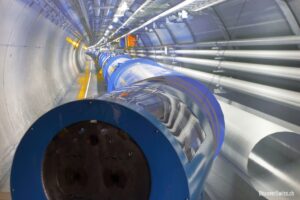
Scientific theories require empirical support, and particle physics has demonstrated its validity through rigorous experimentation. A landmark achievement was the 2012 discovery of the Higgs boson at CERN’s Large Hadron Collider, confirming a particle predicted decades earlier that explains how other particles acquire mass. Such discoveries provide measurable, reproducible evidence that these subatomic entities are not mere theoretical constructs but have tangible effects observable through sophisticated instruments.
Challenges in Observation and Interpretation
Despite experimental successes, the nature of particle detection introduces complexities. Many particles exist only briefly before decaying, making direct observation impossible. Instead, their presence is inferred from secondary effects such as energy deposits or particle tracks within detectors. This indirect method of detection raises philosophical questions about whether particle physics describes an objective reality or constructs highly effective models that predict phenomena without directly revealing the particles themselves.
Quantum Mechanics and the Nature of Reality
Quantum mechanics, the foundation of particle physics, portrays particles not as discrete, localized objects but as probabilistic wavefunctions representing fields of potentiality. This challenges classical views of reality, suggesting that at the quantum level, certainty gives way to probability. Consequently, the concept of what is “real” extends beyond direct sensory perception to include phenomena that are reliably predicted and experimentally corroborated, even if they defy intuitive understanding.
Technological Impact and Practical Applications
Beyond theoretical insights, particle physics has driven technological innovations with significant real-world benefits. The development of particle accelerators and detectors has revolutionized fields such as medicine and computing. For example, positron emission tomography (PET) scans utilize principles derived from particle physics to produce detailed images of the human body, demonstrating how abstract scientific concepts translate into practical tools that improve health and quality of life.
Ongoing Mysteries and Future Directions
Despite its achievements, particle physics continues to grapple with unresolved questions: the origin of neutrino masses, the dominance of matter over antimatter, and the reconciliation of quantum mechanics with general relativity remain open challenges. These puzzles highlight the evolving nature of the field and the continuous quest for deeper understanding, emphasizing that scientific knowledge is provisional and subject to refinement as new data emerge.
Philosophical and Scientific Significance
Particle physics embodies a compelling paradox: it is simultaneously grounded in experimental evidence and enriched by theoretical abstraction. This duality reflects the dynamic process of scientific inquiry, where models are rigorously tested yet remain open to revision. The discipline invites us to reconsider traditional notions of reality, embracing a universe that is more complex and enigmatic than everyday experience suggests.
Summary: The Reality of Particle Physics
In conclusion, particle physics transcends the simplistic binary of “real” versus “theoretical.” It represents a continuum-a meticulously tested and detailed narrative about the universe’s fundamental constituents. While it is supported by empirical data and technological applications, it also acknowledges the provisional nature of scientific understanding. Far from being “just a theory,” particle physics is a vibrant, evolving field that continuously reshapes our conception of reality itself.
FAQ
What is particle physics?
Particle physics is a branch of science that studies the fundamental particles of the universe and their interactions.
What is the Standard Model?
The Standard Model is a theoretical framework that describes the known elementary particles and the forces that govern their interactions.
How is particle physics validated?
Particle physics is validated through experimental evidence, such as the discovery of the Higgs boson at CERN.


Leave a Reply