
Short Answer
Definition of Gamma Rays and Mass
Gamma rays are a form of electromagnetic radiation characterized by extremely high energy and short wavelengths. Unlike ordinary matter, which has mass, gamma rays consist of photons-elementary particles of light that are inherently massless. This distinction raises a fundamental question in physics: do gamma rays possess any mass? Understanding this requires a clear grasp of what mass means in the context of particle physics and how gamma rays fit into the broader spectrum of electromagnetic phenomena.
- Gamma Rays:
Electromagnetic waves with the highest energy, originating from nuclear reactions, stellar explosions, and other cosmic events. - Mass:
A measure of an object’s inertia or the amount of matter it contains, typically associated with particles at rest. - Photons:
The quantum particles that make up light, including gamma rays, which have zero rest mass and always travel at the speed of light.
Fundamental Properties of Gamma Rays
Gamma rays are composed of photons, which are unique in that they have no rest mass. This means photons cannot be at rest; they perpetually move at the speed of light (approximately 299,792 kilometers per second). Because only massless particles can achieve this universal speed limit, gamma rays, as photon bundles, are inherently massless. Despite this, they carry energy and momentum, enabling them to interact with matter in significant ways.
Energy and Momentum Without Mass
Although gamma rays lack mass, they possess energy and momentum, which allows them to exert pressure and cause physical effects such as ionization. This phenomenon can be likened to wind: invisible and weightless, yet capable of pushing objects. Gamma rays’ momentum is directly proportional to their energy, enabling them to influence matter despite their massless nature.
Physics Behind Masslessness and Energy
The relationship between energy, mass, and momentum in gamma rays is elegantly described by Einstein’s theory of relativity. The famous equation E=mc² links energy (E) and mass (m), but it does not imply that all energy must have rest mass. Photons have zero rest mass but carry energy (E) and momentum (p), related by the equation:
E = pc
- E: Energy of the photon
- p: Momentum of the photon
- c: Speed of light
This formula shows that a photon’s energy is directly proportional to its momentum and the speed of light, reinforcing that energy can exist independently of rest mass.
Interaction of Gamma Rays with Gravity
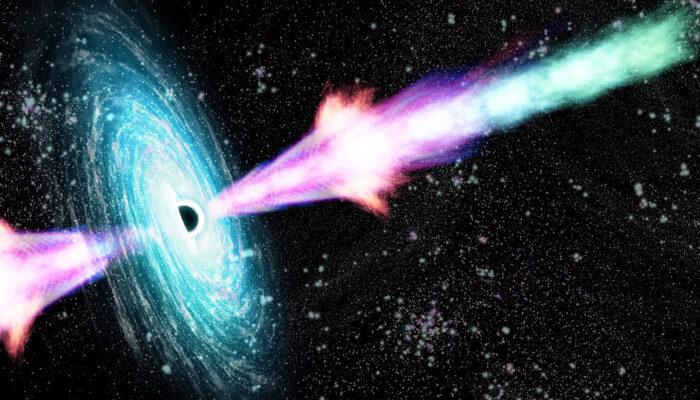
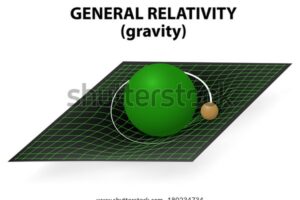
Despite having no mass, gamma rays are influenced by gravity. According to Einstein’s general relativity, gravity affects the curvature of spacetime, and photons follow these curved paths. This gravitational bending, observed near massive objects like black holes and neutron stars, demonstrates that gamma rays respond to gravitational fields not because they have mass, but because gravity acts on energy and momentum as well.
Comparison with Massive Particles
Contrasting gamma rays with particles that have rest mass, such as electrons, highlights their unique characteristics. Electrons possess a defined rest mass and can be stationary, whereas photons are always in motion and massless. This difference underpins the fundamental distinction between matter and pure energy carriers like gamma rays.
Applications and Significance of Gamma Rays
Gamma rays have critical roles in both scientific research and practical applications:
- Medical Uses:
Gamma radiation is employed in diagnostic imaging and cancer treatment, utilizing its penetrating power to target and destroy malignant cells. - Astrophysics:
Observations of gamma-ray bursts provide insights into extreme cosmic events such as supernovae and black hole formation. - Fundamental Physics:
Studying gamma rays helps scientists understand the interplay between energy, matter, and spacetime.
Common Misconceptions About Gamma Rays and Mass
Gamma rays have mass because they carry energy.
Energy does not imply rest mass; photons are massless but still carry energy and momentum.
Only objects with mass can be affected by gravity.
Gravity influences energy and momentum, so massless photons like gamma rays are deflected by gravitational fields.
Why Understanding Gamma Rays’ Masslessness Matters
Recognizing that gamma rays are massless yet energetic particles is crucial for advancing physics and technology. It challenges intuitive notions about matter and energy, deepening our comprehension of the universe’s fundamental laws. This knowledge underpins innovations in medical technology, enhances our grasp of cosmic phenomena, and enriches the theoretical frameworks that describe the fabric of reality.
FAQ
Do gamma rays have mass?
No, gamma rays are composed of massless photons.
How do gamma rays interact with matter?
Gamma rays can ionize atoms and exert pressure despite being massless.

Leave a Reply