
Short Answer
Definition of Entropy and Entropy Bound
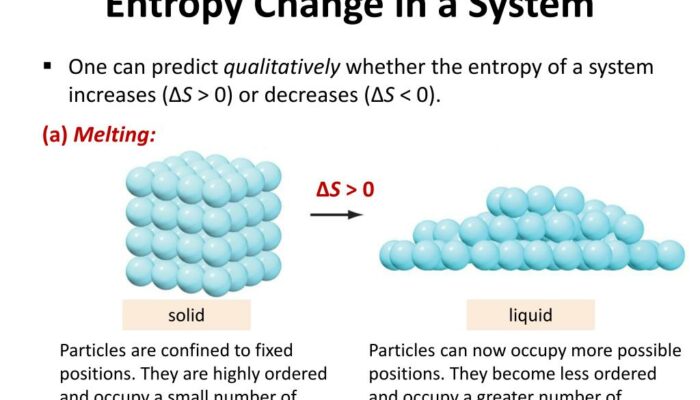
Entropy is a fundamental concept in thermodynamics that quantifies the level of disorder or randomness within a system. It plays a crucial role not only in physics but also in fields such as information theory, statistical mechanics, and cosmology. The entropy bound refers to a theoretical limit on the maximum amount of entropy-or disorder-that can exist within a physical system, often constrained by the system’s boundary properties. Grasping the entropy bound and its relationship with disorder enhances our understanding of phenomena ranging from microscopic particles to the vast cosmos.
Historical Background and Thermodynamic Foundations
The notion of entropy was first introduced in the 19th century by Rudolf Clausius, who formulated the Second Law of Thermodynamics. This law states that in an isolated system, the total entropy cannot decrease over time; it either increases or remains constant in idealized reversible processes. This principle implies that natural processes inherently progress toward a state of maximum entropy, or thermodynamic equilibrium, where energy is uniformly distributed. The Second Law’s implications extend beyond classical thermodynamics, influencing the development of statistical mechanics and modern physics.
Statistical Mechanics Perspective on Entropy
Ludwig Boltzmann advanced the understanding of entropy by providing a microscopic interpretation through statistical mechanics. He introduced the formula:
S = k log Omega
- S: Entropy of the system
- k: Boltzmann constant
- Ω: Number of microstates compatible with the macroscopic state
This equation reveals that entropy is proportional to the logarithm of the number of possible microscopic configurations (microstates) that correspond to the same macroscopic conditions. Consequently, a system with more accessible microstates exhibits higher entropy, providing a quantitative measure of disorder at the microscopic level.
Entropy in Information Theory and Black Hole Physics
Entropy also plays a pivotal role in information theory, where it measures the uncertainty or unpredictability of a random variable. This intersection between physics and information theory has led to profound discussions, especially concerning black holes. The so-called “information paradox” arises from the idea that information entering a black hole might be lost forever, conflicting with quantum mechanics’ principle of information conservation.
Recent theoretical advances have linked black hole entropy to the surface area of its event horizon, encapsulated in the Bekenstein-Hawking entropy formula. This relationship suggests that the entropy of a black hole is proportional to the area of its boundary rather than its volume, offering new insights into the nature of disorder under extreme gravitational conditions.
The Bekenstein Entropy Bound Explained
The entropy bound, particularly the Bekenstein limit, sets a maximum on the entropy contained within a given region of space. It states that the entropy is limited by the energy enclosed and the area of the system’s boundary. In essence, increasing the energy inside a volume-while respecting physical constraints-raises the maximum possible entropy, reinforcing the intrinsic connection between energy, entropy, and disorder.
Cosmological Implications of Entropy
In cosmology, the entropy bound concept helps explain the universe’s evolution. The early universe began in a state of remarkably low entropy. As cosmic expansion and processes unfolded, entropy increased, driving the universe toward higher disorder. This progression sheds light on the large-scale behavior of cosmological phenomena and points toward a future scenario often described as “heat death,” where entropy reaches a maximum and no usable energy remains to sustain processes.
Entropy in Complex and Emergent Systems
Beyond physics, entropy concepts extend to complex systems such as ecosystems, social networks, and economic models. In these contexts, entropy can quantify diversity, disorder, and the flow of information. Although complex interactions and feedback loops can generate new structures and patterns, the overarching tendency remains an increase in entropy, often challenging subsystems that attempt to maintain order.
Self-Organization and Local Entropy Reduction
Interestingly, entropy principles also accommodate phenomena of self-organization, where localized decreases in entropy occur despite the global trend toward disorder. Examples include the formation of biological organisms and crystalline structures. These local reductions in entropy are made possible by energy inputs or information transfer from external sources, illustrating the dynamic balance between order and disorder within evolving systems.
Philosophical Reflections on Entropy and Disorder
The study of entropy and its bounds raises profound philosophical questions about determinism, order, and chaos. If entropy inexorably drives systems toward disorder, can any system achieve lasting intrinsic order, or is chaos an unavoidable destiny? These questions intersect with fundamental debates in science and metaphysics, highlighting the deep connections between entropy, information, and the nature of reality.
Summary: The Significance of Entropy Bound and Disorder
The relationship between entropy bound and disorder is more than a theoretical curiosity; it is a cornerstone for understanding the behavior of systems across scales-from the quantum realm to the cosmic expanse. Exploring the limits imposed by entropy enriches our comprehension of physical laws and invites reflection on the philosophical implications of order, chaos, and existence. This ongoing inquiry continues to shape scientific thought and our worldview.
FAQ
What is the entropy bound?
The entropy bound is a theoretical limit that sets the maximum amount of entropy, or disorder, that can exist within a given physical system, often related to its energy content and boundary area.
How does entropy relate to disorder?
Entropy measures the number of possible microstates of a system, representing its degree of disorder or randomness.
Why is the entropy bound important in black hole physics?
It explains how black holes have entropy proportional to their event horizon area, linking gravity, thermodynamics, and quantum mechanics.
Can entropy decrease locally despite the second law of thermodynamics?
Yes, local decreases in entropy can occur in open systems with energy or information inputs, facilitating self-organization.
What does the entropy bound imply about the fate of the universe?
It suggests the universe will evolve toward maximum entropy, leading to a state of heat death characterized by maximum disorder.



Leave a Reply