
Short Answer
Definition of Quantum Entanglement and Its Role in Imaging
Quantum entanglement is a fundamental phenomenon in quantum mechanics where two or more particles become interconnected such that the state of one instantly influences the state of the other, regardless of the distance separating them. This non-classical correlation defies traditional notions of locality and determinism, challenging our understanding of reality. In the realm of imaging technology, entanglement offers groundbreaking possibilities by enabling new methods of capturing and processing visual information that surpass classical limitations.
- Quantum Entanglement:
A physical phenomenon where particles share linked states instantaneously across any distance. - Imaging Application:
Utilizes entangled photons to create images with enhanced resolution and sensitivity beyond classical optics.
Principles Behind Quantum Entanglement Cameras
The Quantum Entanglement Camera operates by exploiting pairs of entangled photons. One photon interacts with the object being imaged, while its entangled partner is detected separately. The correlation between these photons allows the reconstruction of an image that captures intricate details inaccessible to conventional cameras. This approach leverages the dual wave-particle nature of light, blurring the line between observer and observed, and fundamentally altering how visual information is acquired and interpreted.
Mechanism of Quantum Imaging
In practice, the camera emits entangled photon pairs generated through nonlinear optical processes. One photon, called the signal photon, illuminates the target, interacting with its surface and properties. The other, the idler photon, is measured independently. By analyzing the correlations between these photons, the system synthesizes a composite image that reveals fine structural details with exceptional clarity. This method circumvents some classical limitations such as noise and resolution constraints, enabling imaging at scales previously unattainable.
Mathematical Framework and Formulas
The entanglement process can be described using quantum state vectors and density matrices. For a pair of entangled photons, the joint quantum state |Ψ⟩ can be expressed as:
|Ψ⟩ = (1/√2)(|0⟩_A |1⟩_B + |1⟩_A |0⟩_B)
where |0⟩ and |1⟩ represent quantum states of photons A and B respectively. Measurement outcomes on one photon instantaneously affect the state of the other, a property quantified by correlation functions such as the Bell parameter. These correlations underpin the imaging technique, allowing the extraction of spatial information from entangled photon pairs.
Notable Experimental Achievements
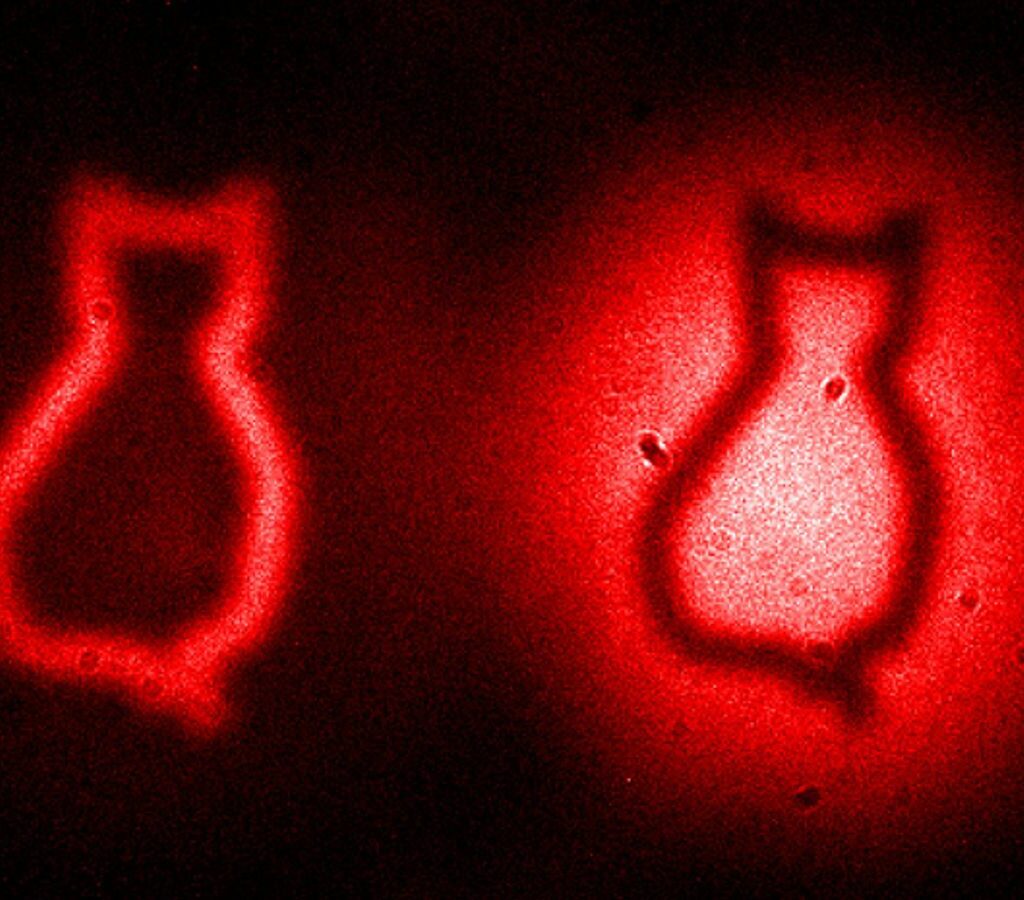
Recent experiments have demonstrated the practical capabilities of quantum entanglement cameras. A landmark example includes imaging a cat pattern etched onto a silicon substrate, revealing complex layers and textures that classical imaging methods fail to resolve. These experiments highlight the camera’s ability to capture high-resolution images with enhanced sensitivity, showcasing the potential for applications in diverse scientific and technological fields.
Philosophical and Scientific Implications
The use of quantum entanglement in imaging extends beyond technical innovation, prompting profound questions about the nature of observation and reality. Unlike classical optics, where observation is passive, quantum measurement actively influences the system’s state. This interplay challenges classical determinism and invites interpretations that explore the fabric of existence, such as the role of the observer in collapsing quantum superpositions into definite outcomes.
Applications and Future Prospects
The implications of quantum entanglement imaging are vast, with promising applications in:
- Biomedical Imaging:
Enhancing resolution and contrast in medical diagnostics without increasing radiation exposure. - Secure Communications:
Utilizing entangled photons for quantum encryption methods that guarantee data security. - Data Encryption:
Leveraging quantum states to develop unbreakable cryptographic protocols.
These advancements parallel the transformative impact classical photography had on society, potentially revolutionizing how information is captured, transmitted, and interpreted.
Challenges in Quantum Imaging Technology
Despite its promise, quantum imaging faces significant hurdles. The fragile nature of entangled photons makes them susceptible to decoherence-loss of quantum coherence due to environmental disturbances-which degrades image quality. Maintaining controlled environments and developing robust techniques to mitigate decoherence are critical for transitioning quantum imaging from laboratory settings to practical, real-world applications.
Public Engagement and Cultural Impact
The captivating visuals produced by quantum entanglement cameras have sparked widespread interest beyond scientific circles. By translating complex quantum phenomena into accessible and striking images, this technology fosters public curiosity and understanding of quantum mechanics. As quantum imaging becomes more mainstream, it is poised to influence cultural perceptions of science, blending artistic expression with empirical discovery.
Conclusion: The Intersection of Science, Art, and Reality
The Quantum Entanglement Camera exemplifies the fusion of cutting-edge science and visual artistry, offering a unique window into the quantum world. It not only advances imaging technology but also deepens our philosophical inquiry into the nature of reality, observation, and existence. As this field evolves, it stands at the crossroads of innovation and imagination, promising to reshape our comprehension of the universe at both microscopic and macroscopic scales.
FAQ
What is quantum entanglement?
Quantum entanglement is a phenomenon where two or more particles become linked, so that the state of one particle instantaneously affects the state of the other, regardless of distance.
How does quantum entanglement improve imaging?
It allows for the creation of images with enhanced resolution and sensitivity by using entangled photons to capture intricate details beyond classical imaging capabilities.





Leave a Reply