
Short Answer
Definition of Electromagnets
Electromagnets are devices that generate magnetic fields through the flow of electric current, representing a significant advancement in the study and application of magnetism. Unlike permanent magnets, their magnetic properties can be controlled dynamically by adjusting the electric current, making them versatile tools in both scientific and industrial contexts.
- Electric Current and Magnetism:
The magnetic field arises when an electric current passes through a conductor, linking electricity and magnetism in a fundamental way. - Controllable Magnetism:
Electromagnets can be activated or deactivated by switching the current on or off, distinguishing them from static permanent magnets.
Fundamental Principles of Electromagnetism
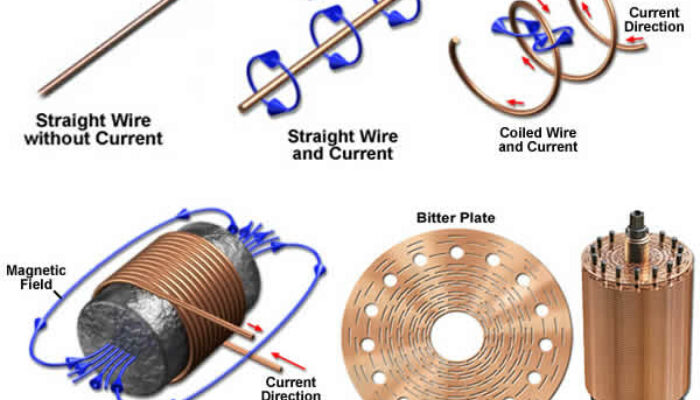
The operation of electromagnets is grounded in the principles of electromagnetism, which describe how electric currents produce magnetic fields. Ampère’s Circuital Law mathematically relates the magnetic field around a conductor to the electric current flowing through it. The right-hand rule provides a practical method to determine the direction of the magnetic field generated by the current.
- Ampère’s Circuital Law:
This law states that the line integral of the magnetic field around a closed loop is proportional to the electric current passing through the loop. - Right-Hand Rule:
A mnemonic to find the direction of the magnetic field: if the thumb points in the direction of current, the curled fingers show the magnetic field lines. - Role of Coils (Solenoids):
Wrapping the conductor into coils amplifies the magnetic field, with the strength increasing proportionally to the number of turns and the current magnitude.
Operational Mechanism of Electromagnets
Electromagnets function by channeling electric current through coils of wire, typically wound around a ferromagnetic core. The magnetic field produced aligns the magnetic domains within the core, significantly enhancing the overall magnetic effect. This magnetic field can be precisely controlled by varying the current or the coil configuration.
Applications Across Various Fields
Data Storage and Electronics
Electromagnets are integral to modern data storage technologies, such as hard disk drives, where they manipulate magnetic orientations to encode and retrieve information rapidly. Additionally, they serve as actuators in devices like relays and magnetic locks, enabling controlled mechanical movements through electromagnetic forces.
Industrial and Manufacturing Uses
In industrial settings, electromagnets are essential for handling heavy ferromagnetic materials. Electromagnetic cranes lift and transport metal objects efficiently, while magnetic separation techniques help in recycling by isolating metallic components from waste streams. These applications enhance productivity and reduce manual labor.
Medical Imaging Technologies
One of the most transformative uses of electromagnets is in magnetic resonance imaging (MRI). Powerful electromagnets generate strong, uniform magnetic fields that interact with atomic nuclei in the body, producing detailed images for non-invasive medical diagnostics. This technology has revolutionized healthcare by enabling early detection and treatment of various conditions.
Theoretical Implications and Advanced Research
Electromagnetism and Quantum Mechanics
The study of electromagnets intersects with quantum physics, where electromagnetic fields exhibit dual characteristics akin to wave-particle duality. This relationship has paved the way for innovations such as quantum computing, which manipulates quantum bits (qubits) through electromagnetic interactions to perform complex computations beyond classical capabilities.
Nanotechnology and Material Science
Emerging research focuses on nanoscale electromagnets, which promise to revolutionize energy harvesting and nano-electronic devices. By engineering materials at the atomic level to exploit electromagnetic properties, scientists aim to develop new functionalities that could transform multiple technological sectors.
Challenges: Electromagnetic Interference (EMI)
Despite their advantages, widespread use of electromagnets introduces challenges, notably electromagnetic interference. EMI occurs when electromagnetic noise disrupts the operation of electronic devices, posing reliability issues. Addressing this requires advanced shielding methods and frequency modulation techniques to minimize interference and ensure stable device performance.
Significance and Future Prospects
Electromagnets embody a powerful fusion of electricity and magnetism, driving progress in technology, medicine, and industry. Their controllable nature and broad applicability make them indispensable in modern innovation. Ongoing research continues to expand their potential, promising enhancements in energy efficiency, computational power, and medical diagnostics. Understanding and harnessing electromagnetism remains a cornerstone of scientific advancement and practical development.
Summary
In essence, electromagnets represent a dynamic and controllable magnetic force generated by electric currents, enabling a wide array of applications from industrial machinery to cutting-edge medical imaging. Their unique ability to switch magnetic fields on and off distinguishes them from permanent magnets and underpins their versatility. As research delves deeper into their quantum and nanoscale properties, electromagnets stand at the forefront of technological evolution, exemplifying human ingenuity in manipulating fundamental natural forces for societal benefit.
FAQ
What is an electromagnet?
An electromagnet is a device that generates a magnetic field when electric current flows through it, allowing for controllable magnetism.
What are the main applications of electromagnets?
Electromagnets are used in data storage, industrial machinery, and medical imaging technologies like MRI.
How do electromagnets work?
Electromagnets work by passing an electric current through coils of wire, which creates a magnetic field, especially when wound around a ferromagnetic core.





Leave a Reply